When You’re Not Greater Than John the Baptist

I’m so sorry I’m not better at being brief. The following is SO IMPORTANT, but it’s written the only way I know how to say it, which I’m sure is too long. You have to be able to get this, however, or the devil will beat the snot out of you with your own evil conscience.

******************

I’m not going to apologize for laying a heavy load on myself and you yesterday because that load is based on simply believing. We can believe like that. The things I wrote are true!

However, if we’re going to walk in real belief and real power, then we’re also going to have to be honest and real about the following, which I got from Jeff Milam’s Transient Glory blog.

There are two things that are constant in the lives of the Hebrew people from the time they leave Egypt until they are on the brink of crossing the Jordan. First, God is always with them; guiding, instructing, providing, delivering, protecting, and performing miracles for them. The other constant is the complaining that reveals their unbelief. … As I’ve been reading through the story of the Hebrews, I’m left with the notion that these people somehow either persistently failed to remember what God had accomplished for them or simply and stubbornly refused to embrace belief in Him. … But do I have any room to talk?

The Right Goal and Looking at the Right Place

I wasn’t completely comfortable with yesterday’s post. It seemed too likely to make people feel like failures rather than lifting them up to the wonderful standard I was talking about.

On the other hand, I feel like I’m as bad at being a good Christian as most people I know, yet I not only have real hope of living in those incredible promises; I’ve experienced it, and not all that rarely.

Jeff’s blog painted a perfect picture. (Thanks, Jeff!)

God is the powerful one, and he was powerful for terrible people like the Israelites Jeff mentions. He was powerful even for someone so unbelieving as …

Moses.

Think about it. Have you ever paid attention to the discussion Moses had with God while a bush was burning without being burned right in front of his eyes? This was going on the whole time they were talking. Oh, yeah, and he was TALKING TO GOD!!!

So God says he’s going to send Moses (Ex. 3:7-10).

Moses says, "Who? Me?" Then he says he doesn’t think he can do it (v. 11).

So God says he’ll be with Moses and give him a sign (v. 12).

Moses asks who he’s supposed to say is sending him. He asks for God’s name (v. 13).

So God gives him 2 different versions of his name (vv. 14-15).

Then God explains the whole scenario to Moses. He explains that the elders of Israel will listen to him, but Pharaoh will not, but God will do miracles to bring the Israelites out. He even tells him that the Israelites will leave wealthy (vv. 16-22).

Moses disagrees with God and says the elders won’t believe him (4:1).

God gives him THREE miracles to show the elders, two of which he works right on the spot so Moses can see them (vv. 2-9).

Moses says he’s not eloquent (v. 10).

Now God, understandably, gets irritated. Picture a parent with a child. The conversation changes from the parent helping the child to understand, to, "Listen, just go do what I tell you" (vv. 11-12).

MOSES SAYS NO!!! (v. 13)

Can you imagine this? Moses is so scared that he won’t look at God. He believes the superstition common among the Jews that if you look at God, you’ll die, and he acts in accordance with that. But while the God he won’t look at is telling him what to do, he’s refusing!

Superstitions are ridiculous. Yes, God himself says that if you look at his face, you’ll die, but Moses wasn’t looking at his face … or his body … or any other part of God. He was looking at a miraculous fire on a bush.

All sorts of Old Testament figures saw "angels"—representative, created-on-the-spot, spiritual bodies—of God, and they lived.

But disobeying God, now that can lead to death, but Moses wasn’t afraid of that!

Now God’s not irritated. He’s angry. The Scripture says, "The anger of Yahweh was kindled against Moses" (v. 14).

So God tells Moses that Aaron is on his way and will be his spokesman. Then he tells Moses that he will take his rod and go do signs (vv. 15-17).

You know the rest of the story. After this ridiculous episode, Moses is pretty awesome. In fact, he’s so awesome that at the end of his life he gets a little haughty and isn’t allowed to enter Canaan.

As an aside, I think about that, and I think Moses was probably pretty frustrated with those people. Their unbelief resulted in his wandering around in the desert for 40 years for a second time.

But that’s just the point. The first time was his own fault, and when God came to end that first 40 years in the desert, God was very patient with Moses’ phenomenal obstinance. So he wasn’t very patient when Moses couldn’t handle the Israelites’ unbelief.

What About Us?

I talked about a high standard of belief yesterday. Thank God for wonderful people like Hudson Taylor and Amy Carmichael who set terribly convicting examples of how to live in faith like that.

I think I’ve given up on ever being Hudson Taylor or Amy Carmichael. Those were good Christians.

But Moses? I could be Moses!

That’s not a joke. It is meant to be ironic or even to make you chuckle, but it’s not a joke. You can be Moses.

The great men I’ve known personally seem to be oblivious to how unworthy they are to do the things they do. Unlike me, they don’t spend time wringing their hands, wondering why anyone ought to listen to them when they’re such wretched creatures, always finding ways to irritate God.

Do you know why?

It’s because they’ve got their eyes off themselves and on the throne of God, where Jesus—the rightful and righteous King—is sitting.

I’ve had a lot of experience with God: 28 years. After 28 years, it has become clear that God has never gotten up on even one morning fretting over what I did yesterday. Only I do.

Our King always has a right to ask—or demand—that his will be done. He always has a right to speak, and he always has a right to speak through whomever he wants. When he asks you to stand up for him, that’s not the time for you to let all your previous failures be an excuse to fail again!

God’s too busy to fret about what you did last time.

Maybe here’s another illustration.

When I was in high school, I made the baseball team for our Air Force base. I wasn’t a starter, though, and I wanted to be. One day, before a game, while the coach was hitting us grounders, I let a ball scoot under the end of my glove. I wanted the coach to know that wasn’t normal for me, so I did a little "I can’t believe that happened" dance of frustration.

The coach was frustrated, too, but not with my error, but with my ridiculous show. "Just pick the *@&* ball up and throw it back to me," he said. "Do you want to play today or not?"

I still like to do a mental dance of mourning when it’s time to rise to the occasion for God. "Look God! Now’s a time I could really be useful, and I’m worthy to be useful, I’m sure! Look how I’m repenting! Look at my mourning over the fact that I’ve been distracted by my own interests for the last 3 hours! Use me now!"

God usually says, "I’m trying to, but you won’t shut up. I don’t have time for all this. I’m going to go find some other fallible, imperfect human that goes out of his way to please me when he can and who will SHUT UP AND LISTEN when I try to get him to do something."

Pretty human, pretty earthy, somewhat gross, but the route to real power with God is along that route. God uses and chooses not only Moses but even Sampson. You might as well line up with Isaiah and say, "Here am I, use me."

You won’t believe the people that are getting called to work out of that line. You could even be one of them.
Posted in Holiness, missions | 2 Comments

Who’s Greater Than John the Baptist?

Who is greater than John the Baptist?

You are.

I can guarantee this truth: Of all people ever born, no one is greater than John the Baptizer. Yet, the least important person in the kingdom of heaven is greater than John. (Matt. 11:11, God’s Word Version)

Have you ever thought about this? You should.

Underestimating Ourselves

In 1 Cor. 3:3 Paul rebukes the Corinthians for behaving like men.

We are not mere children of Adam. Have you ever noticed that Jesus is called "the last Adam" in 1 Cor. 15:45. Two verses later, he is called "the second man."

There’s a reason for the choice of "last" and "second." Jesus’ spiritual brothers are not sons of Adam anymore. Jesus was the last Adam.

He was also the second man. He came to make a new race of people, not children of Adam, but children of God. Not partakers of the fallen nature of man, but partakers of the heavenly nature of God (2 Pet. 1:4). The first man, Paul tells us, was a living soul. The second man, is a life-giving spirit.

We are of that new race of life-giving spirits, not of the old one that lives by the soul.

Whenever Jesus told us to lay down our lives, he used the Greek word psuche, which is the word for soul, the same word used in 1 Cor. 15:45.

Whoever tries to save his psuche shall lose it; whoever is willing to lose his psuche for my sake shall find it. (Matt. 16:25)

Am I taking this too far? I’d like you to consider the following verses:

"Soulish" Men

There’s a word not many of us are familiar with because it’s translated so many ways in our English Bibles.

That word is "soulish." It’s psuchikos in Greek, and it’s used 6 times (in 5 verses) in the New Testament. Let me list the 5 verses for you:

  • The soulish man does not receive the things of the Spirit of God because they are foolishness to him. (1 Cor. 2:14)
  • It is sown a soulish body; it is raised a spiritual body. There is a soulish body, and there is a spiritual one. (1 Cor. 15:44)
  • That which is spiritual was not first, but that which was soulish, then afterward that which is spiritual. (1 Cor. 15:46)
  • This wisdom does not descend from above, but is earthly, soulish, demonic. (Jam. 3:15)
  • These are those who separate themselves, soulish, not having the Spirit. (Jude 1:19)

As you can see, it’s not really good to be soulish.

Do you know how I apply this? I apply this to the times when I want to say, "Well, you know, I’m just human."

No, I’m not. I’m not just human.

By [his divine power] are given to us exceptionally great and precious promises so that through these we may become partakers of the divine nature, having escaped the corruption that is in the world through lust. (2 Pet. 1:4)

Wow. Do we believe this?

Would we accept a rebuke from a brother that said, "You’re behaving like humans."

Beloved, now we are the sons of God, and it does not yet appear what we shall be. (1 Jn. 3:2)

Greater Than John the Baptist

You have something John didn’t have. You have the New Covenant. Those who have entered the kingdom of his beloved Son (Col. 1:13) have been delivered from the darkness in a way which John the Baptist had not yet partaken of.

Remember Jesus’ comment about new wineskins?

Jesus was being asked why his disciples weren’t fasting. Jesus told the disciples of John—it wasn’t the Pharisees asking—that his disciples would fast when the bridegroom left them (Matt. 9:14-17).

Was that only because they would mourn over the bridegroom being gone?

Well, let me ask you. Are you living in mourning over the loss of Jesus? Are you supposed to be mourning that Jesus is gone?

I think not. I think that Jesus said it would be better if he left because that’s the only way the Comforter would come. C’est ne pas? (I’m probably misusing that French phrase, but it felt like a good place for it.)

Immediately after the comment about the bridegroom leaving, Jesus adds that you can’t put unshrunk cloth on an old garment, nor new wine in old wineskins.

He was saying his disciples’ fasting not only wasn’t necessary until he left, but their fasting wouldn’t be worth much until he left.

Why? Because they were still old garments and hardened wineskins. He was looking for new wine, and he needed to make them new garments and refreshed wineskins before he could patch them up or give them the new wine.

But now it’s happened! The bridegroom has gone—temporarily—and the Comforter has come. We are partakers of the new covenant, built on better promises—exceptionally great and precious promises—so that through these we might be partakers of the divine nature!

Divine beings; sons of Almighty God.

No wonder Paul rebukes the Corinthians for behaving like men. No wonder Jesus said it was better that he go away. No wonder he said the very least in his kingdom would be greater than John.

These all, having obtained a good report through faith, did not receive the promise; God having provided something better for us, so that they should not be made complete without us. (Heb. 11:39-40)

Do you know who "these all" are? Isaiah, Enoch, Abraham, Isaac, Jacob, Moses!

This comment by Jesus that we would be greater than John is not unique or alone!

But if the service of death, written and engraved on stones, was glorious, so that the children of Israel could not gaze at the face of Moses because of the glory of his countenance—a glory that would pass away—how will the service of the Spirit not be greater in glory? (2 Cor. 3:7-8)

Walking in the Promises of God

Okay, I’m taking a deep breath as I write this, so often the stinking hypocrite that I can be.

Can I believe this? Can I walk this out in truth?

The truth is that I do walk this out in truth … often. It’s those times when I don’t that make me breathe hard, lower my eyes, and mutter and mourn. What great promises! What great power!

Look what John the Baptist, Moses, and Abraham did without that same great power!

Listen, if we believe the Bible, that’s what it says. We have a more glorious service. We are greater than John who was greater than all men born before him. We have promises they did not have.

Yeah, I know; that can be depressing. Us? Greater than Moses?

I don’t believe God does "depressing." I believe that we should walk boldly into the light by the blood of Christ … and BELIEVE.

He can take care of the past. He can overlook all that of which we repent.

Don’t the righteous live by faith? Let’s BELIEVE.

Sin will not have power over you because you are not under Law but under grace. (Rom. 6:14)

Those who are Christ’s have crucified the flesh with its passions and desires. (Gal. 5:24)

I can do all things through Christ who strengthens me. (Php. 4:13)

Posted in Holiness | Tagged , , , , , , , | 8 Comments

Polycarp, Anicetus, Popes, Tradition, the Passover, and Easter

Odd title, I know. This is a story I wrote, based on a true 2nd-century story, to start a chapter in the book I’m writing on the Council of Nicea. (Decoding Nicea is now available wherever books are sold.)

I include it here in hopes that it’s interesting and gives you a little picture into life in the 2nd-century church, complete with a couple known early Christian traditions thrown in.

Note, a couple days ago I sent an entire chapter, the short version of the overview of the council, to my mailing list from Christian History for Everyman. If you’re not on that mailing list and would like to be, you can sign up here.

Polycarp, the aged and respected bishop of Smyrna, was in Rome. It was spring, and the Italian weather was beautiful.

Polycarp was over 70, and attendants helped him across the threshold into the home of Anicetus, bishop of Rome.

Rome was the most prestigious church in the world. It was not only founded by Paul, but Peter had lived there as an elder for many years before Nero had him crucified, upside down at Peter’s request. He felt unworthy to die in the same manner as his Lord.

Now, though, Anicetus had an issue with Polycarp. It was Saturday, the day before Pascha, the Christian version of Passover, the celebration of the resurrection of Christ. In preparation, the Roman church was fasting, but the Smyrneans, and Polycarp himself, were not.

It was a time of great unity and joy in the churches. They did everything together. Having vanquished the gnostic heretics, the apostolic churches proclaimed their Gospel together as if they had “but one soul and one and the same heart.” They proclaimed the teaching of the apostles and handed them down “with perfect harmony, as if they possessed but one mouth” (Irenaeus, Against Heresies I:10:2).

Anicetus, then, was shocked at the distinction he was now witnessing. Why did the Smyrneans not fast with the Romans in preparation for the greatest of all first days, the great feast of Pascha?

“John, and other apostles, as well,” Polycarp explained to Anicetus, “taught us this tradition. The Lord Jesus Christ suffered on the Passover day, Nisan 14 by Jewish reckoning, and so we celebrate that day as we have been taught by the apostles.”

Anicetus was not sure what to do. The tradition of celebrating Pascha on the Lord’s day, the first day of the week when Jesus rose from the dead, had come to them from Peter and Paul. How could they do otherwise? Yet here was Polycarp, possibly the last bishop alive who actually knew the apostles. As Peter and Paul were the greatest of apostles in their day, so Polycarp was greatest of the bishops in this day.

But Anicetus’ flock knew that there was disparity in practice between the Smyrneans and the Romans. Something must be done.

The Christian spirit and affection was strong in those days. From great to small, Christians were known for their bravery. Not just men, but women and children scorned the punishment of Roman persecutors, passing judgment on their judges by their joy in facing death, and knowing that every drop of blood they shed was seed. “The more often you mow us down, the more of us there are,” they would boast (Tertullian, Apology 50).

The Christians were not just brave but even poetic in their sufferings.

“It’s a beautiful thing to God when a Christian does battle with pain: when he faces threats, punishments, and tortures by mocking death and treading underfoot the horror of the executioner; when he raises up his freedom in Christ as a standard before kings and princes; when he yields to God alone and, triumphant and victorious, he tramples upon the very man who has pronounced sentence upon him. God finds all these things beautiful.” (Minucius Felix, The Octavius 37, c. 200).

Warmed by that Christian spirit, Anicetus asked his venerable fellow bishop to appear in the gathering the following morning.

Each first day, the Christians in Rome—and indeed all over the world—would gather early, before the day’s work commenced, and break bread and drink wine in remembrance of the Lord’s death, as he had commanded. They did not kneel, for the first day was the Lord’s day, the day of resurrection, and thus it was to be celebrated with joy. When they prayed, they raised their hands, making their whole bodies a sign of the cross and expecting acceptance at the throne of God because of the precious blood of Christ, who had died on their behalf.

This first day, the presiding one, the bishop of Rome, handed the bread to Polycarp to break.

Polycarp offered prayer to God in heaven, thanking him that as the wheat was gathered from every hillside to be ground together into one loaf, so the people of God had been gathered from every place to become one body for the Son of God to dwell in. He then broke the loaf, gave it to the servants of the congregation, and they ate the food that they called “the medicine of immortality” (Ignatius of Antioch, AD 107 or 116, “Epistle to the Ephesians,” ch. 20).

Polycarp repeated the prayer with the cup, filled with wine that had been crushed from grapes from many clusters.

And as they finished, the two bishops looked at one another, knowing that without breaking the tradition of their forefathers in the faith, they had preserved that one loaf and that one cup that is the church of Jesus Christ.

Posted in Church, History, Unity | Tagged , , , , , , | Leave a comment

To Evangelize Or Not To Evangelize

Today someone tweeted a link to one of my posts, which I of course appreciate. I looked at his Twittermeme page, and I appreciate guys like that. They’re awesome, and anyone that’s zealous for proclaiming Jesus is my brother. I’m proud of and thrilled with such people.

But …

It is with fear and trepidation that I disagree with the header on his account:

In Acts 5:42, all shared the gospel. Fact: today only 2%. What’s changed?

All shared the Gospel in Acts 5:42?

I looked it up. Acts 5:42 is talking about the apostles and maybe even just a couple of the apostles. A chapter earlier, Luke writes:

And with great power the apostles gave witness to the resurrection of Christ. (Acts 4:33)

Believing the Scriptures Even When We’re More Righteous Than the Scriptures

How’s that for a heading?

The Scriptures say, "How shall they preach unless they are sent?" (Rom. 10:15). But we want everyone to preach.

Our righteousness is supposed to exceed that of the scribes and Pharisees (Matt. 5:20), but it is not supposed to exceed that of the Scriptures or of Christ! Bad things happen when we get ourselves in that position!

Paul didn’t travel and preach the Gospel until many years—more than a decade—after he was saved.

Now keep in mind Paul was a preacher by nature. He was zealous and outspoken enough to be trying to crush the Christians, even by violence, before he was saved. You can be assured that people like him will always be trying to convince everyone around them of what they think.

Others are not so. Should we all be Pauls?

Well, I’ve pointed out that Acts has only the apostles, plus some additional men like Stephen, Philip, Apollos, and even a woman, Priscilla, preaching the Gospel, but not the general populace of the church.

Nor is there a single command in the New Testament to preach the Gospel except commands directed to the apostles or to Timothy, an apostle himself.

Really.

Shut Up!

The Scriptures, in order to see the Gospel spread, tell us …

Honor yourself by shutting up! Work with your own hands, like we told you, so that you are living decently in front of outsiders! (1 Thess. 4:11)

You’ve probably never seen that translation before. It’s from the PAVAO Bible (Paul’s Annotated Version and Anointed Opinions).

Okay, I made it up, and I’m kidding around a little bit, but it’s not an illegitimate translation. It’s overboard, but I’m not misrepresenting the gist of 1 Thess. 4:11. That verse is trying to say, in context, "Quit being a busybody. Leave people alone. Quit ‘living by faith’ and get a job so that people don’t think you’re a bum."

Read it yourself. That’s the point. And if you move on to 2 Thessalonians and read the 3rd chapter, you’ll see that he had to tell them the same thing all over again.

Evangelizing the Bible Way

It has always stood out to me that when Justin Martyr, around A.D. 150, described how people had become Christians, he listed only three things:

  • By the consistency they witnessed in their Christian neighbor’s lives
  • By the extraordinary forbearance they witnessed in Christian travelers when they were cheated. (I guess this was common in the 2nd century.)
  • By the honesty of the Christians with whom they’d transacted business.

In other words, Christians had shut up, gotten jobs, and lived honorable lives in front of outsiders, and those outsiders saw it and wanted in.

Would it be fair to say that we’re failing miserably at that today?

As a whole, we are. Christianity in America, as a whole, is embarrassing. Overall, it produces no change in people’s lives except an occasional obsession with right-wing politics. Christians are divided, and they are not distinguished by honesty or by anything else.

And, in general, they’re sure not going to be forbearing when they’re cheated at a hotel!

Individually, though, there are some Christians, and everyone who’s ever lived like that knows that people take notice.

I remember only one real Christian that I knew as a child. I never forgot her. It put an openness to the Gospel in me that never went away.

Before I lived in a Christian community where everyone is patient, forbearing, and kind, I was told several times that I was the first real Christian that a person had met. I was even told by an atheist once that meeting me across the internet and seeing my honest dealings with the Gospel shook his atheism.

I’m not bragging. Anyone who’s really devoted themselves to the Gospel, whether they’re lousy at it like me or real good at it like that lady I knew as a child, has had such experiences.

But we ruin it when we try to turn every Christian into a used-religion salesmen. Those people are no better a testimony for the Gospel than is a used-car salesman.

In Danger of Rambling On, I Conclude …

For most of us, shut up, get a job, and be a good testimony with your life until you’re sent, then preach, is good advice.

Here’s Jesus’ general command to evangelize: Let your light so shine before men that they may see your good works and glorify your Father in heaven.

If you think that is a big enough goal for the average Christian to pursue all by itself, you don’t know the half of it! That "your" is plural! It’s not okay to shine "this little light of mine." You have to shine the great light on a hill that can’t be hidden. That means you not only have to live for Jesus, you have to find others, join yourself to them, and live for Jesus with them, exhorting one another every day so that none of you are hardened by the deceitfulness of sin.

If you do that, then maybe one day, God will say, "Set aside <your name here> and <your co-workers name here> for the work to which I’ve called them."

This post’s a disorganized mess, but I’m happy with that conclusion.

Posted in Gospel, Holiness, missions, Modern Doctrines | Tagged , , , , , , , , | 7 Comments

Mexico Missions Blogs

I couldn’t think of an exciting title, but this is a really exciting, practical, useful, and potentially life-changing post … no, potentially world-changing.

We have idealistic ideas about what it means to be a missionary. In reality, missionaries are people who get up and do what needs to be done, day after day after day.

Recently, one of our young people—she’s just 19—blogged her 6 or 7 weeks with Jason Fitzpatrick in very rural Mexico, ministering to impoverished Indians. I don’t know how she found time to do all the things she wrote about; it seems like there wasn’t even enough time to write about it.

You don’t have to read all her blog posts. Completely unnecessary. But you should read some of them.

Mexico Trip Updates

"Mexico Trip Updates"??? Completely inappropriately named. "Adventures in Mexico" wouldn’t be exciting enough!

Threats, crazy people, medical emergencies, rescued children, communal living situations … all of that in 6 weeks, and most of it over and over again.

Lots of ministries offer short-term mission trips as a "vacation" nowadays. You should take advantage of one. One trip to a 3rd-world area, and your whole perspective on life and the world changes.

You should do it.

The blog above is Dassi’s blog. The one below is Dossie’s blog. Two Hadassahs with two slightly different nicknames and two different mission trips. There’s just nothing like it:

2010 Mexico Mission Trip

Posted in missions | Tagged , , | Leave a comment

Preaching the Gospel: A Story

Today’s post is just a story to illustrate yesterday’s post. It’s just a short one, and I don’t remember the source, but everyone ought to know this story.

I believe that it was David Brainerd, preaching to Native Americans, who told the story of an Native American girl who had believed the Gospel.

"I would follow Jesus anywhere," she said, "even to hell!"

"You won’t go to hell now," Brainerd explained. "Jesus has saved you from your sins."

"It doesn’t matter to me," she replied. "All that matters is that I get to be with him."

That’s a woman that’s been saved by Jesus. She’s heard about him, fallen in love with him, and there is no doubt that she will have power when the devil rises up against her.

She’s a modern (somewhat modern) equivalent of Mary Magdalene, and the devil finds no place in Mary Magdalenes.

Posted in Gospel | Tagged , | 2 Comments

The Gospel: Dare We Trust It?

The article, Jesus vs. Paul, by Scot McKnight is, in my opinion, absolutely crucial for modern Evangelicals not only to read … but to understand and hold onto.

I found it painfully long and slow to get to the point, but perhaps that’s necessary for the average Christian, who hasn’t already spent time thinking about those things, to get a good picture of what he’s saying. Either way, it’s worth wading through, even if you find it painfully long. It could change your whole understanding of the Gospel and resolve some questions that I know are asked by a lot of Christians because I’ve both heard and read those questions … often.

I only want to make two comments:

The Gospel of the Kingdom

One, the article addresses the whole issue of Jesus’ emphasis on the kingdom of God and does an excellent job of putting the Gospel of the Kingdom in perspective. This means that he touches lightly on what the Gospel of the Kingdom is, but even more importantly, he puts it in a role of proper importance that may do more for explaining what the Gospel of the Kingdom is than trying to explain it directly.

Justification Is Not the Gospel

Two, I think one of the reasons Evangelicals focus so much on justification is because we don’t really believe the Gospel enough to let it work.

Listen, explaining justification and preaching the Gospel are not the same thing. When you explain justification, like Paul did in Romans, you are not preaching the Gospel.

Everyone’s a sinner … We all fall short of the glory of God … If you confess with your mouth the Lord Jesus … The gift of God is eternal life … He who has died has been freed from sin …

None of those things has anything to do with the Gospel.

They’re cold, critical analyses of what happens when someone does believe the Gospel.

Cold and critical aren’t bad words. If you’re going to explain something carefully, you need to be cold and critical. Paul’s explanation and defense of his Gospel in Romans is awesome.

But an explanation and defense of the Gospel is not preaching the Gospel.

Preaching the Gospel vs. Explaining the Gospel

The Gospel is Christ. Have you heard of the four Gospels? Matthew, Mark, Luke, and John are called Gospel because that’s what they are. They’re not Gospels because they contain a few sentences where Jesus talks about how to be saved. They are Gospels because they contain somewhere around a thousand sentences about who Jesus is!

Jesus is the King! He as a kingdom. You can be in it, and in it your sins will be forgiven, and you will be joined to God because he is God’s Son. He has taken God’s only kingdom on earth, Israel, and he has opened it up to all of us who were formerly outside of it, so that we can born again and partake of him.

Why him? Because he rose from the dead and is thus proven to be the Son of God.

I’m sure there’s better ways to phrase the Gospel than that. Paul chose this:

In addition, brothers, I declare to you the Gospel which I preached to you, which you have received, in which you stand, and by which you are saved … : … that Christ died for our sins according to the Scriptures, that he was buried, and that he rose again the third day according to the Scriptures, and that he was seen by Cephas, then the twelve … (1 Cor. 15:1-5)

Either way, the focus is Christ. Where’s the "you’re all sinners"? Where’s the "we all needed someone to pay the price for our sins"?

Search in vain for it in Acts when the apostles are preaching the Gospel. Search in vain for those things in 1 Cor. 15 where Paul says what the Gospel is.

You find those things in Romans, where Paul explains why he preaches his Gospel and why it works.

Taking the Gospel Apart

We’re like people who have taken apart a car in order to prove that it works. "See, here’s the fuel injectors. They put fuel in the car. The fuel comes from that tank back there. Look, there’s fuel in it, and this pump right here can pump it right down this fuel line. You can tell it works, can’t you? Look, look, here’s pistons! See how big they are? They catch the power from the fuel and transfer it to the camshaft, which turns the transmission, and the car can go down the road. Can you tell how much power this car must have?"

The person who says, "Here’s a car, here’s the keys, and here’s how you drive it," will find themselves demonstrating the power of the car, which can always be explained later.

We Evangelicals are so often like that first person. We spend our time explaining salvation, and then, when there’s no power in a person’s life, we explain why they have to pretend there’s power.

"You believe, don’t you? John 6:47 says that if you believe, you have eternal life. There you go! You’ve got it! It doesn’t matter that nothing’s changed and that you’ve got no power over sin nor any relationship with God. You believe, so you’re born again. That’s how it works!"

That’s not how it works.

John took 21 chapters and about 1,000 verses to explain the Gospel "so that you might believe, and believing, you might have eternal life."

We don’t give people anything to believe. We give them a driveway full of parts.

What if we really believed? What if we trusted Jesus, and we just told people who Jesus is and what he did?

People are getting saved today. They are finding themselves transformed. But it’s not because they had justification explained to them. It’s because they fell in love with the Jesus that they either experienced or were told about.

Posted in Bible, Gospel | Tagged , , , , | 2 Comments

Scriptural Terminology: Why It Matters

I mentioned yesterday—I hope it was yesterday; I’m a few days ahead and I’m scheduling these to come up one day at a time—that the blood of Jesus is said in Scripture to be sprinkled, not to be a "mighty river."

We can understand the importance of that terminology. After all, we’re talking about the precious blood of Jesus Christ, the purchase price of our salvation.

Today I want to point out that Scriptural terminology matters in a lot of other areas, too.

I want to give you two examples.

Salvation by Faith Alone

This subject illustrates how Scriptural terminology can save us from traditions of men that are not true. This isn’t a very popular subject, though, so you may not agree with what follows. Unfortunately, though, I’m right. So those of you that prefer to hold to doctrines you like rather than doctrines that are Scriptural may want to skip this section.

It was on this subject that I developed the principle for myself that even if I didn’t understand why the Bible said something, I would say it the Bible’s way, anyway.

The problem began when I, a good faith-alone believer, discovered that Paul thought that people could be rewarded eternal life by doing good. It doesn’t matter whether you’re just anyone (Rom. 2:5-7) or a Christian (Gal. 6:9), eternal life is reaped by those who patiently continue to do good.

Then why in the world did Paul also say, "Not of works, lest any man should boast"? (Eph. 2:9). Heavens! What was he thinking? Was he bipolar?

The more I researched, the worse it got. Eph. 5 not only says that you will be kept out of God’s kingdom by sexual immorality, uncleanness, and greed, but Paul makes a point of using the judgment of unbelievers as an example to keep us from being deceived (v. 6). In other words, don’t be fooled because if the sons of disobedience experience God’s wrath for these things, so will you.

Peter nails that idea down. All of us, he says, ought to fear the judgment of God because God is not partial. We’re not going to get an easier judgment than the lost (1 Pet. 1:17).

But then there’s Paul’s repeated statements that we’re saved apart from works. It’s not just Eph. 2:9. There’s the famous Rom. 3:28, but there’s also his statement that if salvation is by grace, then it’s not by works in Rom. 11:6. And, of course, there’s also all of Ephesians 4, making a point that Abraham was saved apart from works.

Then James says that Abraham was saved by works!

What’s a man to do with that?

What I chose to do was to say what the Scriptures say. For years—yes, literally; at least 4 or 5 years—I simply said what the Scriptures said in whatever situations I thought they applied. I became as likely to tell a "greasy grace" believer that a man is justified by works and not by faith alone (Jam. 2:24) as to tell a self-condemned believer that we are justified by faith apart from the works of the Law (Rom. 3:28).

Let me tell you that you get in a lot less trouble saying the latter than the former!

It became apparent to me that most Christians handled these verses by picking the ones they like. Romans 3:28 is popular. James 2:24 is basically ejected from Protestant churches. You may never repeat it in any situation or in any company … except one. In a theological discussion, you can explain why "justified by works and not by faith only" really means "justified by faith only."

If you don’t go along with that, then everyone concludes you’re not saved because you’re adding to faith, which is apparently a big no-no in fundamentalist churches.

In the Bible, however, it’s a command (2 Pet. 1:5).

And thus, we have an excellent illustration of how in the anti-tradition fundamentalist churches, they have used their tradition to make void the command of God (2 Pet. 1:5-11) and the theology of a leading apostle (Jam. 2:14-26).

So, first, I recommend using Scriptural terminology to overthrow false tradition, such as the belief that going to heaven occurs by faith alone.

If you keep saying what the Scripture says, I tell you from experience, you eventually figure out (especially if you have help from the early Christian writings) that the Scriptures never say you go to heaven by faith alone, they only say that you are justified or saved by faith alone.

And sometimes, in Scripture, those are different.

I say sometimes because if you work at using Scriptural terminology, you’ll also discover that different apostles used different terminology. You have to pay attention to which apostle is speaking, especially when the subject is eternal life (Paul vs. John) or justification & righteousness (Paul vs. James).

The Trinity

On the Trinity, my opinion is that our modern understanding of the Trinity is close enough to Scripture that’s the difference is not a big deal.

Nonetheless, here Scriptural terminology will not so much deliver you from false tradition as to save you from being confused by 1.) the Scriptures, and 2.) the Jehovah’s Witnesses.

A couple real doozies for the typical Christian are:

  • John 17:3: (Jesus praying) "… that they may know you, the only true God, and Jesus Christ, whom you have sent."
  • 1 Cor. 8:6: "For us there is but one God, the Father, from whom are all things, and one Lord, Jesus Christ, through whom are all things.

There’s others, but the Jehovah’s Witnesses really like both of those. (Of course, they don’t like John 1:1, so they had to change a bit, using 1st year Greek that doesn’t apply, and they really don’t like the two Jehovah’s they have in the New World Translation’s Zech. 2:8-11.)

Anyway, Christians should be told that the apostles and their churches regularly referred to the Father as the one God. When they speak of the Father and Son together, they talk about God and his Son or God and his Word. The Son is almost never referred to as God when the Father is being talked about at the same time.

Tertullian, in A.D. 200, explains this:

Though Tertullian is the one illustrating this, he is illustrating what is true. Go check it out in Scripture. Go read the apostolic fathers. The Scriptures may not explain, as Tertullian does, why they only call the Son God when the Father is not being talked about as well, but that is what the Scriptures do.

I have some explanations for Scriptural terminology concerning the Trinity—which is, by the way, the same terminology used in the Nicene Creed and the Apostles Creed—based on what early Christians said the apostles taught.

I can’t think of a smooth ending, so … try to speak the way the Scriptures speak. That will help you understand what the Scriptures mean and help deliver you from believing whatever you’re told by whatever particular sect said it to you.

That’s only one step, though. Truth is given to the church by God, so the ultimate step to knowing what the Scriptures mean is to bind together with other Christians as a family, forget your individual traditions, leave no one out that tries to obey Christ, and learn from the Spirit of God together

Posted in Bible, Church, Modern Doctrines | Tagged , , , , , , , , , | 7 Comments

The Cleansing Flood and Some Really Bad Christian Images

I was raised Roman Catholic, so when I first attended an Assembly of God after being gloriously and astonishingly saved by the name of Jesus Christ, all the Protestant hymns were new to me.

There were several I loved, but one in particular was "Victory in Jesus."

A couple days ago, I was thinking about one of the major lines in that hymn’s chorus:

He sought me and he bought me with his redeeming blood

He plunged me to victory beneath the cleansing flood

Um … what’s the cleansing flood?

The picture I’ve always had is a river of the blood of Jesus cleansing us from sin.

Isn’t that gruesome?

I’ve never questioned it until this week. When I did question it, however, I thought, one, is that accurate?, and two, is that just plain gross?

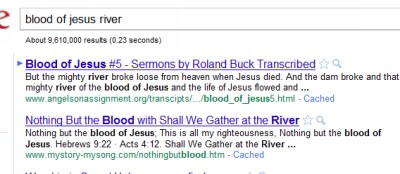
I’m not the only one. I googled "blood of Jesus river" just now, and I got:

Jesus' blood like a river

Apparently a man named Roland Buck is not just picturing a river of Jesus’ blood, but a mighty river. And his site is the #1 result for "blood of Jesus river" at Google.

So I’m not the only one with this picture. But is it accurate?

Washed in the Blood

I checked real quick to make sure that our terminology, "washed in the blood," is accurate. It is. In Rev. 7:14 the 144,000 are said to have washed their robes and made them white in the blood of the Lamb. In addition, Rev. 1:5 says that Jesus loved us and washed us from our sins in his own blood.

That’s a legitimate picture. There’s a fascinating prophecy in Genesis 49:11 that the early Christians quoted all the time. It was obvious to them, but we’re oblivious to Old Testament prophecy for the most part, so we only ever quote Gen. 49:10. (Obvious; oblivious; there’s got to be a good word play there.)

Anyway, Gen. 49:10-11 says:

The scepter shall not depart from Judah, nor a lawgiver from between his feet, until Shiloh come. The people will gather under his rule. He will tie his foal to the vine, and the donkey’s colt to the choice vine. He will wash his robe in wine, and his clothes in the blood of grapes.

He’ll what?

Who washes their clothes in wine? No one I know. They might dye their clothes in wine, but they sure don’t wash their clothes in wine. And if they did, they wouldn’t refer to it as "the blood of grapes"!!

When things don’t make any sense in Scripture, you have to look deeper. I am confident that Moses didn’t wash his clothes in wine any more than you do, and he knew that was a bizarre statement. But, hey, he was reporting the prophecy Jacob gave to Judah, not commenting on the laundry.

This is one of the best prophecies in the Old Testament (the best has to be either Isaiah 53 or Wisdom 2:10-22). It’s a clear prophecy that someone from Judah, a lawgiver no less, will redeem us with blood—his own blood because it’s his clothes that are being washed.

So Scripture does say that we’re washed in the blood. But is it a river?

The Blood of Sprinkling

The idea of washing with blood is in the Scriptures, but it is really not the primary picture. In the Bible, blood is primarily sprinkled, and Jesus’ blood is specifically called "the blood of sprinkling" (Heb. 12:24).

If you have any familiarity with the Law, you know there was a lot of sprinkling and dabbing of blood done. It was rubbed on the horns of the altar, it was sprinkled in the tabernacle, and it was sprinkled on the book of the Law when it was commissioned.

When the writer of the book of Hebrews said that "almost all things in the Law are purged by blood," that purging was accomplished by sprinkling. ("He sprinkled with blood both the tabernacle and all the vessels of ministry" [Heb. 9:21].)

The Cleansing Flood

There is a cleansing flood, and there is a river. But the flood, and the river are water. He sanctifies and cleanses by the washing of water, says the apostle (Eph. 5:26). Water and washing are tied together much more often than blood and washing are.

And rivers are always a reference to water in Scripture. There are no rivers of blood except as the result of gruesome wars, and those are not cleansing floods.

Really, it’s kind of unfortunate that we’ve lost the tradition of the apostles concerning baptism. Baptism was the apostles’ version of a sinner’s prayer. Peter even called it that, saying that it is "the plea to God for [or from] a good conscience" (1 Pet. 3:21, NASB, which is the only accurate one on that verse).

Read through Acts sometime. The only regeneration to God that the apostles ever witnessed—except for Cornelius, whom they would have refused to baptize unless he had been born again—was by baptism.

So the early church didn’t miss the fact that baptism is "the washing of regeneration" in Titus 3:5 was baptism. They could picture the washing waters of baptism when they read Eph. 5:26, and they knew it was done "by the Word," or by the authority of Christ, so that they didn’t have to wonder, like we do, how baptism could be both in Jesus’ name (Acts, repeatedly) and in the name of the Father, Son, and Holy Spirit (Matt. 28:19).

Anyway, the only cleansing flood that God gave us is the waters of baptism. The cleansing blood, which we need repeatedly (e.g., 1 Jn. 1:7), is the blood of sprinkling.

It’s time to drop that picture of a river of blood. Jesus had just one human body to offer, and it cleansed us once for all so that it would not have to be offered repeatedly and produce a flood of blood.

Posted in Miscellaneous, Modern Doctrines | Tagged , , , , , , | Leave a comment

When It’s Good To Feel Bad

I don’t know how your Christian walk has been, but in mine I’ve found myself having to overthrow parts of my personality regularly.

Right now, I’ve having to overthrow the part of my personality that doesn’t want others to feel bad. The reason I’m such a lousy salesman—which I am—is because I don’t like talking people into what they don’t want to do. I don’t like to make people uncomfortable. In fact, I don’t like to even risk making people uncomfortable.

And I certainly don’t like to risk making them angry.

The problem is, a helpful person is always going to make people angry. A loving person is always going to make some people angry some time because people, in general, need help doing what’s right.

As the Scripture says:

Exhort one another daily … lest any of you be hardened through the deceitfulness of sin. (Heb. 3:13)

We need exhortation because even as Christians, obeying God does not always come naturally. Sometimes obeying God is painful. Sometimes obeying God goes against some deep, ingrained parts of our personality.

There’s another verse that applies here …

Let us consider how to provoke one another to love and good works.

"Provoking" means that we’re going to have to say some things that are difficult for people to hear. We’re going to have to say things to one another that give strength to their good side, their spiritual side, and that cause their flesh to rise up and war against their soul.

If you’re the one who’s spoken whatever it is that is overthrowing their fleshly desires, then they are a lot more likely to be angry at you than angry at the good part of themselves that agrees with you.

For some people, such exhortation comes naturally. It’s not difficult for them. I think, however, that there are an awful lot of us who like the comfort of having people never be angry at us, so we are quiet when we ought to speak.

What I’ve found for myself is that when I choose what’s right and say what I ought to say, even though I want to be quiet, I don’t feel wonderful afterwards for helping by brother or sister. Instead, I feel awful because they’re angry at me. I question myself, and I wonder whether I was mean, whether the issue was too petty to comment on, or whether I had no room to speak because I’m no better than they are, even in the specific area I was admonishing them about.

So I tell myself all the time that feeling bad is not an important issue.

I have to speak when I ought to speak. It’s going to have to be okay that I feel bad afterward. It’s going to have to be okay that I question myself.

It’s even going to have to be okay that I really had no room to talk. Who cares if I’m no better than they are? Humility requires me to not even consider whether I’m better than anyone in any area, anyway. We don’t speak to one another out of a superior holiness. We speak to one another because it will help the brother or sister we are speaking to—even if we look like hypocrites in the process.

If I really am a hypocrite, then it would be great for them to speak back to me and provoke me to love and good works as well!

Admonishing One Another Isn’t the Only Issue

I picked the topic of admonishing one another because I tend to feel bad after I admonish a person.

When we’re talking about feeling bad, though, that’s not the only topic that applies.

If you’re a Christian you need to get used to making moral choices and being okay with feeling bad afterward.

Yesterday I read a story in Reader’s Digest about a guy who overcame his addiction to prescription drugs cold turkey and on his own, without getting help from anyone else.

Talk about feeling bad! I assure you that when he made the wise, moral decision to quit taking those pills, he did not suddenly feel good about it. In fact, he went through a real, physical withdrawal, which means he felt terrible about it.

Later, when the physical feelings went away, I’m sure he felt great about his decision.

Today, I watched an episode of Undercover Boss, and it addressed the Boss’ history. He had quit playing music with a band after he quit doing drugs and drinking in order to ensure that he didn’t go back to the drugs and drinking. I’m sure he hated not being able to play music; he did go back to it years later when he had the help he needed to stay clean.

Small Decisions and Feeling Bad

These people made really big decisions in their life that they stuck to despite feeling bad. We all look at them, and we think, "Wise decision."

But the fact is, as Christians we face such choices every day. They’re not as big, so we don’t pay much attention to them. We give in to our desire to avoid feeling bad, and we barely notice because the offense is so minor. It’s just "the way we are."

We read about missionaries whose life’s work happened because they made small but hard choices. Perhaps we read about someone who began to get up very early to read the Scriptures and to pray for an hour or more before they did anything else in their day.

But we don’t do the same because we’re not morning persons.

We read about, say, David Wilkerson, who put his TV up for sale for just half an hour in order to find out whether God wanted him to give up watching TV. After the TV sold in 29 minutes, he gave the time to other things, some spiritual, some not so spiritual.

One of those not so spiritual things was reading a magazine that gave him a heart for reaching youth in New York’s inner city.

Besides the result that youth in the inner city were reached, that decision also produced the book and movie The Cross and the Switchblade and the powerfully effective Teen Challenge ministry. Today, thousands of people read what David Wilkerson writes because he made the small but difficult and feel-bad decision to sell his TV.

That small decision led to the big decision to risk his life, out of faith in God, by talking to gang members in Harlem.

That big decision has effected and changed thousands of lives.

Jesus said that it is faithfulness in little things that leads to faithfulness in big things.

Let me make it one step simpler than that. Are you willing to feel bad today in order to make a choice you know is right in some little thing that you don’t generally notice?

And are you willing to do it again tomorrow?

Do the same things, and you will get the same results. Are the results you’re getting today the results you want for the rest of your life?

The difference may be as simple as getting used to feeling bad.

Posted in Holiness, Leadership | Tagged , , , , , , , | 6 Comments