Conflict Resolution

I really like A-B-C sort of teachings. I like to look at a couple Scriptures, point out what they clearly say, and apply them to us as Christians.

I feel very secure doing that.

I also like to be able to examine our current experience as Christians, painting a picture of how things are versus how they could be, then call us to make the changes to necessary to experience "how things could be."

Can’t do that today. Have to get out of my comfort zone a bit.

We are making a list of subjects for the purpose of training the men of Rose Creek Village to carry responsibility and leadership. Some of those are simple—or not so simple—theological subjects, but some aren’t.

One of those is …

Conflict Resolution

Where there are two or more people who are not identical twins, there will be conflict.

If you don’t know that, then I don’t know how you’re reading this. Surely only children under 12 months could not know that putting people together produces conflict.

At Rose Creek Village, we have put lots of people together in a relatively small space—at least for Americans. We produce lots of conflict. Our children grow up with it as a normal part of life.

Our children also know that excluding people or dividing from people is sin. It’s as wrong as stealing or punching someone in the face. It happens, but it’s decidedly, unequivocally wrong, and if you exclude or divide you cannot be right with God.

That’s just how it is as a follower of Christ. At least, that’s how we see things, and that’s how we train our children to think.

So, how do we avoid allowing conflict to result in exclusion or division?

Well, I can only give one clear answer to that, but first I want to add all the unclear answers …

Conflict Resolution as an Art

How does an artist paint a portrait? How does a singer sing a song?

There’s a lot of things you can teach a budding artist and a budding musician, but a lot of the skill of painting and singing simply come out of yourself.

Conflict resolution is like painting and singing. You can teach anyone to paint or sing; you just can’t teach everyone to be excellent at it. There is some skill and natural talent involved.

It’s the same way with resulting conflicts. Some people have an incredible talent, others have even a gift from God, and others find it extremely difficult and are not very good at it.

But everyone, whether poorly or well, can do it.

The Secret of Conflict Resolution

For the Christian, the secret of conflict resolution is knowing that you must do it.

We can teach you some things about resolving conflicts. We can tell you that you can say almost anything if you will first communicate—probably non-verbally but possibly with words—that you love, understand, and care about the person with whom you are in conflict. We can explain "mitigating language" to you and how it helps with diplomacy. We can teach you about compromise, give and take, and "win-win" solutions.

But in the end, the ultimate Christian weapon to overcome conflict is knowing that you must.

Is that person across from you a Christian?

Yes, yes, I know he or she is a wicked, carnal Christian who doesn’t care about you and is causing you great harm and pain that you are being forced to bear with great self-denial and compassion, but is that person a Christian?

If so, that is your brother, your sister, your mother, your father, or your child.

More so than your biological relatives.

The tie between you and a fellow Christian is based on the precious, eternal blood of King Jesus, while your tie to your biological family is based on your personal, non-eternal blood.

You cannot separate. If Jesus Christ is showing them mercy, then so must you. If Jesus Christ intends to allow them into his kingdom, then you must allow them into your circle of acquaintances as well.

You are a servant of Jesus.

You are a servant of the greatest King of all time and eternity.

Think butler. Think housemaid.

Then picture yourself at his door, opening it for his guest, and then deciding that you don’t like that guest.

Imagine doing that for some mere human sovereign like Iran’s prime minister or the Russian president.

What would happen to you?

Would you remain in the employ of some mere human like Ted Turner or Bill Gates if you were hired as a host or hostess and you refused entry to one of their friends that you didn’t like?

You are a servant of the King of kings.

Yeah, you get the picture.

That picture is the secret of conflict resolution.

This isn’t about you. It’s about Jesus, and every time we shrug off that picture and ignore a brother or sister or choose to meet separately from other Christians over something as minor as our view of the baptism in the Holy Spirit, eternal security, or worse of all, how loud we sing and with what instruments, then we are telling the whole world that Jesus Christ is not much of a king at all, much less the King of kings.

"Nor do I pray for these [apostles] only, but also for those who will believe in me through their word, that they may all be one, as you, Father, are in me and I in you, that they may also be one in us so that the world will know that you have sent me." (John 17:20-23)


Posted in Holiness, Miscellaneous, Modern Doctrines, Unity | Tagged , | 3 Comments

Where I’ve Been

I haven’t had much time to write lately. This is only the 2nd post in about 4 weeks.

I’m in the process of moving to California—temporarily—to preach the Gospel and to help a couple families learn to live it despite the temptations of living in modern America. (The ultimate temptation? "All my needs are met; who cares about anyone else?")

It got busy trying to make things were going to be okay while I was gone and getting myself ready to have an office on the road. (I’m very impressed with GoToMyPC.com, by the way—and that’s not an ad; I’m not an affiliate, and I get no commission if you sign up.)

But it’s not the light difficulties that come up in life that I thought might interest you.

It’s this …

Wandering Through Colorado

As we made our way across the US in an RV towing a van packed with stuff while our dear friends David and Ari drove our Suburban with a trailer attached, I kept remembering the words of a couple children, now grown into impressive young adults, saying, "Traveling with you was a lot of fun, papa Shammah."

So, in the spirit of fun and adventure for the kids we brought along, I—and my brave as well as beautiful wife—opted for a windy, mountainous, and hopefully scenic drive on I-70 over the Rockies, rather than a tamer and less scenic trip on I-80.

We woke up Monday morning to reports that a snow storm was rushing over our route. We almost changed our minds, but weather reports indicated the I-80 descent into Salt Lake City might be treacherous as well. So …

I rushed everyone, and we headed out the door hoping to get to the Vail pass before the snow did.

Nope.

We didn’t get anywhere before the snow did. It hit us 20 miles into the trip, which was over a half hour into the trip because the RV couldn’t climb the hill any faster than 30 or 35 mph. (And I was still passing trucks doing that!)

Snow begins in the Rockies

Snow beginning on I-70

Is This a Good Idea?

As the snow increased, we began wondering if this was a good idea.

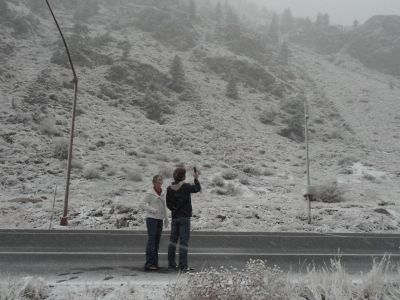
We had two issues. One, David was slipping and sliding in our Suburban, and even had to pull over at one point because he couldn’t keep going …

Pulled over in snow on I-70

That’s David standing next to the Suburban in the background of that picture.

Two, there was the issue of chain laws.

For those that haven’t heard of chain laws, it sounds pretty sinister. But what it means is that at certain times in the snow in the mountains, Colorado requires either snow tires or snow chains on all vehicles—beginning with commercial vehicles and moving on to everyone if conditions warrant it—and you can be ticketed for not complying.

We didn’t have chains or snow tires.

Worse, we were in the mountains. The towns are spread out in the Rockies, 20 and 30 miles apart or more, and as we were driving 15 MPH in the snow now, that meant the towns were spaced one or two hours apart.

Where we were going to get chains?

Tackling the Problem

A snowplow resolved our first problem. It came along a couple minutes after David had to pull over and cleared enough snow for David to press on.

By the way, his neophyte snow driving was astounding. He kept a cool head, never panicked, and never stomped on the brake or accelerator. Very, very impressive.

We also took a shot at helping our spirits by getting at least a little joy out of the snow …

Pictures in the snow in Colorado

Pictures in the snow in Colorado

The second problem scared us a bit. The conditions got worse and worse, and we were hearing on 511—the number to local state’s department of transportation—that there were road closures ahead of us.

I kept wondering, "So, if they pull us over for no chains, what will they do with us? Will they ask us to park on the side of the road and slowly freeze and starve to death until winter’s over in March, April, or May?"

We decided to press on to exit 205, which was Silverthorne, Colorado, and get chains there. We really weren’t certain the Suburban would make it that far, though the RV was handling just fine … at 15 MPH.

As it turned out, we simply drove for an hour and reached Silverthorne. The only incident, though that incident was heart-stopping to David, Ariel, and their 4 kids, was the Suburban and trailer beginning to jackknife on one of the downhills.

Hillbillies in the Rockies

It’s a crime that we took no pictures in Silverthorne, though our excuse that there were other things on our mind is valid.

The temperature in Silverthorne was 15, and the wind chill was 3.

The snow had just fallen, and so the roads weren’t cleared. Neither were the parking lots. Just as badly, snowplows were clearing the parking lots while we were in them, leaving huge mounds of snow that created an obstacle course for the RV.

We had to buy a first class set of chains for the Suburban, costing us about $40 extra, because the auto parts store was out of the normal kind. They did, however, have one very large set for the RV, so we were set.

The pictures I wish I had are pictures of me in tennis shoes, trekking through calf-deep snow, carrying heavy tire chains at 9,000 feet elevation and of the kids running into Target in sweaters and light jackets, then emerging in winter coats.

Chains on Tires?

Have you ever put snow chains on tires?

Yeah, neither have I.

Somehow, David and I managed to read the directions, melt snow onto our knees and hips and we knelt and lay in the Big Bass parking lot, freeze our fingers in wet cloth gloves or no gloves at all, and get the chains on.

The other picture I wish I had was a local who got out of his pickup truck in a t-shirt, stood there with a smile and without shivering, and warned us that we needed to secure the extra little length of chain that hung down after we tightened them on the tires.

If you don’t know what I mean by that extra, little length of chain, then enjoy your ignorance and pray that you never have to find out.

We couldn’t get it quite secured on the Suburban. We pulled over once on the freeway, then exited at 203, just 2 miles from Silverthorne, to buy clips at some grocery store.

Those worked.

Of course, by the time we left that exit, it was something like 2 pm. We had left at 8 in the morning. We had traveled around 70 miles in 6 hours.

Not fast going.

Was It Worth It?

When we got past Vail, Colorado, we were able to take off the chains. The sun came out, and we were treated to some of the best scenery in the world … mile after mile, turn after turn, all afternoon.

Cresting Vail Pass at 10,662 feet

It was worth it.

Admittedly, pictures don’t come close to doing the job, and they’re all the less sufficient when sized down for a blog.

You can look at some better ones on my Picasa Web Album, but even those are only a small glimpse. I’ll try to keep expanding those albums over the next couple days, though we’re still getting set up in California at the moment.

Here’s some blog-sized ones, though …

Driving with chains on

More while the chains were on

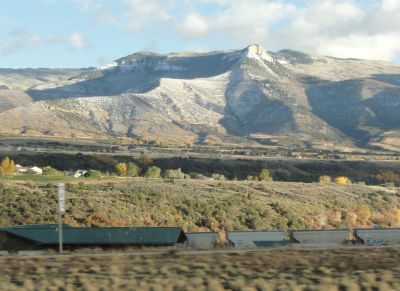
Colorado mountain lake

Colorado scenery on I-70

Posted in Uncategorized | 1 Comment

Truth and Error, The Fall of the Church, and the Fathers

Well, it’s been a while; over 2 weeks.

So this will lightly touch on several subjects.

Email Rumors: Taking Things With a Grain of Salt

I had an email forwarded to me titled "Interesting Facts." It read:

This October has 5 Fridays, 5 Saturdays, and 5 Sundays, all in 1 month. It happens once in 823 years. These are considered money bags months, based on Chinese fengshui.

That is interesting!

That isn’t true!

Think about this a minute. Why does October have 5 Fridays, 5 Saturdays, and 5 Sundays, all in 1 month?

It’s because October has 31 days and starts on a Friday.

Do you really think that a 31 day month—there’s 7 of them each year—only starts on a Friday once every 823 years?

The last time a month had 5 Fridays, 5 Saturdays, and 5 Sundays was January, 2010. That’s not quite 823 years ago.

The last time October had 5 Fridays, 5 Saturdays, and 5 Sundays was 2004. That’s also a bit short of 823 years.

The day a month starts on goes forward one day of the week each year because a year is 52 weeks and one day long. Thus, next year, October will start on a Saturday.

The exception is a leap year, when the starting day jumps two days of the week forward. So, normally, October will have 5 Fridays, 5 Saturdays, and 5 Sundays every six years right on schedule, except when a leap year makes it jump from Thursday to Saturday. In that case, it will be 12 years between such Octobers, making it average out to exactly once every 7 years, which is what you’d expect since there’s 7 days in a week.

Back to Christianity

I was told that I spread "vile calumny" because of my teaching on the fall of the church.

I’ve been asked what I mean by that a lot, so I wrote a page explaining myself.

That page has a "What To Do About It" section that might be considered a wee bit controversial, but seems to me to be the only logically consistent step. I think that those who long for the purity of the church already know that’s what needs to be done.

On the Early Church Fathers

There’s a bloke (I hope that’s just a general word and not insulting in anyway; my English is a little lacking) from England who is probably going to think at some point that he provides most of the material for my blog. Half the time he writes me, I write a blog on the subject.

The truth is that the majority of everything that I write is prompted by questions. The rest is prompted by news reports or teachings I hear.

For example, the page I link above was prompted by a question from an Orthodox bishop in Jerusalem. Normally it would be gratifying to know a Jerusalem bishop is reading my site, but since he compared me to Jews who insult Jesus, I probably shouldn’t get too excited.

Anyway, I hope none of you think I’m recommending following everything the early church fathers said as though they’re some sort of second set of Scriptures!

The idea is to get as clear a picture as we can of the faith as it was practiced in the apostolic churches.

We can claim all we want that all we need is the Bible, but that’s not Biblical and it’s clear to see in real life that it doesn’t work. Look around. Real Christians who really have the Spirit and really want to know the will of God end up not only differing on Bible interpretations, but even dividing over them.

I bolded that for a reason. Division will send you to hell (Gal. 5:19-21).

That’s one key area where we’re off Biblically. We divide from one another like there’s no consequences. Oh, too bad, we think.

Yeah, well, Biblically and historically, that’s like shrugging off adultery or bank robbery. You don’t shrug it off. You confess, repent, and do everything in your power to make it right.

Anyway, the point of knowing what the early church fathers taught is not to do or believe everything they say. It’s to get a good general picture of the faith as it was known in the apostolic churches.

For example, Ignatius of Antioch puts an extreme emphasis on the importance of the bishop in the churches he writes to. He has 7 letters that he wrote in either A.D. 107 or 116, just 40 to 50 years after Peter and Paul were executed for the name of Jesus.

His letters stand out because there’s nothing else like them in his time period. Had he written his letters in A.D. 207 rather than 107, they would not have stood out so much. If he had written them in 307, they would not have stood out at all.

Ignatius wrote at a time that the gnostics were still in the church, dividing it and spreading false doctrines. John’s Gospels and letters had probably only been written a decade or two earlier, and the letters address gnosticism directly. So do Ignatius’ letters.

Ignatius, however, had a different solution than John did, a solution that must have seemed obvious to him: stick to the bishop.

Why? Schools of that day were simply homes or shops with a shingle hung out front. Gnostic teachers easily set up their own schools, took in students, and taught what they wanted without supervision and accountability. Then the teacher and his students would mingle with other members of the churches and spread their heresies (which at that time did not mean false doctrines, but doctrines which divided Christians).

Ignatius solution? Don’t go to those schools unless the bishop tells you it’s okay. Definitely don’t go to a baptism unless the bishop has approved it, or you could wind up baptized by an non-Christian heretic!

So what do we learn from Ignatius?

I don’t recommend simply following his suggestion unless your bishop—that word just denoted the head elder of a church in Ignatius’ writings—is a man you ought to follow.

What I do recommend is learning. The church in Ignatius’ day was free! Church members baptized freely, it seems, or Ignatius would not have had to tell them to stop doing so without the bishop’s permission. People taught the Scriptures freely, and church members were free to attend each others’ teachings, or else Ignatius would not have had to tell them to make sure those teachings were checked out by the bishop.

This is the purpose of the early Christian writings. There are important global things to learn! Such as …

They had a rule of faith that was the limit of what Christians were required to believed. How much of the canon was developed? You may also be surprised to learn what their focus was.

I hope that’s clear. I don’t recommend just following whatever they say. Overall, I do think there was a couple things that crept into the church early. They had a negative view of sex in marriage and honored lifetime virginity in a way that seems clearly unscriptural to me. The authority of and emphasis on church leadership, and the divide between "clergy" and "laity," grew quickly, though that did not really even begin until the middle of the 2nd century.

Things the Fathers Taught

I do recommend knowing what the church was like, however. It’s worth knowing that no one believed in a purely symbolic communion or baptism for centuries after the time of Christ. Baptism was the point of conversion, not a sinner’s prayer, and the believers all thought they received grace and power from eating the fellowship meal.

They were exceptionally gracious in allowing variance of opinions on doctrines, they did not all speak in tongues, and they did not believe in taking lives …. even in war. Their emphasis was on behavior, not theological doctrines.

All those things are global things that the church, not just any individual fathers, taught, and those things are worth knowing.

Posted in Church, History, Holiness, Roman Catholic & Orthodox | Tagged , , , , , , | 7 Comments

Undoing the Devil’s Work

I wrote a booklet that I really believe the Lord gave to me. I got the whole book practically dropped in my heart word for word on a 20-minute drive to work. When I got there, I sat down and typed the thing out in no more than 3 hours. I just gave it as I got it.

It’s a brief history of the first 300 years of the church from the devil’s perspective. It’s the story of how we went from a church that could boast that even its blue-collar workers and old women, even if they didn’t know how to express their faith, knew how to live it. They knew how to love and to turn the other cheek.

About 180 years after Athenagoras wrote that boast, Christians brawled in a church yard until the "gore" ran into the streets, according to Socrates Scholasticus.

My booklet describes, from the devil’s perspective, how that change happened.

I think it’s really interesting, and you can get it here. It’s for sale for $5 so that other web sites will be willing to help me get it out, but it’s not money I’m after. If it’s a problem to pay $5, just email me and I’ll email it to you.

This post isn’t meant to be about the book, though. It’s about how to undo the devil’s work …

The Devil’s Plan

The book outlines the devil’s very effective plan in 3 steps:

  1. Persecute hard and fast; drive off the weak and get the strong to be looking around them rather than upwards.
  2. Bring a boring peace afterward that a "war-torn" church doesn’t know how to handle.
  3. As soon as the church is complacent, fill it with nominal believers so the strong ones feel like outsiders.

I don’t know what you would think of that plan in advance, but in hind sight? Awesome plan. It was entirely successful, producing a violent and worldly church with leaders that were almost exclusively ambitious, politically-inclined appointees of the emperor.

Undoing the Devil’s Work: Step One

If we’re going to get back to apostolic Christianity, we’re going to have to undo what the devil did.

Primarily, what the devil did was fill the church with complacent, nominal believers who are not disciples of Christ.

How many times have you heard a pastor say, "If I preached that, I’d lose half my church"?

Most of the time that pastor is wrong. If he preached the Gospel Christ preached, complete with "Unless you forsake all you have, you cannot be my disciple" (Luke 14:33), then he’ll lose more like 95% of his church.

Hmm, no. Based on the experience of a couple pastors I know about, he’d lose half his church, and then the other half would drive him out.

The first step in undoing the devil’s work is for the saints to be together without those that are only church attenders.

That probably isn’t going to happen in a church building. The saints are probably going to have to "come out of her."

Undoing the Devil’s Work: Step Two

The "come out of her" part is happening. George Barna says that 20 million Christians have left institutional churches in the last couple decades. He calls it a revolution.

It’s not a revolution yet.

It’s not a revolution until we get those saints back together.

It’s not enough to pull everyone out of the harlot. No church is not really any better than a fake church.

We’ve got to learn how to be in unity.

And about that, we’re clueless.

Unity

I can’t address uniting today’s very misguided saints in one blog post, but let me throw out a couple thoughts that perhaps y’all can run with.

Unity is spiritual. If God provides spiritual unity between you and a brother or sister, you are not allowed to break up that spiritual unity over your stupid Bible interpretations.

Oh, yeah, that’s right. You don’t think your Bible interpretation is stupid. You think that you came up with a spiritual and accurate Bible interpretation in order to produce the evil fruit of division.

Only bad trees produce bad fruit.

Listen, God gave you a foundation to work from. That foundation says that the Lord knows those who are his and that those who name the name of Christ must depart from iniquity.

You’re allowed to divide from adulterers, drunkards, and even greedy people (1 Cor. 5:10-13).

You’re not allowed to divide from people who understand the Trinity or eternal security differently than you.

Doctrine and Division

Those who want to justify their division over doctrines point to verses like Rom. 16:17-18.

However, those who point to those verses do not understand what doctrine Paul taught.

Read what Paul says sound doctrine is in Titus 2.

If people agree with you on those doctrines in Titus 2—things like sobriety, sensibleness, faith, love, kindness, loving your spouse and children—then you’re agreed on doctrine. Every Christian must assent to departing from inquity. Every Christian is called to forsake their own lives.

Did you know the majority of the early church did not believe in the Trinity?

Mind you, they were wrong, but Tertullian excused them as ignorant and uninformed, and then says the ignorant and uninformed will always constitute the majority of the church.

But not the willfully sinful!

You are not supposed even to eat with those that are in unrepentant sin (again, 1 Cor. 5:10-13).

Overthrowing the Devil

Do you want to overthrow the devil?

Join forces with people who believe in following Christ wholeheartedly and who have agreed to depart from iniquity (even if there’s some weakness that you have to help with), and you will find incredible power.

You will find such incredible power that the devil will hurriedly rise up and fight you, too. He’ll apply all the same tactics he applied to the early churches.

Most likely, he’ll win because you’re poorly equipped, you don’t know what you’re getting into, you’re unaware that you don’t have the right to divide, and you trust your interpretation of the Bible more than you trust God to guide you (even though the Bible itself says that’s backward). You also don’t have an apostle to bail you out when you have big problems.

But since there’s no other way to win, you’re going to have to try it.

We’d love to help when you do.

Posted in Church, Gospel, Holiness, Unity | Tagged , , | 1 Comment

The Church Fathers and the Pope

I wasn’t going to blog today; I don’t have time. Nonetheless, I simply can’t let this pass.

I couldn’t believe it when I read this:

This is what stuck in Alex’s mind, and it led him to make a fateful mistake: He started to read the Fathers of the Church. In a short time it was all over for him. He realized that the earliest Christians were, uh, Catholics! Alex saw the continuity between what the writers of the early centuries professed and what the Christians who saw our Lord professed. There was a straight line connecting them. The sacraments, the papacy, authority, Mary and the saints—the whole works. (Restless Pilgrim)

Mary? The papacy? In the church fathers?

If this blog were talking about 5th and 6th century Christians, I could understand that. After virtually the whole Roman empire became "Christians" in the 4th century, all sorts of idolatry come roaring in. The emperor Julian the Apostate commented that Christians were more into hero worship than the pagans, and that was just A.D. 360 or so.

However, this blog specifically mentioned "the Fathers of the Church, those earliest Christian writers who lived in the first, second, and third centuries."

The Pope Before Nicea

In the first, second, and third centuries, there is dead silence on the matter of the pope because there was no pope. Oops, sorry … the bishop of Alexandria was being called "The Papa"—the pope—by the mid-3rd century.

So what made Alex think there was a pope in the 1st, 2nd, and 3rd century fathers?

  • Was it Clement of Rome’s use of elder and bishop interchangeably to indicate that there was no individual bishop in Rome in A.D. 96?
  • Was it that Ignatius’ letter to Rome is astonishingly silent on the matter of a bishop there, when he praises and extols the bishop of every other church he writes to?
  • Was it the 7th Council of Carthage, where "Saint" Cyprian led 82 bishops in rejecting a decision of Stephen, bishop of Rome in A.D. 250?
  • Was it the comment made by "Saint" Cyprian at that council that no bishop could set himself up as a bishop over other bishops?
  • Was it Irenaeus comment that Rome was a really important church because it was founded by Paul and Peter, but any apostolic church would do for showing that truth was passed down from the apostles to his time (A.D. 185 or so)?
  • Was it Firmilian’s letter to "Saint" Cyprian commenting that it was unconscionable for Stephen to set himself up as the successor of Peter? Or was it perhaps Cyprian’s teaching, On the Unity of the Church, which says that every bishop inherited the authority of Peter?

Mary Before the Council of Nicea

Admittedly, I’m a little uninformed on the fathers from the late 3rd century. In the 2nd century, however, Mary is simply ignored. The same with Tertullian and Origen from the early 3rd centuries. There is simply no indication that she was venerated in any way.

I just did a search on Catholic sources. They have one quote from Justin (A.D. 150) and one from Irenaeus (A.D. 185) saying approximately the same thing. Eve, the virgin, fell by disobedience, and Mary, the virgin, corrected this by her obedience.

Recapitulation is found here and there in the fathers, and it’s an inspiring teaching. Adam sinned through a tree; Jesus obeyed through a tree. Adam sinned in a garden; Jesus gave himself to God in a garden. There’s a lot of other such symbology, which is really awesome to read about.

But none of that gives the slightest indication of Mariology in the early church fathers!

Were the Early Church Fathers Catholic?

I have to suppose that if you are Protestant, and you have major objections to the Lord’s Supper as being more than symbolic, you could react and call the early church fathers Catholic. Ignatius calls the bread and wine the "medicine of immortality." Justin says that Christians received the meal as more than mere bread and wine.

Otherwise, I’m at a loss as to how anyone reading the 2nd century fathers could count them Catholic. There’s not a hint of it.

Even infant baptism isn’t mentioned–at least not specifically. It has to be read into a passing comment by Irenaeus about those who are born again, a list that includes infants. On the other hand, Justin—before Irenaeus—says that the apostles taught that baptism was a new birth since we had no choice in our natural birth, being too young to decide for ourselves. Tertullian—after Irenaeus—says that rushing children before they’re young enough to answer for themselves is a bad idea.

Someone needs to say that the early church fathers were not Catholic.

More importantly, someone needs to say that attending a Roman Catholic congregation will not teach you about God’s ways, will not give you a real family, God’s family, that the new covenant promises (though most Protestant churches won’t, either; a new Gospel, which is nothing but the apostles’ old one, is needed), and will not provide the strength you need to continue as self-forsaking disciple of the Lord Jesus Christ.

Our call is that those who obey the Gospel of Jesus—that those who hear would forsake their own lives to follow Jesus Christ together—would quit attending clubs with weekly meetings and would join together into one family, dependent upon the Spirit of God as their guide and teacher, and that we could forget about denominations, which are nothing more than fleshly divisions, and forget about the rule of a pompous prelate in a faraway land.

Posted in Church, Gospel, History, Roman Catholic & Orthodox, Unity | Tagged , , , , , , | 11 Comments

Things as I See Them

I mentioned in the last post that I would be asking y’all to help me write a book.

Are you willing to do that?

It’s working title is Things as I See Them. I have three chapters and an introduction up at my Christian History site (link takes you straight to introduction to book).

Thank you for looking at it and for any input you may have!

By the way, I wrote the introduction and the chapters on the Gospel and the Church one day, and I wrote the chapter on the Word of God on another day. So there’s only 2 days of work into it right now. I’m planning on working on this with you if you’ll help me!

Posted in Miscellaneous | Tagged , | 1 Comment

Doctrines of Demons

I spent yesterday starting another book. I wrote a chapter and a half, and a finished the 2nd chapter this morning (rough draft only).

I’d like to get your help in writing that book, but I have to set some things up to make that happen. So hopefully, telling you how you can help me with that will be a tomorrow blog.

Today, I want to share 2 paragraphs from an email I sent.

Just to think about.

First …

Lead-in or Introduction

The email was about the fact that "sound doctrine," according to Scripture, involves things like the older men being reverent, dignified, sensible and sound in love, faith, and perseverance and the older women teaching the younger women how to love their husbands and raise their children.

That’s from Titus 2. Read it sometime and note that it starts by saying that these are the things that pertain to "sound doctrine."

So, here was my 2 paragraph comment at the end of my little dissertation.

2 Paragraphs To Chew or Choke On


How many Christians are there that want to live in obedience to Christ, and they get along so well when they talk about Christ and his commands? Then, as soon as they get on their churches’ pet issues … boom, they’re divided.

So then 2 people that really want to obey Christ go their separate ways so that each can fellowship with people who don’t want to obey Christ but do agree with them on the stupid, putrescent doctrines that demons taught to their godless denomination.

Example

I’ll give you an example in the comment section so that this post stays short. It only takes a bite of meat to choke a person. No sense loading up the whole pork chop.

Posted in Church, Holiness, Modern Doctrines, Unity | 4 Comments

Assumptions

Today, I read where one more person claimed Acts 17:11 commends the Bereans as nobler in mind than the Thessalonians because they searched the Scriptures to test what Paul was saying.

It’s not true. Here’s the verse:

These were more noble than those in Thessalonica, in that they received the word with all readiness of mind, and searched the scriptures daily, whether those things were so.

That’s the KJV. I’m using it because I have it on my computer. It won’t read any differently in any other version (except maybe a paraphrase).

The Bereans were commended for receiving the Word with all readiness of mind!

The Thessalonians rejected the Word; the Bereans received it. Acts is all about people receiving the Word. When they do, it is like a seed planted inside of them, and it grows into a full knowledge of how to follow God, so that all of them, from the least to the greatest, would know him (Heb. 8:11).

Yes, they also examined the Scriptures to see if what he was saying could really be true. But they were not commended for doing this. They were commended for receiving the Word.

The Pharisees searched the Scriptures daily, too, but they are not commended by Christ, they are rebuked by him.

You search the Scriptures, for you think that in them you have life, but these are they which testify of me, but you refuse to come to me so that you may have life. (Jn. 5:39-40)

I didn’t use the KJV here because it has this verse wrong. It translates the verse as a command: "Search the Scriptures." The context makes it clear that’s not what Christ was saying, and more modern translations translate it as above. (I always make sure that a translation I choose is supported by multiple versions.)

What’s the difference between the Pharisees and the Bereans?

The difference is which of them were prepared to receive the Word readily. The Bereans were, and the Pharisees were not. Both searched the Scriptures, but one group was prepared to receive the Word, and the other was prepared to reject it.

Thus, the Bereans were not commended for testing Paul by the Scriptures; they were commended for being open to the Word.

Bonus Assumption

While we’re on things that just get repeated over and over but aren’t accurate, let’s do Romans 2:4 as well.

Or do you despise the wealth of God’s kindness, tolerance, and patience, not knowing that the kindness of God leads to repentance?

When we modern Christians quote it, we emphasize kindness: "It is the kindness of God that leads to repentance."

In other words, we use this verse to teach that if we want to produce repentance in people, then we need to show them the kindness of God, not his severity or judgment.

But the context makes it clear that Paul is emphasizing repentance, not kindness: "The kindness of God leads you to repentance."

In other words, the kindness, tolerance, and patience that God has shown you is not a reason for you to harden and continue in sin. God has been showing you kindness in order to give you time to repent.

The kindness of God is not the only thing that leads to repentance. Ps. 38, for example, is all about David repenting when God was angry at him. We all know that the Lord chastens those whom he loves.

Anyway, you can read the verses leading up to Rom. 2:4, and the context makes it clear what the verse is talking about.

Posted in Bible, Modern Doctrines | Tagged , , , , , | 2 Comments

Roman Catholicism, the Orthodox Churches, and Salvation

This is another email I sent in response to questions that were asked.

In addition to the email I was responding to, I have had several recent emails from supporters of the Roman Catholic and Orthodox Churches. Most are unable to even consider a thought outside their little boxes, and false beliefs about their “grand” heritage puff them up so they can’t imagine that they have to consider anything except their point of view.

This is why I dismiss their claims …

The Fall of the Church

I generally stick to the fathers from before Nicea because I think that after Nicea the church was basically destroyed. In A.D. 300, perhaps 10% of the empire called themselves Christian, but in A.D. 350 it would have been closer to 90%. That number jumped because the emperor “embraced” Christianity, not because the Gospel actually converted 80% of Roman citizens in 50 years.

Christianity Before the Fall

Before Nicea, I find the agreement among Christian writers remarkable. They have a view of the Trinity that is slightly different from ours, but they completely agree among themselves, and the Nicene Creed expresses their view, not ours. Their description of the basics of the faith is consistent, and their understanding of the church, baptism, and the Lord’s Supper are consistent.

Church leadership changed over that time. Their church meetings got larger, and so they got more organized, more often, and more centered on leaders.

The Orthodox, Roman Catholics, and Trees Bearing Fruit

The problem with the Orthodox and Catholics boils down to one Biblical issue. Jesus said that we would know those who spoke for God by their fruit. The Orthodox and Catholics have not had good fruit for centuries, and at times the fruit of the RCC has been as evil as it is possible to be. Even today, almost all Catholics and Orthodox are Christian in name and ritual only. Their faith really doesn’t affect their behavior, and most of them have no idea what it is like to have the Spirit of God living inside of you.

If the fruit is bad, the tree is bad.

Salvation Outside the Church

Yes, both teach that there is no salvation outside the church. How I wish we could still teach that!!!

In the 2nd and 3rd centuries, there was only one church. All churches that held that the apostles had taught the one true Gospel were united. They were holy, they were empowered by God, and they were separate from the world. They were an excellent testimony for the Gospel of the Lord Jesus Christ.

To willingly choose not to be a part of those churches, which constituted the one church and one mother of us all, was clearly a divisive and thus evil act.

Alas, we no longer have such a situation. To choose to be a part of the Catholic or Orthodox church will do you no good at all. If you are holy in their churches, it is because you learned to be holy somewhere else–whether from the Bible or from a Christian that has the Spirit of God. You will not learn to be holy from Catholic or Orthodox teaching.

Thus, they are in no position to say there’s no salvation outside their churches. The fact is, there is very little salvation inside their churches.

Salvation That Is "Revealed"
(Can Be Seen)

Paul said that he was not ashamed of the Gospel because it was the power of God to salvation, producing a justification that was revealed when people believed (Rom. 1:16-17). The RC and Orthodox Gospel produces no such justification.

Words vs. Power

Modern Christians are way too busy throwing words around. The life of Christ is not about words, it is about power. There’s a lot of talk among RC and Orthodox churches, but almost no power. Among Protestants, power to save and justify is found here and there, but you have a lot better shot than among the RC and Orthodox.

Finding People

My advice is always to look for the people who preach a Gospel that saves and that can be seen to save. You will know the good tree by its fruit, not by its empty words.

Hang with those people, and you will learn the doctrines that God cares about.

Posted in Bible, Church, Gospel, History, Holiness, Leadership, Roman Catholic & Orthodox | Tagged , , , , , , , , , | 25 Comments

The Gates of Hades Shall Not Prevail Against the Church

I’m traveling … not much time to be posting blogs, but this email discussion I’m having addresses an important issue. So here’s the email …

************

I don’t have the confidence that you have to say, “How can the pope and ecumenical bishops deny the first 300 years of the church if brought to them accurately?”

I’ve been asking questions of Christians–Protestants, Catholics, Orthodox, and Independents alike–for 28 years now. I used to believe that if they only knew what was true, they would change. It took me a long time and a lot of heartache to realize that most of them don’t want to know what is true. No matter how you present the truth, they will not understand it because they don’t want to understand it.

THE GATES OF HADES

I’d like to also question one of your premises. You said that the promise that the gates of Hades would not prevail against the church means that the true church will always be here until Jesus returns.

Does it really mean that? I know the Roman Catholic Church says it means that, but does that interpretation really make any sense?

Think about it. Since when are gates offensive weapons?

Gates are for defense. I think that Jesus is saying that the church, wherever it exists, will have the power to overthrow death (Hades being the place of the dead in Scripture). If it happens not to exist at some time, that doesn’t mean Jesus promise isn’t true. It’s not the gates of Hades that caused the church to begin accepting carnal people during the time of Constantine.

It is simply true that the testimony of the church was at least reduced and perhaps absent during the 4th century.

It is also true that if you wanted to see a group of people with the same testimony that 2nd century churches had–unity, love, commitment to Jesus Christ, rejection of this world–then the place to find that testimony was among the Anabaptists, not among the Catholics or Protestants.

Thus, I would argue that God doesn’t recognize or care about hierarchies. The church is an organism, not an organization, and it always has been.

Let’s take my small town, for example. If the Gospel of Christ is preached, and people begin to live by his Spirit, displaying the righteousness that is always the product of the Gospel, and uniting with one another as a family in love … why should those people bother to contact a hierarchy that is neither scripturally nor historically justified?

Why shouldn’t those people simply continue in the Gospel together, opening their hearts and homes for fellowship with any other churches living the same way?

As Tertullian put it: “Those churches, who, although they derive not their founder from apostles or apostolic men (as being of much later date, for they are in fact being founded daily), yet, since they agree in the same faith, they are accounted as not less apostolic because they are akin in doctrine.”

It is teaching (and the holy living that results from teaching) that marks a church as apostolic, not its attachment to an unscriptural organization.

Posted in Church, History | Tagged , , , , , | 2 Comments