Scriptural Terminology: Why It Matters

I mentioned yesterday—I hope it was yesterday; I’m a few days ahead and I’m scheduling these to come up one day at a time—that the blood of Jesus is said in Scripture to be sprinkled, not to be a "mighty river."

We can understand the importance of that terminology. After all, we’re talking about the precious blood of Jesus Christ, the purchase price of our salvation.

Today I want to point out that Scriptural terminology matters in a lot of other areas, too.

I want to give you two examples.

Salvation by Faith Alone

This subject illustrates how Scriptural terminology can save us from traditions of men that are not true. This isn’t a very popular subject, though, so you may not agree with what follows. Unfortunately, though, I’m right. So those of you that prefer to hold to doctrines you like rather than doctrines that are Scriptural may want to skip this section.

It was on this subject that I developed the principle for myself that even if I didn’t understand why the Bible said something, I would say it the Bible’s way, anyway.

The problem began when I, a good faith-alone believer, discovered that Paul thought that people could be rewarded eternal life by doing good. It doesn’t matter whether you’re just anyone (Rom. 2:5-7) or a Christian (Gal. 6:9), eternal life is reaped by those who patiently continue to do good.

Then why in the world did Paul also say, "Not of works, lest any man should boast"? (Eph. 2:9). Heavens! What was he thinking? Was he bipolar?

The more I researched, the worse it got. Eph. 5 not only says that you will be kept out of God’s kingdom by sexual immorality, uncleanness, and greed, but Paul makes a point of using the judgment of unbelievers as an example to keep us from being deceived (v. 6). In other words, don’t be fooled because if the sons of disobedience experience God’s wrath for these things, so will you.

Peter nails that idea down. All of us, he says, ought to fear the judgment of God because God is not partial. We’re not going to get an easier judgment than the lost (1 Pet. 1:17).

But then there’s Paul’s repeated statements that we’re saved apart from works. It’s not just Eph. 2:9. There’s the famous Rom. 3:28, but there’s also his statement that if salvation is by grace, then it’s not by works in Rom. 11:6. And, of course, there’s also all of Ephesians 4, making a point that Abraham was saved apart from works.

Then James says that Abraham was saved by works!

What’s a man to do with that?

What I chose to do was to say what the Scriptures say. For years—yes, literally; at least 4 or 5 years—I simply said what the Scriptures said in whatever situations I thought they applied. I became as likely to tell a "greasy grace" believer that a man is justified by works and not by faith alone (Jam. 2:24) as to tell a self-condemned believer that we are justified by faith apart from the works of the Law (Rom. 3:28).

Let me tell you that you get in a lot less trouble saying the latter than the former!

It became apparent to me that most Christians handled these verses by picking the ones they like. Romans 3:28 is popular. James 2:24 is basically ejected from Protestant churches. You may never repeat it in any situation or in any company … except one. In a theological discussion, you can explain why "justified by works and not by faith only" really means "justified by faith only."

If you don’t go along with that, then everyone concludes you’re not saved because you’re adding to faith, which is apparently a big no-no in fundamentalist churches.

In the Bible, however, it’s a command (2 Pet. 1:5).

And thus, we have an excellent illustration of how in the anti-tradition fundamentalist churches, they have used their tradition to make void the command of God (2 Pet. 1:5-11) and the theology of a leading apostle (Jam. 2:14-26).

So, first, I recommend using Scriptural terminology to overthrow false tradition, such as the belief that going to heaven occurs by faith alone.

If you keep saying what the Scripture says, I tell you from experience, you eventually figure out (especially if you have help from the early Christian writings) that the Scriptures never say you go to heaven by faith alone, they only say that you are justified or saved by faith alone.

And sometimes, in Scripture, those are different.

I say sometimes because if you work at using Scriptural terminology, you’ll also discover that different apostles used different terminology. You have to pay attention to which apostle is speaking, especially when the subject is eternal life (Paul vs. John) or justification & righteousness (Paul vs. James).

The Trinity

On the Trinity, my opinion is that our modern understanding of the Trinity is close enough to Scripture that’s the difference is not a big deal.

Nonetheless, here Scriptural terminology will not so much deliver you from false tradition as to save you from being confused by 1.) the Scriptures, and 2.) the Jehovah’s Witnesses.

A couple real doozies for the typical Christian are:

  • John 17:3: (Jesus praying) "… that they may know you, the only true God, and Jesus Christ, whom you have sent."
  • 1 Cor. 8:6: "For us there is but one God, the Father, from whom are all things, and one Lord, Jesus Christ, through whom are all things.

There’s others, but the Jehovah’s Witnesses really like both of those. (Of course, they don’t like John 1:1, so they had to change a bit, using 1st year Greek that doesn’t apply, and they really don’t like the two Jehovah’s they have in the New World Translation’s Zech. 2:8-11.)

Anyway, Christians should be told that the apostles and their churches regularly referred to the Father as the one God. When they speak of the Father and Son together, they talk about God and his Son or God and his Word. The Son is almost never referred to as God when the Father is being talked about at the same time.

Tertullian, in A.D. 200, explains this:

Though Tertullian is the one illustrating this, he is illustrating what is true. Go check it out in Scripture. Go read the apostolic fathers. The Scriptures may not explain, as Tertullian does, why they only call the Son God when the Father is not being talked about as well, but that is what the Scriptures do.

I have some explanations for Scriptural terminology concerning the Trinity—which is, by the way, the same terminology used in the Nicene Creed and the Apostles Creed—based on what early Christians said the apostles taught.

I can’t think of a smooth ending, so … try to speak the way the Scriptures speak. That will help you understand what the Scriptures mean and help deliver you from believing whatever you’re told by whatever particular sect said it to you.

That’s only one step, though. Truth is given to the church by God, so the ultimate step to knowing what the Scriptures mean is to bind together with other Christians as a family, forget your individual traditions, leave no one out that tries to obey Christ, and learn from the Spirit of God together
Posted in Bible, Church, Modern Doctrines | Tagged , , , , , , , , , | 7 Comments

The Cleansing Flood and Some Really Bad Christian Images

I was raised Roman Catholic, so when I first attended an Assembly of God after being gloriously and astonishingly saved by the name of Jesus Christ, all the Protestant hymns were new to me.

There were several I loved, but one in particular was "Victory in Jesus."

A couple days ago, I was thinking about one of the major lines in that hymn’s chorus:

He sought me and he bought me with his redeeming blood

He plunged me to victory beneath the cleansing flood

Um … what’s the cleansing flood?

The picture I’ve always had is a river of the blood of Jesus cleansing us from sin.

Isn’t that gruesome?

I’ve never questioned it until this week. When I did question it, however, I thought, one, is that accurate?, and two, is that just plain gross?

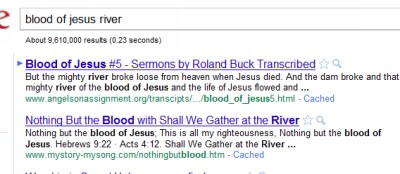
I’m not the only one. I googled "blood of Jesus river" just now, and I got:

Jesus' blood like a river

Apparently a man named Roland Buck is not just picturing a river of Jesus’ blood, but a mighty river. And his site is the #1 result for "blood of Jesus river" at Google.

So I’m not the only one with this picture. But is it accurate?

Washed in the Blood

I checked real quick to make sure that our terminology, "washed in the blood," is accurate. It is. In Rev. 7:14 the 144,000 are said to have washed their robes and made them white in the blood of the Lamb. In addition, Rev. 1:5 says that Jesus loved us and washed us from our sins in his own blood.

That’s a legitimate picture. There’s a fascinating prophecy in Genesis 49:11 that the early Christians quoted all the time. It was obvious to them, but we’re oblivious to Old Testament prophecy for the most part, so we only ever quote Gen. 49:10. (Obvious; oblivious; there’s got to be a good word play there.)

Anyway, Gen. 49:10-11 says:

The scepter shall not depart from Judah, nor a lawgiver from between his feet, until Shiloh come. The people will gather under his rule. He will tie his foal to the vine, and the donkey’s colt to the choice vine. He will wash his robe in wine, and his clothes in the blood of grapes.

He’ll what?

Who washes their clothes in wine? No one I know. They might dye their clothes in wine, but they sure don’t wash their clothes in wine. And if they did, they wouldn’t refer to it as "the blood of grapes"!!

When things don’t make any sense in Scripture, you have to look deeper. I am confident that Moses didn’t wash his clothes in wine any more than you do, and he knew that was a bizarre statement. But, hey, he was reporting the prophecy Jacob gave to Judah, not commenting on the laundry.

This is one of the best prophecies in the Old Testament (the best has to be either Isaiah 53 or Wisdom 2:10-22). It’s a clear prophecy that someone from Judah, a lawgiver no less, will redeem us with blood—his own blood because it’s his clothes that are being washed.

So Scripture does say that we’re washed in the blood. But is it a river?

The Blood of Sprinkling

The idea of washing with blood is in the Scriptures, but it is really not the primary picture. In the Bible, blood is primarily sprinkled, and Jesus’ blood is specifically called "the blood of sprinkling" (Heb. 12:24).

If you have any familiarity with the Law, you know there was a lot of sprinkling and dabbing of blood done. It was rubbed on the horns of the altar, it was sprinkled in the tabernacle, and it was sprinkled on the book of the Law when it was commissioned.

When the writer of the book of Hebrews said that "almost all things in the Law are purged by blood," that purging was accomplished by sprinkling. ("He sprinkled with blood both the tabernacle and all the vessels of ministry" [Heb. 9:21].)

The Cleansing Flood

There is a cleansing flood, and there is a river. But the flood, and the river are water. He sanctifies and cleanses by the washing of water, says the apostle (Eph. 5:26). Water and washing are tied together much more often than blood and washing are.

And rivers are always a reference to water in Scripture. There are no rivers of blood except as the result of gruesome wars, and those are not cleansing floods.

Really, it’s kind of unfortunate that we’ve lost the tradition of the apostles concerning baptism. Baptism was the apostles’ version of a sinner’s prayer. Peter even called it that, saying that it is "the plea to God for [or from] a good conscience" (1 Pet. 3:21, NASB, which is the only accurate one on that verse).

Read through Acts sometime. The only regeneration to God that the apostles ever witnessed—except for Cornelius, whom they would have refused to baptize unless he had been born again—was by baptism.

So the early church didn’t miss the fact that baptism is "the washing of regeneration" in Titus 3:5 was baptism. They could picture the washing waters of baptism when they read Eph. 5:26, and they knew it was done "by the Word," or by the authority of Christ, so that they didn’t have to wonder, like we do, how baptism could be both in Jesus’ name (Acts, repeatedly) and in the name of the Father, Son, and Holy Spirit (Matt. 28:19).

Anyway, the only cleansing flood that God gave us is the waters of baptism. The cleansing blood, which we need repeatedly (e.g., 1 Jn. 1:7), is the blood of sprinkling.

It’s time to drop that picture of a river of blood. Jesus had just one human body to offer, and it cleansed us once for all so that it would not have to be offered repeatedly and produce a flood of blood.

Posted in Miscellaneous, Modern Doctrines | Tagged , , , , , , | Leave a comment

When It’s Good To Feel Bad

I don’t know how your Christian walk has been, but in mine I’ve found myself having to overthrow parts of my personality regularly.

Right now, I’ve having to overthrow the part of my personality that doesn’t want others to feel bad. The reason I’m such a lousy salesman—which I am—is because I don’t like talking people into what they don’t want to do. I don’t like to make people uncomfortable. In fact, I don’t like to even risk making people uncomfortable.

And I certainly don’t like to risk making them angry.

The problem is, a helpful person is always going to make people angry. A loving person is always going to make some people angry some time because people, in general, need help doing what’s right.

As the Scripture says:

Exhort one another daily … lest any of you be hardened through the deceitfulness of sin. (Heb. 3:13)

We need exhortation because even as Christians, obeying God does not always come naturally. Sometimes obeying God is painful. Sometimes obeying God goes against some deep, ingrained parts of our personality.

There’s another verse that applies here …

Let us consider how to provoke one another to love and good works.

"Provoking" means that we’re going to have to say some things that are difficult for people to hear. We’re going to have to say things to one another that give strength to their good side, their spiritual side, and that cause their flesh to rise up and war against their soul.

If you’re the one who’s spoken whatever it is that is overthrowing their fleshly desires, then they are a lot more likely to be angry at you than angry at the good part of themselves that agrees with you.

For some people, such exhortation comes naturally. It’s not difficult for them. I think, however, that there are an awful lot of us who like the comfort of having people never be angry at us, so we are quiet when we ought to speak.

What I’ve found for myself is that when I choose what’s right and say what I ought to say, even though I want to be quiet, I don’t feel wonderful afterwards for helping by brother or sister. Instead, I feel awful because they’re angry at me. I question myself, and I wonder whether I was mean, whether the issue was too petty to comment on, or whether I had no room to speak because I’m no better than they are, even in the specific area I was admonishing them about.

So I tell myself all the time that feeling bad is not an important issue.

I have to speak when I ought to speak. It’s going to have to be okay that I feel bad afterward. It’s going to have to be okay that I question myself.

It’s even going to have to be okay that I really had no room to talk. Who cares if I’m no better than they are? Humility requires me to not even consider whether I’m better than anyone in any area, anyway. We don’t speak to one another out of a superior holiness. We speak to one another because it will help the brother or sister we are speaking to—even if we look like hypocrites in the process.

If I really am a hypocrite, then it would be great for them to speak back to me and provoke me to love and good works as well!

Admonishing One Another Isn’t the Only Issue

I picked the topic of admonishing one another because I tend to feel bad after I admonish a person.

When we’re talking about feeling bad, though, that’s not the only topic that applies.

If you’re a Christian you need to get used to making moral choices and being okay with feeling bad afterward.

Yesterday I read a story in Reader’s Digest about a guy who overcame his addiction to prescription drugs cold turkey and on his own, without getting help from anyone else.

Talk about feeling bad! I assure you that when he made the wise, moral decision to quit taking those pills, he did not suddenly feel good about it. In fact, he went through a real, physical withdrawal, which means he felt terrible about it.

Later, when the physical feelings went away, I’m sure he felt great about his decision.

Today, I watched an episode of Undercover Boss, and it addressed the Boss’ history. He had quit playing music with a band after he quit doing drugs and drinking in order to ensure that he didn’t go back to the drugs and drinking. I’m sure he hated not being able to play music; he did go back to it years later when he had the help he needed to stay clean.

Small Decisions and Feeling Bad

These people made really big decisions in their life that they stuck to despite feeling bad. We all look at them, and we think, "Wise decision."

But the fact is, as Christians we face such choices every day. They’re not as big, so we don’t pay much attention to them. We give in to our desire to avoid feeling bad, and we barely notice because the offense is so minor. It’s just "the way we are."

We read about missionaries whose life’s work happened because they made small but hard choices. Perhaps we read about someone who began to get up very early to read the Scriptures and to pray for an hour or more before they did anything else in their day.

But we don’t do the same because we’re not morning persons.

We read about, say, David Wilkerson, who put his TV up for sale for just half an hour in order to find out whether God wanted him to give up watching TV. After the TV sold in 29 minutes, he gave the time to other things, some spiritual, some not so spiritual.

One of those not so spiritual things was reading a magazine that gave him a heart for reaching youth in New York’s inner city.

Besides the result that youth in the inner city were reached, that decision also produced the book and movie The Cross and the Switchblade and the powerfully effective Teen Challenge ministry. Today, thousands of people read what David Wilkerson writes because he made the small but difficult and feel-bad decision to sell his TV.

That small decision led to the big decision to risk his life, out of faith in God, by talking to gang members in Harlem.

That big decision has effected and changed thousands of lives.

Jesus said that it is faithfulness in little things that leads to faithfulness in big things.

Let me make it one step simpler than that. Are you willing to feel bad today in order to make a choice you know is right in some little thing that you don’t generally notice?

And are you willing to do it again tomorrow?

Do the same things, and you will get the same results. Are the results you’re getting today the results you want for the rest of your life?

The difference may be as simple as getting used to feeling bad.

Posted in Holiness, Leadership | Tagged , , , , , , , | 6 Comments

Intermission: Minor Request To Quench Curiosity

In my left column is a little box that says "by 139 readers" right now.

That is an "IntenseDebate – Site Stats" widget. IntenseDebate is the program that runs my comment section.

Anyway, I’m sure that widget with the "by 139 readers" written on it is trying to tell us something. What that something is, I have no idea.

Do you?

Posted in Miscellaneous | 1 Comment

I Am of Paul

Today’s post is a sister post to yesterday’s.

1 Corinthians 1:10:

Now I beseech you, brothers, by the name of our Lord Jesus Christ, that you all speak the same thing and that there be no divisions among you, but that you be perfectly joined together in the same mind and in the same judgment.

So Paul commands this. That command is strong enough for me to ask, "Are we doing this? Shouldn’t we be looking at this?"

But in the case of this command—or I should say, this plea, for he says he’s beseeching us—Paul even tells us why he’s begging for this:

I’ve been told, by Chloe’s household, that there are contentions among you. Now this I say, that every one of you says, "I am of Paul"; and "I am of Apollos"; and "I am of Cephas"; and "I am of Christ." (1:13)

Sound familiar?

Is there really any difference between "I am of Paul" and "I’m a Baptist"? (I’m picking on the Baptists because they’re the biggest Protestant denomination.)

But let’s not just fire at Protestants. Let’s assume the Roman Catholic Church has the best claim to being the correct denomination because of apostolic succession, even though that’s not’s historical. Given that they’re the correct denomination, is there any difference between the "I am of Christ" that Paul adresses here and "I am Roman Catholic"?

One last verse, since Paul didn’t only say this once:

You are still carnal, for while there is envy, strife, and divisions among you, are you not carnal and walking like men? For while one says, "I am of Paul," and another, "I am of Apollos," are you not carnal?

So let me ask, while there is envy, strife, and denominations among you, are you not carnal and walking like fleshly men? (See my post on denominations as a work of the flesh from yesterday.) While one of you says, "I’m a Pentecostal," and another, "I’m Russian Orthodox," are you not walking in the flesh?

Posted in Church, Modern Doctrines, Unity | Tagged , , , , | Leave a comment

Denominations and Going to Hell

Sorry for the purposely shocking title. You can decide for yourself whether it’s accurate.

I’m always surprised that no one ever talks about the fact that Galatians 5:19-21 says that those who "practice" denominations will not inherit the kingdom of God.

I’m assuming that the huge majority of Christians don’t know that. You’d think, however, that the few that do would bring it up and at least ask whether we ought to talk about it.

Hairesis and Denominations

One of the "deeds of the flesh" listed in Galatians 5 is translated by the KJV as "heresies," but I think most modern translations use "factions." I’ve heard people say that a good translation is "a party spirit."

Here’s what they’re translating.

The Greek word hairesis is used 9 times in the New Testament. 6 of those occurrences are in Acts:

  • Acts 5:17: The high priest and others were part of the hairesis of the Sadducees.
  • Acts 15:5: Some members of the hairesis of the Pharisees argued for circumcision at the council in Jerusalem.
  • Acts 24:5: Paul was a member of the hairesis of the Nazarenes (i.e., a Christian).
  • Acts 24:14: Paul says he worships according to "the Way," which Jews call a hairesis.
  • Acts 26:5: Paul calls the Pharisees the strictest hairesis of Judaism.
  • Acts 28:22: Jews tell Paul they have heard of this hairesis (i.e., Christianity).

I don’t think you have to be a Greek scholar to conclude that this word hairesis could accurately be translated "denomination." The KJV translates it "sect" 5 of those times in Acts. As I said, modern translations tend to use "factions" in Galatians 5:20, where it’s plural.

Will Denominations Keep Us Out of the Kingdom of Heaven?

So here we are. Most Protestant denominations claim to be following the Bible. Many say that it is divinely inspired down to every word.

Yet, the Bible says that those who practice haireseis—which, as you can see, is probably best translated "denominations"—will not enter the kingdom of heaven.

So, now you know. I’ll let you decide what to do about it.

It seems like it would be a good thing for your hairesis to talk about. Don’t you?

Posted in Bible, Church, Modern Doctrines, Unity | Tagged , , , , , | 5 Comments

Unity and the Protestant Church

I said yesterday that Protestant denominations are not any different than the apostolic succession Rome is trying to enforce on us.

Unity is not agreement upon doctrines held by an organization and enforced upon its members.

Jesus said that our unity would let the world know that the Father sent him (Jn. 17:20-23). But he also said that our love for one another would let the world know that he sent us (Jn. 13:34-35).

Unity is only unity when it is manifested by love. Unity is not unity when it based on a doctrinal statement.

Every time someone drives by two churches with two different names and two different pastors sitting next door to one another or on the same intersection, they know that Christians aren’t united and can’t unite. It is a pronouncement to the world that this Jesus stuff is a bunch of bunk.

But, yeah, I understand. You’re busy. You’ve got your own life to live. Who cares if Christ’s name is being blasphemed among the gentiles because of us?

It’s not your fault, anyway. What can you do about it? Why should it be your responsibility? You’re just doing what your parents did before you. Who can blame you?

What can you do about it?

I like the idea of opening our windows and shouting, "I’m as mad as heaven, and I’m not going to take it anymore."

At least figuratively.

Posted in Church, Unity | Tagged , , , , | Leave a comment

Unity and the Roman Catholic Church

I got two more emails, one yesterday and one today, from men who think that the only route to unity is joining the Roman Catholic Church. (I have to assume that they wouldn’t have a problem with the Eastern Orthodox Churches, either, since every one of their arguments would apply to them as well … only better.)
http://rosecreekvillage.com/shammah/wp-admin/post-new.php
It’s apparently impossible for me to communicate the importance of the local church to people like that, and so I keep trying to find different words with which to do that.

What I’m about to say is as important for Protestants to consider as for those seeking unity by apostolic succession because so many of them seek unity by denomination, which is no different.

The only unity that matters is one that can express itself in visible love. Thus, the primary unity that matters is local unity.

God wants a unity that is real, not one that can be justified with words.

If Jesus wanted a unity that was based on agreement among all ecclesiastical leaders that is mandated to all members, without regard to whether that unity produces holiness among those who adhere to it, then why bother with Christianity? Why bother dying? The Pharisees already had that unity.

The unity desired by those who want it through apostolic succession and through all of us joining an organization that already has well over a billion members is what I just described. I’m sure they wish that unity produced holiness, but since it has a long history of mostly members whose religion only barely affected their daily lives, they have to hold to that unity even when it doesn’t produce holiness (which is always).

So, two issues:

Should the Christians in Selmer, Tennessee Become Members of the Church in Rome, Italy?

It seems bizarre to me that anyone would suggest in order to have unity, the Christians in Selmer, Tennessee—or any other place, of course—should officially become members of the church in Rome, Italy. Or, if the issue is the Eastern Orthodox apostolic succession, that they should members of the church in Istanbul, Turkey; Antioch, Greece; or Moscow, Russia.

Where’s that in Scripture? Where’s that in any apostolic tradition found in the early Christian writings?

Apostolic succession, according to those who wrote about it in the 2nd and 3rd century, was a way to preserve the truth unchanged. That works for a while, but as we all can see, after 2,000 years it’s pretty ineffective.

Those early churches consulted one another to help stick with what the apostles handed down. Thus, it would have been typical to consult important apostolic churches like Rome, Ephesus, and Philippi. Fortunately, we live in the information age. We can consult what the church in Rome handed down, and we can compare it to earlier writings of the church, and help sort what’s true and what’s been added or taken away over the last 2,000 years.

I recommend doing that. But I don’t recommend joining a church that’s 5,000 miles away. That’s certainly not apostolic.

Bad Fruit Is Only Produced by Bad Trees

The other fortunate thing is that unity by apostolic succession, agreed upon by everyone, has been tried by an entire continent for hundreds of years. The continent is Europe, the church it submitted to was the church in Rome, and the time period is known as "The Dark Ages."

According to Christ, bad fruit only comes from bad trees.

So, you tell me. Is this a good idea?

Posted in Church, Modern Doctrines, Roman Catholic & Orthodox, Unity | Tagged , , , , , | 7 Comments

The Jehovah’s Witnesses and the Trinity … No, and Dishonesty

I’ve probably mentioned before that dishonesty in research really bugs me.

In preparing a book on the Council of Nicea that I’m working on—and progressing well!—I decided to hunt down a Jehovah’s Witness booklet called Should You Believe in the Trinity. I wanted to point out that because we don’t really know what the Council of Nicea was about, nor what the early Christians believed about the Father and his Son—or, more precisely, about God and his Logos—we leave a wide open door for the Jehovah’s Witnesses to accurately quote the early church fathers, but twist their meaning into Jehovah’s Witness/Arian doctrine.

My mistake.

Not content with twisting their meaning, the Jehovah’s Witnesses do violence to their very words. I have to suppose they didn’t think they’d be exposed by anyone who actually understood the beliefs of the early Christians because so few do.

You see, right now if you confront a Jehovah’s Witness about their misquoting, they could take you to the section that they’re misquoting, and most Christians would be bewildered by what they read. Unprepared, the Jehovah’s Witness would tear them apart or get them to accuse the early church fathers of heresy.

I guess the fortunate part is that the Watchtower doesn’t acknowledge where they get these quotes, so the average Witness would never be able to find them anyway.

I can find the quotes, or something similar, so let me take a moment to expose their open, rampant dishonesty. These quotes might as well be completely made up because the words of the original authors are twisted so far from what they say, not only in meaning, but even in the actual wording.

Just one more proof that the Watchtower is a corrupt, dishonest organization.

Like most religious organizations that aren’t allowed to be questioned.

The Most Egregious Misquote

Egregious means "conspicuously bad or offensive."

I’m putting a picture of the offending portion of their page below so you can see what they’ve done.

Note the quote box in the picture. (I’m sorry that my blog’s column is only 400 pixels wide. That’s the biggest I can make it for you! Just follow the link above to their page if you want to see it larger.)

First note that the quote in the text box is attributed to "The Triune God."

I thought they didn’t think the Triune God existed! I am certainly surprised they have some direct quotes from him!

I suspect they must be referring to a publication (of theirs?) called The Triune God.

Anyway, the quote says that there is no evidence that any sacred writer even suspected the existence of a Trinity within the Godhead.

Really?

Note that their text box is right next to a quote from Origen. I’m pretty certain that, in context, Origen and everyone else on that page constitute the "sacred writers" to whom they’re referring.

So let’s address both the quote from Origen, and, while we’re there, the assertion of the Triune God that no one had ever even imagined the Trinity back then.

A Very Small Light

Now, they don’t give a reference for this supposed quote from Origen in which he supposedly says that the Son is a very small Light compared to the Father. However, since Origen has a huge section right at the beginning of De Principiis that is singularly focused on what it means that the Son of God is the Light, that seems a good place to look for the quote the Watchtower references.

There, rather than reading that the Son is a "very small light," we read:

The only-begotten Son, therefore, is the glory of this light, proceeding inseparably from [God] Himself, as brightness does from light, and illuminating the whole of creation. (De Principiis I:2:7)

What a strange small light this is that can illumine the whole of creation!

What a strange small light this is that proceeds "inseparably" from God himself!

I can only think that the Watchtower was purposely twisting Origen’s explanation that in being "the express image of the invisible Father" the Son presented himself "gently and softly to the frail and weak eyes of mortals," so that as they got used to it, he would "render them capable of enduring the splendor of the light" (ibid.).

Suspicion That There Might Be a Trinity

What’s of note is that if they’d just read a little further, to see what Origen might have to say about the Holy Spirit when he got done talking about the Son, they might have read:

From all [the Scriptures Origen had just quoted] we learn that the person of the Holy Spirit was of such authority and dignity that saving baptism was not complete except BY THE AUTHORITY OF THE MOST EXCELLENT TRINITY OF THEM ALL, i.e., BY THE NAMING OF THE FATHER, SON, AND HOLY SPIRIT, and by joining to the unbegotten God the Father and to his only-begotten Son the name also of the Holy Spirit. (ibid. I:3:2)

Now I may not be the most insightful person there ever was, but I have a sneaking suspicion that Origen suspected there was a Trinity in the Godhead.

Don’t you?

Even if he had not specifically mentioned the Trinity, called the Holy Spirit a person, and named the 3 persons of the Trinity, I think we could have proved that he at least suspected there was a Trinity in another way.

Notice the places I got the quotes from.

I got the quotes about the Son from I:2:7 of De Principiis. Those first two numbers mean Book one and Chapter two. I got the second quote from I:3:2, which is Book one and Chapter 3. (The third number is the paragraph.)

The reason they are numbered like that is because chapter one is about God, chapter two is about the Son, and chapter three is about the Holy Spirit. These are in Book one of his multiple-volume treatise, De Principiis, which means "Concerning Beginning Principles."

Thus, what does he consider the very first beginning principle?

The Trinity!

A Free Added Quote

Chapter 4 of the first book of De Principiis is about falling away. In the second paragraph of that very short chapter, he explains why he’s covering falling away so early:

In our desire to show the divine benefits bestowed upon us by Father, Son, and Holy Spirit, the Trinity that is the fountain of all holiness, we have fallen … into a digression, having considered the subject of the soul, which accidentally came before us.

So, just in case the Watchtower, or anyone else, couldn’t figure out that Origen started De Principiis with a chapter each on the Father, Son, and Holy Spirit, he states it explicitly. He wanted to begin his work by addressing the Trinity that is the fountain of all holiness.

I guess if I was going to be as dishonest as the Watchtower, I wouldn’t reference my sources, either.

Posted in Modern Doctrines | Tagged , , , , , , , | 5 Comments

When Doctrine and History Matter

Yesterday I talked about when doctrine and history don’t matter; when they are just issues to create dissension and divide us.

Today I want to talk about when they do matter:

The other day, I got a really awesome letter from someone I think is outside the U.S. Here’s some excerpts:

I’m a Bible Study teacher at my college and as such, I am expected to at least know a good outline or so of what Christianity is about. I won’t lie, your website has taught me much more than any Bible Study or message I’ve actually heard in real life, and its answered a lot of questions I’ve always had.

Your explanation of the Trinity helped me to figure out the question I have had for a while: Why in the world does John call Jesus the Word? …

Not to mention, you helped me understand whether salvation is by faith alone or we need more (the answer: Both!). …

More importantly than anything else though, you have made me realize the importance of fruit in our life. I can teach Bible Studies and even be a good person, but when Jesus says he wants! us to surpass the righteousness of the Pharisees, well, he actually means it! … And now that I have finally accepted it in my life, God has really been working through me, it is an amazing and beautiful life to live.

You can probably imagine how exciting it was for me to get a letter like that.

Spiritual Unity First

Locally, as I talked about yesterday, we are in desperate need of unity.

Until that unity exists, it is worse than pointless, it’s counterproductive, to talk about things like the Trinity and works versus faith.

Only later, when the unity of the Spirit is defended, when the openness that comes with love, trust, and harmony are established, and when we’ve learned to resolve conflicts between one another, then we can discuss such potentially divisive issues and find God’s mind on the matter.

Until then, there’s just too much danger that we’ll produce only the conflict of our human minds the division that our flesh longs for.

Local vs. Worldwide

Worldwide, there can be no such unity. If you have never met me, and if you live hundreds or thousands of miles away from me, then we cannot be joined to each other as a hand is to a wrist. You don’t need and can’t have my input, and I don’t need and cannot have your input.

We are not in danger of division. If you don’t like what I say, you can simply write me off, and it will not do me, you, or the body of Christ any harm.

But I could do some good. The above letter is from a person outside my country that was helped.

They were not helped by my accurate doctrine. They were helped by an explanation that helped Scripture make sense to them. They were less confused and more comfortable.

In some cases, my explanations can’t produce that. Don’t take my doctrinal explanations, no matter how good they are, and created division in your local fellowship. It would be much better for you to be doctrinally inaccurate and united than doctrinally correct and divided.

One’s ignorance unlikely to do much harm. The other is sin that always does harm and immense harm at that.

The one exception is the matter of obedience to Christ. If you are not devoting yourself to following our King in obedience then you are not a Christian and unity is not the issue (2 Tim. 2:19).

By the way, I’m not going to be humble to the point of falsehood. I have plenty of true reasons to be humble. My doctrinal explanations are very good. I limit myself to teaching on what I know is historical and what I know fits all the verses on a subject. I don’t pit one verse against another, and I have devoted long years to admitting ignorance until I could speak things that fit all of Scripture. The things I teach are settle the soul scripturally, are historical, and have been held by most of those who have been powerfully successful in living in unity and righteousness.

New vs. Mature

Theology and history can also be of benefit to mature Christians where they need to be dodged by new Christians.

Mature Christians have learned the importance of unity, obedience, and mercy. They know what the weightier matters of the law are. They are more able to examine difficult, potentially divisive issues without actually dividing.

As the writer of Hebrews puts it, "Solid food belongs to those who are mature, who by reason of training have their senses exercised to distinguish between good and evil."

Posted in Church, Gospel, History, Holiness, Modern Doctrines | Tagged , , , , , , | Leave a comment