Knowing the Will of God

So you want to know the will of God for your life.

A friend and mentor once told me that it is the job of a parent to make his or her will known to a child. It’s not the child’s job; it’s the parent’s.

God is the best Father of all. He is able to make his will known to his children.

We write books about knowing his will; we analyze how to know his will; and all our analysis just gets in the way.

We have only one thing to work on: how much do you want to do his will.

Sometimes the will of God is the most delightful thing that could ever happen to you. Sometimes it seems like the most painful thing that could happen to you.

What are you going to look at? The will of God? Or the cost of the will of God?

If anyone wants to do his will, then he will know of my teaching, whether it is from God. ~ Jesus Christ
Posted in Holiness | Tagged , | Leave a comment

The Power of the Church: Never Be Lonely Again

I was reading The Scandal of the Evangelical Conscience again this morning.

Scandal documents the terrible testimony that we Christians are giving to the western world. The book is important. It will do us no good to pretend that there is not a problem. We need to change. If we do the same things we’ve always done, we will get the same results we’ve always gotten.

This time, however, I read it knowing that there are people doing something about it. There are people preaching a true Gospel and offering real change.

Examples that I know of are Francis Chan, who has been preaching simple obedience to Christ and modeling it with thousands of people in southern California, though I understand he has moved on to new fields of service. I hear heartening and inspiring stories from David Platt’s church in Birmingham, AL. I’m also hearing very encouraging stories both secondhand and firsthand from Memphis, Tn, where I know of an inner city church and even politicians getting involved in helping troubled youth at great expense to themselves in order to honor Jesus Christ and the Gospel.

Here in Auburn I’ve run across a denominational church trying to bring its people together in real service, real fellowship, and a real relationship with our Father in heaven. The steps they’ve taken are working, at least for now. I’m going to their men’s breakfast in a few minutes, and it’s encouraging to be with those men.

The Need That Still Exists

The reality is, however, that most Christians are still detached. Even if they attend a church, they’re lonely, independent, and many struggle to maintain a holy life in the midst of the incredible temptations offered by our modern world and its easy access to just about anything we want.

I’m in Auburn because I know people who are active—very active—in their churches, but they see the fellowship we have at Rose Creek Village and say, "We don’t have that. What do we need to do?"

I’ve visited Kenya, India, and Myanmar. It’s incredible to see the response to the Gospel from simple, poor people and the great joy that the Gospel brings to their lives.

But it’s also disheartening to see Christians in those places come together, get help from westerners, obtain some security and wealth, and then begin to focus on nice shoes and tailored suits. Leading pastors from humble backgrounds seem to suddenly have as much distance between themselves and their poor flocks as visiting American preachers do. Prestige and position seem to matter more than fellowship with their brothers and sisters in Christ.

Is it any wonder that obtaining the same prestige and nice clothes is as important to their flock, or more important, than obeying Christ, loving others, and living a life of service?

The Change

We have to purposely work at focusing on the right things.

It does not come naturally to walk the narrow path. There is a reason that "deny yourselves" was right at the start of Jesus’ preaching.

But what do we focus on? What works? How do Christians come together in unity?

I keep telling people here that I have one goal, which is that no one who embraces the Gospel would ever have to say they’re lonely again.

How do we achieve that goal?

Part of what is necessary is knowing what the Gospel is. God did not call us to follow Christ alone. God has always wanted a people, not just scattered persons.

We have some idea of what it means for Israel to be a nation. Their capitol city, Jerusalem, was destroyed in A.D. 70, and they were forbidden to enter the rebuilt city …

for 1870 years!

It is simply astounding that the Jews maintained their national identity for almost 19 centuries while scattered among other nations. Is there any others story like that in all of world history? Nations and peoples are conquered all the time, and they are integrated with their conquerors.

The Jews had a national identity, and it came from God. When they went to new nations, they considered themselves first and foremost a part of the nation of Israel. They no longer had a land, but in their eyes, they had God. He was their King, and he had promised them a nation.

But we don’t have the same idea with Christianity.

Somehow, the Gospel has been distorted so that we believe that following Christ means, primarily, having a personal relationship with him.

It’s not so. God wanted a people under the old covenant. He wants a people under the new covenant, too. The church, according to the New Testament, is God’s family. It is a nation. In fact, it is the new Israel, and being a heavenly people with heavenly citizenship, it ought to have a stronger sense of identity than old Israel, not a lesser one.

God’s Family

Somehow, it makes a difference when we say the family of God versus saying God’s family, even though grammatically they’re exactly the same thing.

"The family of God" is a nice religious phrase. We sing about it:

I’m so glad I’m a part of the family of God
Joint heirs with Jesus as we travel this sod

But how real is that?

Isn’t it true that in most churches, if you lose your job, go broke, and have your home foreclosed upon, it is your parents or some other relative that you’re going to go live with, not your church family?

We have a wonderful opportunity in the current recession. People have lost jobs and homes. Lots of people, and some of them are Christians.

I watched one church trying to take advantage of it. They gave 20 minutes of a service for members to tell their stories of what this recession did to them. In a few cases, there were responses of others who weathered the recession better. They offered jobs and told each other of places to stay.

Good start, but it’s not enough.

The Gospel calls for a complete commitment, but it’s not just a commitment to pray in our rooms to a private God. The Gospel is supposed to offer a people to commit ourselves, too.

A real family; God’s family.

Shouldn’t God’s family be the best family in the whole world?

Where Does It Start

I don’t know that I’m saying any of this in the best way or even a good way.

I do know that I want to call us to begin to live like family.

Where does it start? It starts with 2 or 3. It starts by deciding we will believe the Gospel, that we will acknowledge that Christ calls us to a narrow path, forsaking our own needs, and seeking first the kingdom of God in faith that God will provide all our other needs.

That’s hard enough, but it’s the Gospel, we have to do it, and it’s only the beginning.

Faith needs to be working. Faith needs to produce action.

It begins with 2 or 3. Christ has promised to be in the midst of 2 or 3 who gather in his name. People who promise themselves that together they will go after Christ, following him by his Spirit and obeying his commands.

Maybe not everyone can do that. Those of us who can need to.

If we are going to be able to say that following Christ means entering the family of God, then we need to provide a family for new believers—and old ones who’ve never experienced this—to join themselves to.

Posted in Church, Gospel | Tagged , , , | 2 Comments

Interesting Odds and Ends in Auburn

Here’s a couple things you may find interesting.

Thanksgiving Turkey a Couple Days Early

Yesterday, I had to go to an RV repair place. As I left their office, I saw this:

Turkey on road in Auburn, CA

In case you can’t see it well enough. Here’s a closer, clearer picture:

Turkey in road, Auburn, CA

There’s lots of turkeys in the foothills of the Sierra. This one wandered a couple blocks from the nearest woods. It’s only about 40 feet from Highway 49, the busiest road in Auburn.

Bad timing for the turkey. This was just two days before Thanksgiving!

(It was alive when I left.)

A Park?

One of the weirder things I’ve run into out here is this, uh, park?

I first noticed this park as I walked past an alley between two stores in an outdoor shopping center. I looked to the right, and I saw a trail going up to a sign that you may not be able to see in this small picture. It’s at the top of the path.

Is this a park?

I got closer, curious what sort of sign would be at the top of a trail behind a dumpster at a shopping center.

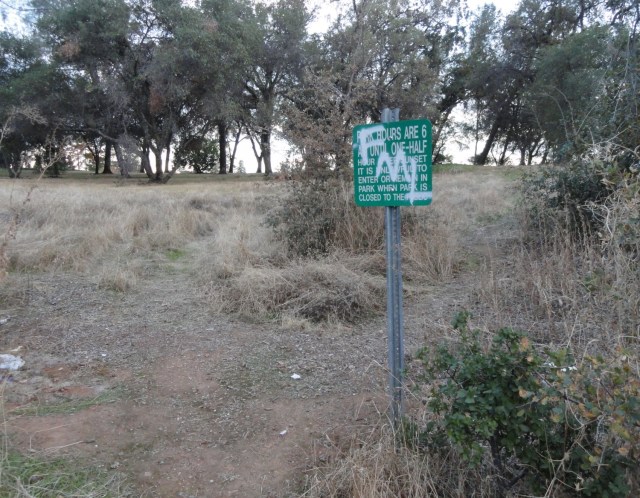
Park sign behind shopping center

At least now you can tell it’s a sign. You probably can’t read it, though. It says:

PARK HOURS ARE 6 AM UNTIL ONE-HALF HOUR AFTER SUNSET. IT IS UNLAWFUL TO ENTER OR REMAIN IN PARK WHEN PARK IS CLOSED TO PUBLIC.

Park???

I couldn’t resist. I climbed to the top of the path and took this picture:

A park with nothing in it in Auburn, CA

There’s nothing in this "park." Past this picture, straight ahead, is a fence and then a freeway. To the right is a drive-through fence that’s always locked and then a highway.

There’s no other entrance to this "park" other than the path I’d just climbed and …

this, to the left from the last picture:

'Park' entrance in Auburn, CA

This is the other "entrance" to the park. I went down it. From the bottom, It looks like this:

'Park' entrance in Auburn, CA

Those are the only two entrances to this park.

That’s not all! Yesterday I ran at lunchtime, and I chose a path (on purpose) that went through the park. I snapped this picture:

Homeless bed and grave in 'park' in Auburn, CA

Once again, this picture is probably too small for you to see, but at the left of the picture is a GRAVESTONE. There are two graves in this "park" and this caved-in mattress is one of three places that look like a mini homeless camp.

Would You Like a Manicure with That Web Page?

One more thing to show you. This is in that outdoor shopping center:

Manicure and internet

Do those two things really go together? Do you really need free wireless internet during a manicure?

There’s probably something I don’t understand about manicures or modern technology, but all I can picture is a woman typing on her ipad with her nose while one hand dries and the other is being clipped and painted.

Hmm. No pictures of that. I should have hung around longer …

Posted in Miscellaneous | Tagged , , | 4 Comments

Kenya Kingdom Hikers: Something To Get Excited About

Missionaries are awesome. Thank God for every one God has called, from Paul and Barnabas to ones that are leaving today.

What every missionary wants, however, is something more than someone coming from a foreign country to preach the Gospel. They want indigenous churches in that country that are fired up for God, preaching the Gospel, and bent on changing their nation.

Well, this is one group of kids doing that in Kenya.

Check them out! Leave them a comment of encouragement and help inspire them to keep up the commitment they’ve zealously adopted.

Posted in Gospel, missions | Tagged , , | Leave a comment

Who Invented the Internet? A Word from the Real Inventor

Scientific American has an article by the guy who really did invent the world wide web: Tim Berners-Lee.

He says the freedom of the internet needs to be defended, and he has some pretty interesting thoughts, especially if you’re "techie" enough to understand it all. Even if you can’t understand it all, he’s got some things to say about Facebook and other such "communities" that ought to be heard.

I guess he’s been fighting a bit to keep the internet free, and he suggests there are more attacks on that freedom than we realize.

Anyway, I wanted to do my part to spread this information.

If nothing else, there’s something unique about reading an article on the internet written by a guy who, just 20 years ago, had the only web page and only browser in existence on his computer.

Posted in Miscellaneous, news | Tagged , , | Leave a comment

Healing Testimony

I thought y’all would like to hear this story …

I met a guy here named Todd. When I met him, he was wearing shorts and was missing a very noticeable chunk out his calf. I asked him about it, and here’s his story. I’ll keep it short.

He was on a motorcycle, riding passenger behind a friend, when they were broadsided by a truck. I forgot to ask whether that was a pickup or semi!

Anyway, he was launched down the road about 60 feet and broke ribs, his leg in several places, punctured his lung, and some other things I don’t remember.

The story here is about his leg, which was twisted sideways, torn open, and not healing, even in the hospital. The doctors were telling Todd that his leg was gangrenous and that they would almost certainly have to amputate to save his life. They told him he’d never walk on it again whether they amputated or not.

Then a pastor, John Cowan, whom I know and I mentioned in a blog as the nicest man I have ever met, came in and prayed for him. John said that he was thinking about James 5, where James says that the elders of the church should anoint a sick man with oil and pray for him. John simply wanted to obey that, so he brought olive oil with him, anointed Todd and prayed for him.

Todd said he doesn’t remember the time frame, but over the next hour to several hours, his leg slowly straightened and the pain dissipated.

A few hours later, the doctor came in to check on his leg and make sure they didn’t have to do an emergency amputation. He looked at the leg and asked what happened.

Then he called in several other doctors, and they were all stunned.

The end of that story is that Todd walks just fine, though all his other injuries just healed over time, and he has back problems to this day.

Arguments with Atheists

I used to write on an evolution versus creation message forum a few years ago. I got in a lot of discussions with Christians about evolution and with atheists about the historicity of Christ and miracles.

Atheists, especially ones that study science, love to ask for verifiable scientific studies, especially "double-blind" studies. Otherwise, they say, they don’t believe these miracles ever happened.

They also add that these miracles always seem to happen to a friend of a friend or some distant relative that the person giving the testimony has never met.

Hmm. Not my experience. I’ve met dozens of people with stories like Todd’s … not friends of friends, but people I’ve met with the most incredible stories of God healing them.

No, these will never be subject to double-blind studies. What are you going to do? Break a few people’s legs, twist them around, and then send John Cowan in to anoint them with oil?

After a while, it becomes not scientific but stupid to ignore such stories.

And it certainly becomes stupid to say miracles "cannot" happen, as though you’d conducted your own double-blind studies to prove they’re impossible. Funny how you only need those double-blind studies to prove God works. They don’t seem to need double-blind studies to pronounce them impossible.

Anyway, grace and peace to y’all!

Posted in Testimonies | Tagged , , , | Leave a comment

Slip Sliding Away

RV accident

Oops!

Brilliant, huh?

Breaking the RV: The Earthly Stuff

It has been raining here in Auburn, but we needed to take the RV to the RV park and empty the holding tanks. I should have learned my lesson when we were leaving.

My kids have more pictures and their own descriptions on their blogs. Their stories are shorter. My children get to the point way better than I do. Must have gotten it from their mom.

Manuha’s Musings
Leilani’s Pipsqueak Blog (She’s 8, and she didn’t write on the RV, but on gold panning yesterday.)

I tried to back out of the yard we’ve been staying in, but I couldn’t make the turn around their garage (which is in the picture) and out the gate. I ended up having to turn the RV around in their yard, which is a hill. We’ve been parked on just about the only flat spot in the whole yard.

Turning it around was some serious mental work, but we did it. Then driving out was not difficult at all.

When we came back, I decided to back in so that I could retrace the same route I took out. But as we made the small turn around the garage, the back wheels kept slipping.

Apparently, I’ve got some sort of brain deficiency, and I still thought I could make it. My son and I decided we would try backing just a little further, and if we slipped anymore, we’d give up and park out front.

We slid too much.

There was nowhere to go, and when I tried something, the side of a small ditch caved in and we tilted right onto the corner of the garage.

The garage was never really in danger. It’s an old oak thing, almost like a barn.

The RV, however …

We were very fortunate. The corner of the garage came into the RV about a foot, and it chose a large sliding window to do so rather than a wall. If the window had been open, the only damage we’d have had would have been the screen on the window.

It was closed, however, and the window just exploded.

Okay, Now the Spiritual Stuff

I have a pretty bad temper. Rose Creek Village has really changed my life in that respect, as I’ve had a lot of input and help controlling it. I’m almost like a nice person now.

This little incident enraged me, though. There was no one to be mad at except myself, so I said some pretty awful things about my intelligence to myself and anyone else I could get to listen—which was just my family. Fortunately, my wonderful wife was offended at the statements. It would have been disappointing if she’d shrugged and said, "Yeah, that’s what I think, too."

I was excited, though, about the fact that I treated everyone else reasonably well.

I was also somewhat panicked. How in the world would we get this RV off of the garage? The garage isn’t even mine! I’m at someone else’s house!

Amazingly, I quickly got my mind set on God, and I sat in a chair, letting all the horrible, painful emotions that had flooded my body and mind fade away. I immediately started wondering what I should learn from this.

Oddly, the first thought that went through my mind was, "There’s nothing to learn. This was just a chance incident; things happen; and there’s not any purpose to things like this."

That only lasted a moment. I’ve lived for 49 years thinking there’s a purpose to everything and that God doesn’t let anything happen to us by accident. We can be stupid and insensitive and learn nothing, or we can pay attention, learn quickly, and not have to go through the same problems over and over and over.

That’s worked really well for me. Though there’s plenty I don’t understand, I’ve never experienced or heard anything that’s made me feel like I need to give up looking at life that way.

Lessons

So here’s what I think.

1. I think the devil doesn’t want us to have it easy out here. I was really encouraged by the thought that he actually sees us as a threat.

2. I have a lot less problems than most people in the world, and it’s really important that I don’t get sucked into the American “Disneyland” mentality that says our purpose in life is to live in comfort.

3. If I will keep my mind on what is my purpose, following our Father and doing whatever he’s doing, this might not have happened. Before I ever drove to the dump station to dump the tanks, I had thought briefly about how easy it would be to just park out by the road. I didn’t pay enough attention to that thought to hold it before God to see if that’s what he wanted.

Life’s simple. You walk in the Spirit all the time, and you do what he leads you to do.

That’s an oversimplification, but it is, nonetheless, exactly what being a Christian is all about. We get to be spiritual people, walking with and knowing God. It’s foolish to get distracted with the things of this world just because we’re Americans with a lot of money, excellent shelter, constant climate control, and more food than necessary.

The End of the Story

Oh, after I let all the emotions run out, I called a tow company and asked them to send me a genius out to help.

Really, I asked for a genius.

The lady laughed, and she said she would send their “guy” within about 45 minutes.

He showed up, and he looked like Jason Fitzpatrick, that missionary to Mexico that I’m so impressed with.

Turns out he was a genius. He simply used a tree to winch the rear end of the RV around until we were pointed at the gate. That probably didn’t require genius, and any tow truck guy could have done it. The genius was the way he handled me.

I asked him, “Is there hope that this will work?”

He said, “Hope? I’m not hoping. I know this is going to work.”

He was careful, slow, and utterly confident, even though he was pretty young in my eyes. He was totally in charge and very friendly. He never once told me I was an idiot. In fact, he never made me feel like one. He acted like this could have happened to anyone.

It could have … to anyone who is overconfident in his ability to drive in mud and trying something he shouldn’t be trying.

Anyway, I got out of it for a very reasonable tow bill and a broken window. Incredible.

One Final Comment

My wife just got done with whatever she was doing on her computer. She got up and said, “All in all, a really good day.”

I have great people around me.

We’re in California trying to help Christians make a choice to live in such a way that everyone can have what I have and what the Gospel is supposed to promise: great people around all of us because we’re together and including everyone who embraces the Gospel.

Posted in Gospel, Miscellaneous, news, Testimonies | Tagged , , , | 2 Comments

Yeah, I Won Over a Million Bucks!

I got a letter from Google Incorporation in London saying that I won a drawing that I never entered!

"Wherein your email address emerged as one of the online Winning (sic) emails in the 2nd category and therefore attracted a cash reward of J950,000.00."

I can only assume that Google in the UK doesn’t have as much money as Google in the US, and so they are unable to obtain a computer that can produce a "£" symbol, which is the 3rd listed symbol under "common symbols" in my Thunderbird email program.

However, in case I couldn’t understand the J they used in its place, which they did at least put in superscript, they added words: "Nine Hundred and Fifty Thousand Great British Pounds Sterling’s."

I’m pretty sure that the apostrophe and s at the end are typical Great British practice, as is the use of "Great British," rather than just British by itself. "Great British" only sounds weird to me because I’m an American, thus establishing even further that this a legitimate email from Google Incorporation UK.

I am also confident that the apostrophe and s in "sterling’s" are typical Great British practice because they also used it in telling me that they will need "information’s" from me to process my "won prize." Of course, the information’s is only required to avoid "double claiming and unwarranted abuse of the program" (in contrast to warranted abuse of the program, which wouldn’t require any information’s).

I’ll keep all of you updated after my "claims is processed." Until then, I have to keep my winning details confidential to, once again, "avoid double claiming and unwarranted d abuse of this program by unscrupulous elements."

I’m thinking that they’re referring to Beryllium, which is definitely one of the more unscrupulous elements. Individual Beryllium atoms have been found in two places at once.

This is further indicated by the fact that this unwarranted abuse is called "d abuse," which I judge to be a reference to Beryllium’s spot as the 4th element in the periodic table.

Posted in Miscellaneous | Tagged , , | 3 Comments

Righteousness, Justification, and God’s Kingdom People

Yesterday I wrote on the man to whom the Lord will not impute sin. (You can use that link to see it, or, if you’re on this blog’s home page, you can just scroll down to the post below.)

The question posed at the end of that post was how John—and Paul in some of his other passages—can put conditions on being one of those blessed people to whom God will not impute sin, when Paul said it’s given to those who believe "in the One who justifies the ungodly apart from works" (Rom. 4:6).

Two Stages of Salvation

I write about this a lot, so if you’ve read my blog or any of my web sites (such as The Rest of the Old, Old Story or Christian History for Everyman), then you already know what I’m about to say.

It never hurts to repeat important things, though, so here goes …

There are two ways in which we need to be saved:

  • We need to be saved from the world and enter the kingdom of Jesus Christ on this earth (Col. 1:13). This is being saved from our sin nature and being born again (Jn. 3:3-8; Rom. 6:3-11), so that we have the power to obey God (Eph. 2:10; Rom. 8:1-4; 2 Cor. 5:15-17). This is one of the main purposes of Jesus’ death (Rom. 14:9; Tit. 2:11-14).
  • We need to be saved at the judgment when we die. The judgment will be based on works and will reward eternal life or condemnation (Matt. 25:31-46; Rom. 2:5-8; 2 Pet. 1:5-11; Rev. 20:11-15).

(That second point is not a very popular thing to say, but the Bible’s very clear about it. It doesn’t take a scholar to look up those verses and see what they say. It takes a scholar to explain such obvious verses away because we don’t like what they teach.)

The first of those things happens completely apart from works. This is the context of the emphasis Paul makes on faith only. If you look up "faith apart from works" verses, you will see that they are only in Paul, and they are consistently in the past tense.

In other words, Paul is the only NT writer careful enough to distinguish between our salvation from our flesh and the world—our being born again—and our entrance into heaven after we die. All other NT writers speak of both together, which is why it’s harder to find faith only taught in them.

Paul distinguishes clearly and consistently, always using the past tense when he says we’re saved apart from works. we have been saved—that is, have been born again and delivered from the flesh—by faith apart from works.

When he talks about works, he speaks in the future tense. We shall be saved from wrath through him. We shall inherit the kingdom of God if we do not walk according to the flesh.

There’s one very interesting passage that helps us see that because he mentions both at the same time, with some clear distinguishing features:

Much more then, being now justified (past and present together here) by his blood, we shall be (future) saved from wrath through him. For if, when we were (past) enemies, we were reconciled (past) to God by the death of his Son, much more, being reconciled (present state), we shall be (future) saved by his life. (Rom. 5:9-10)

Note the distinguishing features. We have been justified and reconciled by his death, by his blood. We shall be saved by his life.

Paul says this because even our current good works are not done by ourselves. It is "by the Spirit" that we put to death the deeds of the body (Rom. 8:13). King Jesus has been made to us wisdom, righteousness, holiness, and redemption (1 Cor. 1:30). It is if we "sow to the Spirit" that we reap eternal life and "do not grow weary in well-doing" and thus "reap, if we do not faint" (Gal. 6:8-9).

So that’s the first reason. Paul knows that we are made into people who live in repentance by faith apart from works. We are the ungodly, and we are justified, past and present tense together, apart from works.

It is thus that we can be those who walk in the light and thus experience fellowship with one another and the ongoing forgiveness of sins by the blood of the King (1 Jn. 1:7).

But there’s a second reason, and it is here that N.T. Wright’s What Saint Paul Really Said really helped me.

Righteousness, the New Covenant, and the People of God

It was fascinating to me, in that passage from Justin I quoted yesterday, to discover that the Jews considered themselves to be those to whom God would not impute sin if they stuck to the terms of the covenant: circumcision, sabbath-keeping, and a couple other important rituals like feasts and sacrifices.

N.T. Wright explains that righteousness doesn’t mean good living. Righteousness is the state of being considered righteous by God if you are in covenant relationship with him.

Jews keeping the terms of the covenant I just described considered themselves in covenant relationship with God, so they were automatically righteous. Those who are righteous are not necessarily living without sin, but since they are righteous, they reckoned, their sins would not be imputed to them.

Justin refutes this idea, but we need to look at it.

I’ve always had a problem with the scholars who say that justification means right standing with God, not necessarily righteous living. The reason I had a problem with that is because there’s a lot of verses where that doesn’t make sense. Righteousness and justification—which are exactly the same word in Greek just translated two different ways by our English translators—are often, if not usually, tied to righteous living.

For example, we looked yesterday at John’s statement that those who are righteous as Jesus is righteous are only those who are practicing righteousness (1 Jn. 3:7). He even warns us not to let ourselves be deceived about this.

Nonetheless, I’m not a Greek scholar, and I’ve never felt comfortable dismissing the definitions of those who are Greek scholars.

But why would they say justification—or righteousness, same word—does not mean righteous living when the Scriptures seem to indicate differently?

N.T. Wright solved that issue for me.

A righteous person has right standing with God because he is in a covenant relationship with God.

Now, I can’t prove that because I’m not a Greek scholar nor enough of a historian to do so. You can always get Wright’s book if you want to see his argument for it, but I can’t cover that here.

However, I can show you how it makes the passages of the New Testament fall into place with one another.

Righteousness, the New Covenant, and the Holy Spirit

Jews are no longer in covenant relationship with God through circumcision because God has made a new covenant in which circumcision is of the heart and of the spirit, not of the flesh nor of the letter (Rom. 2:28-29). Paul even argues that they’re not even Jews, but we are, whose circumcision is worshiping God in the Spirit and having no confidence in the flesh (Php. 3:3).

But that’s just it. The righteousness of the New Covenant is living by the Spirit of God.

Even under the new covenant, righteousness is not right living. It’s living in covenant relationship with God. But the new covenant relationship with God is all about living in the Spirit.

Acts 2:17-18 is a quote from the prophet Joel right at the start of his sermon on the first Pentecost that makes it clear that the central issue of the New Covenant is that everyone would have the Spirit (and the ability to prophesy, 1 Cor. 14:31).

Thus, the person who is righteous is not the person who once asked Jesus into his heart. The person who is righteous—who is in covenant relationship with God—is the person who is living by the Spirit.

This explains why Paul would say that if we live by the flesh, we will die, even though he has told us that salvation is apart from works. If we wish to be in covenant with God, we must live by the Spirit, and if we do, then by the Spirit we will put to death the deeds of the body (Rom. 8:12-13).

It also explains why he would say that those who are Christ’s have crucified the flesh with its passions and desires (Gal. 5:24). (Is that as convicting to you as it is to me?)

In the very next verse, he says, "If we live by the Spirit, let us also walk by the Spirit."

When Paul rebukes the Galatians, does he rebuke them for trying to do good deeds?

That can’t be because he is very strong about exhorting them to good deeds in Gal. 6:9-10. In addition, in the letter to Titus he twice tells us that the people of God—the New Covenant people of God—must be zealous for good works (Tit. 2:14; 3:8).

No, he rebukes them for trying to be made complete by the flesh (Gal. 3:3).

Notice that. He does not rebuke them for trying to be made perfect. They are supposed to try to be made perfect (Php. 3:8-15). He marvels that having begun in the Spirit, they are trying to be made complete by the flesh (Gal. 3:3).

Back to the People to Whom God Will Not Impute Sin

Thus, the people to whom God will not impute sin are those who are sowing to the Spirit. By the Spirit they are putting to death the deeds of the flesh.

They are not perfect at it. They sin. If we say we have no sin, then we are liars and the truth is not in us (1 Jn. 1:8). Nonetheless, the letters are written to the church so that we might not sin (1 Jn. 2:1; 1 Cor. 15:34).

It is only if we sow to the Spirit that we will reap eternal life (Gal. 6:8), and it is only if we do not grow weary in doing good that we will reap eternal life (Gal. 6:9). That is because those two things are the same thing.

If by the Spirit we are putting to death the deeds of the body, then God will not impute sin to us, quite a blessed state to be in.

It’s not an impossible state to be in. David was in that state, except when he violated it by committing adultery and then murder. Paul says that we can all be in it by living by the Spirit.

If we do not live by the Spirit, then we are not Christ’s.

I wish I could say something easier than that because it applies to me as well. But the fact is that the Bible says that it is those who have crucified the flesh with its passions and desires who are Christ’s.

The Gospel and Righteousness

We need to believe a bigger Gospel than we believe.

Paul said that his Gospel was the power of God for salvation to those who believe. In it, he says, the righteousness of God is revealed from faith to faith (Rom. 1:16, 17).

But let’s interpret that saying the way Paul did!

He wondered aloud, "How can those who died to sin continue to live in it" (Rom. 6:2).

Paul had great confidence in the grace of God. It would teach us to deny ungodliness and worldly lusts and to live sensibly, righteously, and godly in the present age (Tit. 2:11-12). It would make us new creatures, created in King Jesus for good works (Eph. 2:10). It would make us zealous for those good works (Tit. 2:14). It would allow the righteousness of the Law to be fulfilled in us (Rom. 8:4). It would remove sin’s power over us (Rom. 6:14).

Paul didn’t know about any other kind of grace. The grace he knew about wouldn’t allow the unrighteous to inherit the kingdom of God (1 Cor. 6:9), but it would wash and free us from unrighteousness (1 Cor. 6:11).

And it wouldn’t happen automatically. In order for it to happen to Paul, he disciplined his body and brought it under subjection (1 Cor. 9:27). He knew that if he didn’t, then he, too, could be disqualified (ibid.).

Well, I’ll let y’all chew on that a while. It’s scary to me, too, but can we really deny that’s what the Bible teaches?

Posted in Gospel, Holiness | 1 Comment

Righteousness and the Man to Whom God Will Not Impute Sin

I’m going to try a very theological post for those who have struggled with some of the same questions concerning faith and works that I have.

Romans 4:6-8 says:

David describes the blessedness of the man to whom God imputes righteousness without works. "Blessed are those whose lawlessness is forgiven and whose sins are covered. Blessed is the man to whom the Lord will not impute sin."

There is no doubt that such a man exists, but does every Christian qualify as such a man?

Some say yes because Paul says, "To him that does not work, but instead believes in the One who justifies the ungodly, his faith is counted for righteousness."

That’s Romans 4:5, immediately before the description of the blessed one to whom the Lord does not impute sin.

However, if we’re going to be honest Bible interpreters and not just people who agree with every tradition that is handed to us, then we have to admit that not every Christian is going to enjoy that blessedness. Paul gives plenty of warnings to Christians that their sins most certainly can be imputed to them.

For example:

Do not be deceived; God is not mocked. Whatever a man sows, that will he reap. He that sows to the flesh shall from the flesh reap corruption. (Gal. 6:7-8a)

Or how about:

Therefore, brothers, we are debtors, not to the flesh to live according to the flesh, for if you live according to the flesh, you will die; but if by the Spirit you put to death the deeds of the body, then you will live. (Rom. 8:12-13)

Or again:

For we shall all stand before the judgment seat of Christ so that everyone may be rewarded for the deeds done in the body, according to what each has done, whether good or bad. (2 Cor. 5:10)

It doesn’t matter whether you believe in eternal security or not. It doesn’t matter whether you think these verses refer to our eternal destiny, heaven or hell, or not. The fact is, in some way there is a judgment for the fleshly or bad things we have done. Thus, those who are facing this judgment are having their sins imputed to them.

That simply cannot be denied.

Ephesians 5 is even more clear. I want you to note in the final sentence of the following passage that Paul is implying that Christians who live in sin will be judged in exactly the same way as the heathen:

For this you know, that no immoral person, unclean person, or covetous person—who is an idolater—has any inheritance in the kingdom of the King and of God. Don’t let anyone deceive you with useless words, for because of these things the wrath of God comes upon the sons of disobedience. Therefore, do not be partakers with them. (Eph. 5:5-7)

Note also that once again, Paul says not to let anyone deceive you about this.

So Who Is the One to Whom the Lord Will Not Impute Sin?

John gives us a couple clues to Paul’s meaning—that is, if we believe that God inspired both Paul and John to write what they wrote. If we believe that, then we don’t want to come up with an interpretation of Paul that contradicts what John wrote or vice versa. We also don’t want to come up with an interpretation of Romans 4:6-8 that contradicts so many other statements Paul made, including the ones we’ve quoted above.

John speaks, in my opinion, of the very same blessedness that Paul speaks of, but in different words.

If we walk in the light, as he is in the light, we have fellowship with one another, and the blood of Jesus the King, his Son, cleanses us from every sin. (1 Jn. 1:7)

This is the same awesome promise Paul made. John is talking about a person who is cleansed from every sin on an ongoing basis.

Pretty neat, but apparently John thinks that’s only going to happen if we "walk in the light."

The Early Christians on the Man to Whom the Lord Will Not Impute Sin

There is a passage in the writings of the early Christians that discusses this subject thoroughly.

Around A.D. 150, a man named Justin Martyr got in a discussion with a Jew named Trypho. Since Romans 4:7-8 is a quote from David, it’s a passage that the Jews knew about and believed in, too. They believed that the man to whom the Lord would not impute sin was any Jew that was circumcised, kept the Sabbath and feasts, and offered sacrifices.

They believed this was true even if that Jews lived in an otherwise unrighteous manner, cheating, drinking, and generally living a corrupt lifestyle.

Justin refutes this from the Scriptures. Here’s how he does it:

If they repent, all who wish for it can obtain mercy from God, and the Scripture foretells that they shall be blessed, saying, "Blessed is the man to whom the Lord does not impute sin."
     That is, having repented of his sins, he may receive remission of them from God. It is not as you deceive yourselves, and some others who resemble you in this, who say that even though they are sinners, but know God, the Lord will not impute sin to them.
     We have as proof of this the one fall of David … which was forgiven when he mourned and wept as described in the Scriptures. If even to such a man no remission was granted before repentance, and only when this great king, anointed one, and prophet mourned and conducted himself as described, then how can the impure and utterly abandoned, if they do not weep, do not mourn, and do not repent, entertain the hope that the Lord will not impute sin to them? (Dialogue with Trypho, a Jew, ch. 141)

The Scripturalness of the Early Christian Position

Perhaps you noticed that Justin accused the Jews of deceiving themselves in this matter. I’ve already pointed out that Paul tells us at least twice not to deceive ourselves about this.

John does so as well …

Little children, let no one deceive you. The one that practices righteousness is righteous just as he is righteous. (1 Jn. 3:7)

John apparently believes that there is some element of works in the blessedness of being one to whom the Lord will not impute sin. First he tells us that such a blessed person is one that walks in the light (1 Jn. 1:7) and now he tells us that such a blessed person is one that practices righteousness (1 Jn. 3:7).

How Can This Possibly Harmonize with Paul’s Statement That This Blessedness Is Apart from Works?

Note that it is not that John disagrees with Paul. Paul also tells us repeatedly—we’ve only covered a small percentage of the many verses from Paul’s letters addressing this—that there are consequences for sins that Christians commit.

How can this possibly harmonize with his statement that this blessedness is apart from works and given by the One who justifies the ungodly? (Rom. 4:6).

Well, that’s what I’ve been getting to this whole time. I believe the answer is critically important and immensely satisfying for those of us who have struggled with exactly that question for years.

My thanks to N. T. Wright, whose book ,What Saint Paul Really Said, brought brilliant, wonderful light on this matter.

But, since I’m already over 1200 words, it’s going to have to wait for tomorrow …

Posted in Gospel, Modern Doctrines | Tagged , , , , , , | 3 Comments