Easy Believism: The Scriptural Version

I’m always harping on the need to have a real commitment to Jesus. Asking Jesus into your heart and believing that he died for your sins are not enough. You have to be a believer in Jesus, which means you listen to what he says, not just a believer in the fact that he died for our sins.

Today, though, I want to talk about not going overboard.

By overboard, I don’t mean that you are zealous for Christ, have a one-track mind, don’t want to talk about anything but Jesus, and are ready to race into the jungles of Africa and give your life for the Gospel. That’s not overboard. That’s commendable zeal.

By overboard, I mean that you sneer at people who tell you that they don’t feel called to the jungles of Africa and that they’d just like to raise their children as good, godly people who will contribute to the world around them.

We, and of course I’m including myself here, can complain about easy believism. There is definitely a false Gospel being preached in America, and it is being preached often, not rarely.

But the word “easy” is not a bad word:

Take my yoke upon you, and learn from me, for I am gentle and lowly in heart, and you will find rest for your souls. For my yoke is easy, and my burden is light. (Jesus, Matthew 11:30, ESV)

In what way is Jesus’ yoke easy?

I’ve heard that explained a lot of ways. My favorite, I think, is that the meaning is that the yoke—a device put upon oxen to help them pull a plow—is perfectly fitted for us. It’s not a one-size-fits-all that rubs our skin and give us blisters. It is comfortably made for each of us.

So some of us are called to trek the jungles of Africa. I’ve got friends packed into a 3-bedroom house in Kenya right now, living together with an African pastor for a couple months so that they can build the church and teach them to love one another and esteem each other equally.

Some of us are called to hospital rooms for chemotherapy like I’ve been going through for 4 weeks.

Others are called to go to work and live their life with kindness, friendliness, and the joy that comes from being in the presence of God.

Aspire to live quietly, and to mind your own affairs, and to work with your hands, as we instructed you, so that you may walk properly before outsiders and be dependent on no one. (1 Thess. 4:11-12)

You will search the letters to the churches in vain for a similar command that says, “Aspire to be an excellent witness at work, finding opportunities to inject Gospel sayings into the lives of others.”

I love the fact that indigenous missionaries are traveling all over India, preaching the Gospel in villages and towns where the name of Jesus has never been heard.

In the USA, however, the name of Jesus has been defamed by idiots and charlatans who chant his name and throw out Scriptures to extort money from people or to get brownie points from God for their zealous evangelism while they are years away from having any real Christian stability in their lives.

It’s time for American Christians to shut up and live their faith.

There are exceptions. Thank God for some of these wonderful people who are in impoverished areas, helping people, and talking about Jesus while they’re doing it. Thank God for ministries like Teen Challenge.

Those ministries will be many times more effective if the rest of us, who are not doing those ministries, would follow the advice of 1 Thess. 4 and be quiet, keep our affairs in order, and give no opportunity for the Gospel to be maligned.

Okay, so I still sound like I’m ranting and raving, chewing people out.

Sorry.

My point is that all of us need to walk with Jesus. We need to be sold out for the Gospel, loving God, and walking by the Spirit.

But that doesn’t mean we’re called to evangelize the whole world. Many, probably most, Christians are simply called to enjoy fellowship with God and be an example by their steadfast, solid, and loving lives, rejecting worldly gain for the simple but huge joy of serving and loving others and giving thanks to God in all things.

That’s the right kind of easy believism.

Live in the grace you’ve been given. Go as far as God has called you. Know where God has called you. Be a good steward of his grace (1 Pet. 4:10-11), but don’t serve him out of a pressured guilt.

It’s okay for us, together, to shine a light that cannot be hidden simply because by our nature—which we have received from Christ when we were born again—we are zealous for good.

And it’s not just okay, but correct, to call that holiness.
Posted in Holiness | Tagged , , , | 5 Comments

Who Am I To Be Fabulous?

Who am I to be fabulous?

Who am I not to be?

Our deepest fear is not that we are inadequate. Our deepest fear is that we are powerful beyond measure. It is our light, not our darkness that most frightens us. We ask ourselves, Who am I to be brilliant, gorgeous, talented, fabulous? Actually, who are you not to be? You are a child of God. Your playing small does not serve the world. … And as we let our own light shine, we unconsciously give other people permission to do the same. (Marianne Williamson, A Return to Love.)

I have chosen not to be a bank robber. I have chosen not to vandalize my neighbor’s property. I have chosen not to shoplift.

We don’t commend such choices. We punish and look down upon those who don’t make them. Whether Christian or not, theist or not, virtually every human alive agrees that each of us is obligated to avoid that type of behavior.

Are we not equally obligated to do what is good?

Are we not equally obligated not to waste the life we have been given?

Today, I was told by a nurse that patients like me are the minority. Most do not have a positive outlook. Most do not look for the best in their situation.

As she was telling me this, she said, “Of course, no one reacts positively when you first find out such devastating news.”

I did.

I didn’t tell her that. It seemed not very humble to say it. Later, though, I got to thinking about the quote that I started this blog with.

As we let our light shine, we unconsciously give other people permission to do the same.

We all have our strengths; we all have our weaknesses.

We don’t all use our strengths, and we don’t all work on our weaknesses. Some of us just give in. We float through life.

Are we any less obligated to avoid that attitude than to avoid being a thief?

It was not an accident or a quirk of my nature that allowed me to receive the news of my leukemia with joy from the moment I received it.

I practiced receiving such news for years.

I asked myself whether I was really a Christian. I asked myself whether I really believed what the Bible says. In fact, I found out that I believe what Jesus said. I believe what Moses said. I believe what the apostles said, and I want to follow Abraham’s example. I believe in the inspiration of the Bible, but I really don’t believe that the earth was made in 7 days. I also believe that when serious science competes with literal Bible interpretation, science always wins, and the unyielding literal interpreters of the Bible always end up, well, looking ignorant and foolish.

So I admitted who I am on evolution. The fact is, I trust scientists more than I do the fundamentalists because scientists have better fruit, are more honest, and slander people less.

But when it comes to believing the Gospel, I believe it. I believe that all things work together for good to those who love God and who are the called according to his purpose.

Therefore, for decades, as angry as I might get about being fined $600 when I was broke for a car accident that a president of a bank caused, then lied about and sued me over, I would acknowledge that it wasn’t the bank president who did that to me. It was God. And it was for my good.

For decades, I made up my mind to first question my own judgment about myself rather than the judgment of a person who accused or admonished me.

For decades, I practiced what I believed.

By that, I don’t mean that I did everything I believed. I practiced. I worked at it. I trained, and I got better.

Then one day, God said, “You’ve come far, Grasshopper. You are now ready for a real test.”

And so far, I’ve passed.

We all have different strengths.

What are yours? And what are you doing with them?

Or are you just lucky there’s no laws against coasting through life, being a lazy, evil steward of the gift of life that God gave you?

Posted in Evolution and Creation, Holiness, Leadership, Leukemia | 1 Comment

The Friend of God?

A friend of mine, Patrick Beard of Indigenous Outreach International, asked me about Psalm 45:10-11, which I mentioned in my book on the Council of Nicea. I love that passage, and I want to share my answer to him with you.

Sometimes it’s hard to know whom you can trust, especially with your money. I’ve visited Ethiopia with Patrick, and I encourage you to join me in supporting their ministry, which involves helping the poor, educating children, and supporting indigenous missionaries. It’s an amazingly efficient and well-managed ministry.

So, here’s the email:

Psalm 45:10-11

"Listen, oh daughter. Consider, and incline your ear. Forget your own people and your father’s house. So the King will greatly desire your beauty. Because he is your Lord, worship him.

Ps. 45:10-11 is for me a more emotional version of “There is no one who has given up relatives and lands for my sake who shall not receive a hundredfold in this life and in the age to come, life everlasting” (loosely quoted, I didn’t look that up).

Psalm 45:10-11 is a more positive side of “If you love father and mother more than me, you are not worthy of me.”

Those quotes from Jesus are important (of course). We must put him first, or we are not worthy of him. Even better, if we forsake everything for him, we will receive a hundredfold in this life.

But Psalm 45:10-11 is the best of all. Forget your own people and your father’s house—leave them behind to come be in Jesus’ house—and the King will greatly desire your beauty.

The picture is a feminine one, of course, addressed to daughters, and I am not a daughter. The church is a bride; I am not a bride.

Nonetheless, this represents the call of Christ to me. Leave everything behind, and enter his household, and he will not only reward you and find you worthy, he will greatly desire your beauty.

Maybe this passage, to me, is like John 15 from Christ’s lips: “As the Father has loved me, so I have loved you. Continue in my love. If you keep my commandments, you shall continue in my love.” And, “You are my friends if you do whatever I command you.”

Somehow, the picture from Psalm 45:10-11 drove that home for me. It’s an incredible thought to me that the King might not only be pleased with me, but that he would count me a friend (greatly desire my beauty).

In 1 Chronicles 27, there is a list of all sorts of officers that served King David. The office I want is found in v. 33 and held by Hushai the Archite.

Posted in Holiness, Miscellaneous | Tagged , , | 1 Comment

Psalm 84: Whose Strength Is in You

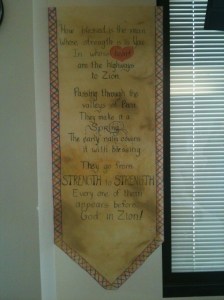
A friend of mine made a banner for me for my hospital room with Psalm 84:5-7 on it.

Banner of Psalm 84 in hospital room

I’m on day 20 of my first round of chemotherapy for acute leukemia, in case you don’t already know that. I’ve been blogging about it at Thrilled to Death.

There’s some hardship involved in my chemotherapy, but it’s not nearly as hard as I expected. I’ve found out, though, that the marrow or stem cell transplant that’s coming will probably be worse and will last much longer—at least 6 months, and one man I talked to today had 18 months that he called bearable but extremely difficult.

So how do I face this?

Strength in God

How blessed is the man whose strength is in you.

The greatest opponent I’ve faced is my own strength, my own attempts to have a positive attitude and to expect the best. My faith is easily shaken. On a bad day, my mood can easily swing, and I question people’s motives and judge their behavior.

God’s strength, however, is never shaken. The one who delights in the Lord is consistently supplied with grace, which Psalm 1 pictures as a tree planted by a flowing river which never runs dry.

"Thou wilt keep him in perfect peace, whose mind is stayed on thee. (Isaiah 26:3)"

If I’ve learned anything in the last five weeks—yeah, it’s only been five weeks since I was diagnosed!—it’s that I have to live right now. God has grace for right now, not grace for next week, six months from now, or next year.

The rest of that passage in Psalm 84 provides two awesome promises:

From Weeping to Springs of Life

Passing through the valleys of Baca, they make it a spring.

Baca is Hebrew for "weeping."

What an awesome picture! For those whose strength is in God, their weeping produces springs that feed those behind them.

You can probably draw your own analogies from that picture.

From Strength to Strength

They go from strength to strength. Every one of them appears before God in Zion.

If I’ve learned anything else over the last five weeks, it’s that strength is not continuous. Yesterday’s grace is not sufficient for today. I’m sure there’s really awesome Christians somewhere who never wander from the presence of God and pray without ceasing.

I’m not one of them.

But I do know what it’s like to go from strength to strength. I do know that the sea of grace is inexhaustible and can be tapped anew each day. I do know that the mercies of God are new every morning, and I know what it’s like to appear before God in Zion, though that last one is a story for a different day.

To sum up, let me encourage you that today is the day to let your strength be in Jesus Christ, to keep your mind stayed on him, and to know that yesterday’s grace won’t carry you today, and that there is no grace for tomorrow until tomorrow.

Posted in Holiness, Leukemia | Tagged , | 4 Comments

Was Jesus a Historical Figure?

I was reading yesterday’s post at The Failed Atheist. I listened to the video on it, and I simply must repost it here.

This is a liberal, non-Christian, pro-gnostic scholar—Bart Ehrman—who really irritates me. In this case, however, I think “The Infidel Guy” was shocked to find out that his anti-fundamentalist-Christian guest thinks that only the ignorant deny the historicity of Jesus.

I’ve got more comments below, but here’s the video (which is really only audio):

The main point of the video is obvious. Bart Ehrman gives some examples of why we can be confident that Jesus was a historical figure. The Infidel Guy’s only response is basically, “Can’t we just doubt everything we don’t like?”

Embarrassing.

There’s a couple more things I should mention that are mentioned in the interview.

“Jesus Christ” doesn’t mean something put together like that, if by “mean” we are implying that there’s some Hebrew definition for Jesus Christ. Jesus is a name. Yes, it has a meaning, but it’s a name. Christ is a title. It’s the Greek word for “anointed one,” but in the context of the New Testament, it basically means king. It means God’s chosen king for his chosen people, but it mostly means king.

In this interview, Bart Ehrman is being a good historian in the matter of whether Jesus existed. The fact is that Paul’s letters, the existence of Christians in Rome under Nero in the AD 60’s, the utter consistency of early Christian letters and drawings, and numerous other things that constitute the “whole tenor” of history make it clear that one ought to trust who the Christians said Jesus was, at least in the matter of being a crucified Jewish prophet.

But on other things, he shows the stubbornness of so many people. He tells Infidel Guy that no serious historian questions the existence of a person Jesus. The Infidel Guy gives him Robert M. Price. It takes Ehrman a significant amount of time to admit he knows of him, and in fact has had correspondence with him. The Infidel Guy points out that Robert Price is a serious historian, Ehrman questions him. The Infidel Guy says he’s a professor; Ehrman insists he doesn’t teach anywhere.

Price is the professor of theological and scriptural studies at Colemon Theological Seminary. It appears to me that institution is probably not accredited, but he is teaching. Price used to be at another similar institution which offered undergraduate courses that were accredited, so he has taught.

The fact is, Ehrman went too far when he said no serious scholar questions the historicity of the person Jesus. People are people, and even “experts” are moved by their biases. You can find legitimately qualified experts denying the obvious in any field of inquiry.

For me, though, it’s like what Jesus said about faithfulness. He who is honest in little things will be honest in big things. If you can’t be honest with the little things, you’re going to miss the evidences that will prevent you from building a house of cards in whatever areas you are studying.

Posted in History | 1 Comment

On the Favor of God

The following post on my leukemia blog seemed worth reposting here. Theologically and practically, there’s a lot of context needed to it that both this blog and that one provides. It may or may not make sense to you if you’re not already familiar with me and my current situation.

http://yippee-leukemia.blogspot.com/2011/07/july-29-news-from-god.html

Posted in Leukemia | Tagged , | 3 Comments

Which Church Is the Pillar and Support of the Truth?

I have very little time to whip this post out. I have a marrow biopsy in 2 hours, though they’re going to do it right here in my bed, but I also have visitors out in the gift shop.

On Facebook, someone posted:

The real issue isn’t-“the Bible alone” versus “the Bible plus tradition.” Rather, the issue is- “the Bible plus Apostolic tradition” versus “the Bible plus man made tradition.”

Depending on your definition of “apostolic tradition” everyone agrees with this.

If apostolic tradition means “what the apostles themselves meant to say when they wrote the words of the New Testament,” then Protestants, Roman Catholics, Orthodox, and even Jehovah’s Witnesses and Mormons are in unity on that belief.

The question is, how do we determine what the apostles meant to teach?

First off, let me say that I believe that 95% of all people who claim to be Christian are so stuck on whatever tradition they practice that it would be fair to say that they couldn’t care less what the apostles meant to say. They just want to continue doing what they’re doing. Even if they change, it will be for some emotional or relationship issue, not because they feel that they’ve gotten any closer to apostolic truth.

For those of us who do care what the apostles taught, there are multiple routes to determining what the apostles meant.

The Roman Catholics and Orthodox tell us that we should just take their word for it. By God’s protection, they’ve preserved the apostles’ meaning through the church, which Jesus promised would never fall (they say).

Most conservative Protestant churches tell us that it can be found just by reading the Bible because the Bible interprets itself, though it seems to have interpreted itself differently to around 50,000 different denominations in the United States, and to a lot of individuals as well.

A newer movement tells us that we can find apostolic tradition in the history of the Pre-Nicene church. I would, uh, almost be among those. However, those who are in this movement are in at least as much disagreement as other Protestants, often more.

I think the obvious route–and any historian would have to agree with me–to understanding the meaning of the apostles is not only to read their writings, but also to see how the churches they started interpreted their writings and put them into practice. And we have thousands of pages of writings from apostolic churches from the first couple centuries after the apostles.

But that doesn’t mean that’s enough to accurately interpret “apostolic tradition.” Even historians disagree among themselves over both the history and the beliefs of the early churches.

So, how do we decide. Here I agree with the Roman Catholic and Orthodox, sort of. If we are Bible believers, then the Bible tells us that the church is the pillar and support of the truth (1 Tim. 3:15). If we are Bible believers, then the Bible tells us that together we can trust the Anointing to lead us into truth (1 Jn. 2:27). If we are Bible believers, then the Bible tells us that as we are trained to build the body of Christ together, speaking the truth in love, each member doing its share, then we will be protected from deceivers and false doctrines (Eph. 4:11-16).

It is the church that can determine whether we have accurately found apostolic tradition, but that church is not some organization based in Rome, Antioch, Istanbul, or Moscow. That church is the local church, believers gathered together, giving themselves to Jesus Christ, willing to be supernaturally taught by him, and to follow his Spirit wherever he leads.

Men will always disagree. It is their nature. Galatians 5:19-21 tells us that divisions, schisms, and dissensions are simply what our flesh produces.

But if we will get out of our flesh and get under the leadership of Jesus Christ together (alone, you’re a sitting duck–Heb. 3:13), then we will know everything we need to know, and the apostolic tradition the Spirit of God leads us into will be exactly the apostolic tradition that the Spirit of God led the apostles into.

Posted in Bible, Church | Tagged , , | Leave a comment

The Mystical Bible

I got an email from a friend. He was trying to post something like it as a comment on my leukemia blog, but computer problems prevented it. I’m glad. His "comment" captures the imagination, stirs the heart, and thrills the spirit. I got his permission to print it here.

So, from Jeremiah Briggs:

The dragonfly story brought tears to my eyes (linked from my leukemia blog).

I wish, oh, how I wish people could see the scriptures in the light of a loving Creator who is trying deserately to redeem His creation from the darkness of self-ruin. The God of heaven and earth desires relationship over rules. How many there are, who see the Bible as a self-help book and not a wonderful book about a mystical realm with an all-powerful and wise King and his quest to redeem his subjects from the tyranny of a usurper!

It’s full of art, music, and poetry and with mythological creatures that are more real than we are. It is like Arthur Spiderwick’s Field Guide; it’s very dangerous in the hands of the wrong people.

The people who wrote it didn’t take a Christian writer’s seminar. They simply had an encounter with the One who loves them. The outcome of their writing is a picture painted in the heart of the reader that is unique to that person. It is like reading Tolkien’s Lord of the Rings and then seeing the movie. Somehow the screen version lacks the ability to match the image that the writer has created in each one of us.

Perhaps thats why I’ve never tried to illustrate Tom Bombadil; I don’t think I can for one, and two, I don’t want to disturb the image in the hearts of others.

Though I’ve attempted numerous times to do illustrations from the Biblical narrative, my art is never from a literal perspective, which I find distastful because most attempts I’ve personally viewed are a very weak cup of coffee at best and at worst… well, I’ll avoid being disreapectful to those who have labored so hard to capture the unimaginable.

Michael the archangel defeats the devil
Michael the archangel throws down the devil
by Jeremiah Briggs, used with permission

It’s like they are trying to catch the wind. I make only a feeble attempt to interpret the image which is within me. For as the author said, "We must have eyes to see and ears to hear." Our hearts and spirits say "amen" to the message and perceive the image it renders.

I’ve tried many times to do an image based on the scripture, "In the year that King Uzziah died I saw the LORD … " I think, after reading your post and the dragonfly post, I may have the composition I’m wanting, but as usual it, like others in the past, will reflect the Hidden Realm where what we see and what is really there are two entirely different things.

Posted in Bible, Miscellaneous | Tagged , , , | 2 Comments

What I Support: Faith Alone and the Family of God … In New Words

I get so caught up in correcting what I see as obvious error that sometimes I forget to make clear what I’m supporting. I believe the Gospel of Jesus Christ really is good news.

I attack all sorts of doctrines. Often, if not always, it is not because I think they are wrong. Most or all of the time I am simply arguing that they are too important to us.

Faith Alone

There is one important thing, and that is Jesus Christ. There is one important act, and that is faith in and obedience to Jesus Christ, and those two things–faith and obedience–are interchangeable.

I don’t have to appeal to Greek to prove that. You know it’s true in English.

Let’s assume you’ve just told me that you’ve become a Hoganite. You have become a believer in Hulk Hogan. Then you hero gets on TV and says that if you want to be a real man, you will stand outside in mid-winter, in the snow, in public, and in daylight in only your All-Star Wresting, speedo-style trunks for four hours. You, rightly thinking that this is idiotic, decide not to do it.

I would have to commend your wisdom. However, I would also add, “You’re not much of a believer in Hulk Hogan now, are you?”

I am against being “not much of a believer” in Jesus Christ.

On the other hand, if you were to go out, shiver in the cold for twenty minutes, then race inside, unable to bear it any more, then I would again commend your wisdom in giving up and coming inside. But I would comment that though you’re loony, you are apparently a real, actual, true Hoganite.

I am for, with, in support of, given to, a servant of, and a prayer for real, actual, true Christians–people who occasionally fail miserably, but who avidly, joyfully, and humbly pursue everything Jesus Christ has called them to.

The One True Church

Everything else I say is just to help those avid, joyful, humble Christians know that they don’t have to pretend other people are Christians. They can love them, witness to them, and serve them. Then they can leave work and from hospital visits and dinners with the not-much-of-a-believers and devote their meetings and fellowship and life to other avid, joyful, and humble Christians who are their only true family.

And those avid, joyful, humble, and failing Christians, together, leaning on Jesus Christ are the one, true, and only church, the pillar and support of the truth.

And God can be trusted to be their God, and Jesus can be trusted to be their King, and the Holy Spirit can be trusted to be their teacher, and the Triune God, Two proceeding from One, can and will lead them into everything they need far better than any seminary graduate or any confident interpreter of Scripture.

We are in danger of deception when we seek to follow God alone (Heb. 3:13), but when avid, joyful, and humble Christians live as family to one another, feeling free to keep their fellowship with other avid, joyful, and humble Christians, then they can know everything that matters and their zeal, joy, and humility will not only spread, but will be backed powerfully by God.

Posted in Bible, Church, Gospel | Tagged , , | 1 Comment

Hearing God

I’m mixing my blogs today.

On my Leukemia blog, “Thrilled to Death,” I’m writing about setting our eyes on Jesus. That requires some comments about hearing God, which goes better here. You’ll understand the short teaching you’re reading here, but if you want it in context, read today’s leukemia blog as well.

In fact, the teaching there is way more important than the teaching here, at least today. But the sidelight needs to go here, so here it is:

The general context is that I believe God has said that leukemia is not going to kill me.

So here goes:

I have some doubts about whether God really said I won’t die. A follower of Christ should always have a healthy question about whether he’s really heard God or whether he’s heard some whispering spirit or is simply deceiving himself. That’s where the body of Christ comes in. That’s where you set your opinions, and often even your hearing of God, down on “the pillar and support of the truth.” (If you don’t know what I’m talking about, see 1 Timothy 3:15.)

The body of Christ doesn’t think I’m going to die, either.

Note: By body of Christ, I don’t mean ask a bunch of people who are bound by modern traditions to agree that God always wants to heal people. They’re just going to tell you doctrine they’ve interpreted from the Bible; they’re not going to be able to listen to the Anointing which is true and not a lie, so they’re certainly not going to be able to tell you what it’s saying.

At that point, my doubts don’t matter. At that point, my job is to obey God. I am to both do and say what he’s saying.

Really? Does that work?

It’s worked for me for 29 years solid. I’m a church historian, amateur though I may be. It’s worked for the saints of God for 2,000 years.

Posted in Bible, Church, Leukemia, Modern Doctrines | Tagged , , , | Leave a comment