Traditions and Common Sense Versus the Fullness of Divinity

I think most of us have seen and probably spent time considering the following verse.

Beware lest any man spoil you through philosophy and vain deceit, after the tradition of men, after the basic principles of the world, and not after Christ. (Colossians 2:8)

We—especially those of us who are Protestants—know to avoid the traditions of men.

(We’re aware we’re supposed to avoid them, but in practice, the vast majority of Christians, including Protestants, live almost exclusively by the traditions of men, turning a purposefully blind eye to Scripture, history, and science alike when they contradict our customs and preconceived ideas. Only culture and politics can turn us from our religious traditions.)

Well, that little aside is a bump in the road that could throw us way off my topic for today!

Well, anyway, we all know that verse tells us not to deviate from Christ because of philosophy, traditions of men, and whatever else seems like a good idea.

But why?

Why did Paul tell us not to deviate for the sake of all these relatively important things, things that most religions lean heavily upon? The "basic principles of the world" are a reference to common sense. They are the things we all know must be true. Paul’s example in this chapter is that we are certain that if we deny ourselves—if we "do not touch, do not taste, do not handle"—then of course we’re doing what God wants.

No, Paul says. Don’t turn away from Christ even for such seemingly obvious things.

Why?

Here’s the next two verses:

For in [Christ] all the fullness of divinity dwells physically, and you are complete in him.

I have no way of knowing if that’s a wow moment for you, but it sure was for me today.

Why are we avoiding the traditions of men and all those things that seem like good ideas to everyone, the "basic principles of the world"?

Because all the fullness of divinity lives in Jesus Christ physically, and because we are complete in him, it would be stupid to turn to anything else. Anything else is not only less, but immeasurably less. Divinity is infinite. The fullness of divinity is in Jesus, and we are complete in him.

Why would we not, then, live by the Spirit he has place inside of us rather than by all our other good ideas?

"As many as are led by the Spirit of God, these are the sons of God" (Romans 8:14).

"You search the Scriptures because you think you have life in them, but these are they which testify of me [Jesus]. Yet you refuse to come to me so that you might have life!" (John 5:39-40).

Posted in Holiness, Modern Doctrines, Roman Catholic & Orthodox | Tagged , , , , | 1 Comment

Taking a Stand

Someone has to say what’s true. Today, I want to point you to two blogs doing just that.

One is mine. I started addressing all the nonsense that people say about Christian history. It’s high time that the truth got more play than rumors and falsehood.

Christian History Blog

That blog also has all the new pages that are put up at my Christian History for Everyman site.

The other one is from J. Lee Grady, who writes way more than his share of powerful, timely posts. All of us who are committed, believing Jesus followers should read his blog, pray for him, and recommend his blog to others.

J. Lee Grady: The Ominous Handwriting on America’s Wall

You may notice that I don’t write or recommend much in the way of "God is judging such and such" blogs. J. Lee Grady is not overboard, a kook, a conspiracy theorist, nor even particularly right wing. He’s just an honest, godly man, of which there are far too few nowadays.

Posted in Miscellaneous | Leave a comment

Why You Get Pushed Around and Why You’ll Miss Out If You Let it Happen

This is a defense of Rose Creek Village … sort of.

It’s not about Rose Creek Village. It’s about you.

I’ve heard, recently, several people complain about some friends of mine—leaders at Rose Creek Village—who are intimidating. I agree they’re intimidating; that’s not just the opinion of the complainers. Pushy is probably a fair description, too. The complainers definitely felt pushed around by my friends, and I am certain that at least a few times those feelings were legitimate.

Of course, these are my friends, so it was self-evident to the complainers, while they were complaining, that however my friends treated them, they would have treated me the same way, at least in the early days of our community. So, more than once recently, I was told, "Well, that doesn’t happen to you, of course. You always spoke up." That’s always followed by some statement about how I don’t let myself get pushed around.

Worse, that’s always said as though it’s some sort of excuse for others. They’re not like me. Indeed, they cannot be. Apparently, I must be bold by nature. My personality innately stands up to others and refuses to be intimidated.

Laughable.

There were very few children more timid than me. I was pushed around by everyone. I stood up for next to nothing. I did homework once for a kid in 9th grade, much bigger than me, because he asked me and I was scared of him. Afterward, he taunted me publicly for doing it. I never did anything about it, and until this day I’ve never even told anyone that it happened. (And now I’m writing it on the internet; go figure.) In fact, it didn’t much matter to me that he taunted me in class, since I was neither friend nor acquaintance of most of the kids in the class. All my friends were from the street I lived on, not from the school.

I never went to a school dance, not even Homecoming or the Prom. I was 21 before I was brave enough to ask a girl out on a date, and I never had an official girlfriend until my wife-to-be when I was 25.

It wasn’t until I met her that I first worked up the courage to return a fast food meal that wasn’t made right. Telling a waiter or waitress in a real restaurant that my meal wasn’t right would have to wait till I was in the my 40’s, and I’m pretty certain I’ve only done that once in my life despite the fact that incorrect meals have happened to me a lot more than that. I was in my mid-30’s when I began to work on looking at strangers in the eye if I crossed paths with them in a store.

Yeah, I was painfully shy and embarrassingly timid.

In other words, standing up to other people does not come naturally for me. It is very easy for me to let people intimidate me. I prefer that to confrontation, even if that confrontation is telling a merchant that they got my order wrong. (To this day, that’s still true. I’d rather pay money I don’t owe than have a confrontation about money. You’d love doing business with me.)

But I’m not allowed to live like that in the church!

Since the day I became a Christian I have believed in God. (Some Christians only believe in God in theory, not in practice.) God is greater than dictators, kings, and especially than leaders of Christian churches, whether real ones or self-serving ones.

Early on at Rose Creek Village (actually before it was called Rose Creek Village) I had my first run in with leadership. They wanted me to be baptized, and I didn’t believe I needed to be baptized by this church. I had been baptized before, understanding what it was, and thus I had been baptized both into Christ and into the body of Christ. There was no need for me to be baptized by Rose Creek Village.

The head elder, Noah, overrode the others and said, "Maybe he’s right. Let’s leave this in the hands of God."

(Over the next few months, the leaders won that one. The story is too long to tell here, and I don’t have answers for all the theology, but God convinced me that they were right, and I was baptized.)

A few months later, a couple leading men came up with a whole morass of rules for the house I was living in. I didn’t like it, but I decided not to say anything. I would wait for God to provide some examples of whether these rules were a good or bad idea.

But one of the other men spoke up. It turns out I wasn’t the only one who didn’t like it, so I felt free to talk. We debated the rules, though I was left as the only spokesman for the anti-rule group. Eventually, a person who’d been around a lot longer than me said that I was taking the gift of God—their rules—and throwing it on the ground. I couldn’t take the conflict, and I just turned and walked out. I went for a drive for an hour or so and just prayed.

When I got back, everyone had decided to put the rules on hold. I think they were concerned that they’d hurt me.

I want to point out here before I tell any more stories, the issue wasn’t just that they felt they’d hurt me. God is in control of my life, and God is in control of the church. God will always show the willing and malleable where to take a stand. If I’m part of the church, then God will ensure that where he makes me stand, he will make the church stand as well. What he’s saying to one, he will say to all.

How could it be otherwise?

A few months after that, it was Noah who laid a bunch of rules on that very same house. Again, I opted not to say anything and to wait and see what would happen.

My wife, who’s a lot braver than I am, wasn’t so willing to sit back and wait.

No problem. I’m the head of my wife. I told her to just give it time. I specifically told her not to say anything to Noah.

So the next morning I walked onto the porch and my wife was giving Noah a piece of her mind. I was surprised, somewhat upset with her, and somewhat afraid of the situation. I was not prepared for this confrontation.

Noah looked at me. He was clearly angry. He asked, "Do you feel the same way your wife does?"

"Yes," I said.

"Great," he replied. "You make me feel like some kind of cult leader ordering people around. I can’t believe you didn’t say anything!"

I gave some feeble excuse, and he stormed back to his room. (Apparently, God was overriding my husbandly authority. Some day we can do a blog on realms of authority and talk about why I was the one who was out of line.)

There was a gathering that morning (the rough equivalent of a church service), and we had the gathering outside. We sang a couple songs, and then Noah stood up.

He said. "God has shown me that his people are to be free. They are to be ruled by God, and not by rules. I repent for trying to put rules on the people of God."

He then gave public thanks to God, crossed the circle, and kissed both my wife and I on the foreheads.

We’d been part of Rose Creek Village less than a year. We had no position. We were just some of the new people.

I’ll tell you one more story, also from the early days here in Tennessee. All of this would have taken place in 1996 and 1997.

Originally the house I was living in had 7 bedrooms. We had added a couple rooms in the basement, and we had an RV or two outside, so there were five or six families living out of the house. In 1997 (I think), we built an 8-bedroom, 4-and-1/2-bath addition onto the house. It was three stories tall, and the bottom story became a dining hall. Between all those bedrooms, some additional RV’s, and a cabin we built outside, at one point around 100 people were eating in the 900-square-foot room.

The room wasn’t carpeted at that point, and with all those people, many of them children, it could get very loud. Noah and another brother were having trouble handling the noise, and so they were making extreme efforts to get everyone to be less noisy. I’m pretty sure that most people felt like the biggest disturbance of the peace was not the noise but Noah’s and this other brother’s complaints about the noise.

Once again, I took it upon myself to talk to Noah about it. I never wondered why someone less shy hadn’t already gone to him. I knew from the talk around the house that I wasn’t the only one who felt that way. The question to me, though, was not whether people were doing what they should be doing. The question to me was whether I was doing what I was supposed to be doing.

So I talked to him, and he got mad. There was nothing to do but have a heated discussion with him.

I hate discussions like that, especially with someone a lot braver than I am, so it was easy for me to keep one ear tuned to God. My prayer to him was pretty simple: "How do I get out of this conflict as fast as possible without having to back down?"

I felt like I wasn’t allowed to back down. It was Noah who had taught us that peace comes from God, not from outward quiet.

But reminding him of that wasn’t helping.

Finally, God dropped something to say into my spirit. I said it, and Noah stopped talking and looked at me. Then he hung his head and said, "You’re trying to help, and I’m talking to you like this."

(In Noah’s defense, due to the subject of this post, I am leaving out all the parts where I was in the wrong. He had to talk to me about skipping gatherings, complaining about church activities, exploding on a brother in a situation where I was completely wrong, and other things that I’m sure I’ve forgotten. However, this blog’s about talking when needed, not about my numerous faults.)

How many people would just have judged the rules that were handed down in my first story above? How many people would have let those first rules happen, then let Noah’s rules happen, then let the situation in the dining room remain unchanged, full of pressure and complaints about leadership?

How many would later have walked away from the church saying, "You wouldn’t believe the terrible things that happened! There were all these rules! And then there was complete chaos in the dining room, and the leaders were upset and making it worse. Everyone knew and agreed with me that the chaos was all the leaders’ fault, but do you think they changed?"

The real question, however, does not concern how many but concerns only one.

You.

Would you have just let those things happen? Would you have been wondering about whether those rules were the will of God, and would you have taken it upon yourself to speak up for God if you felt no one else was?

Or would you just walk away later and talk about all those terrible people and the terrible things they did?

There are reasons that you are not allowed to remain a coward, making excuses for not doing the will of God.

Let me tell you one more story.

When I was a very new Christian, attending an Assembly of God church down in Florida in 1982, a very excited evangelist came to town. His name was Danny Duvall, and if anyone ever inspired me to a Christian walk that was both practical and zealous, Danny Duvall did.

He didn’t just preach about being zealous for Jesus, he took us out and showed us how to do it. He took us door to door in town passing out flyers for the revival he was preaching. He also took us to the tourist section of town to witness.

I was terrified. Remember, I didn’t talk to strangers. I didn’t even ask girls out on dates until shortly before this time. Stopping people to talk about Jesus when all they wanted was a good time at the bars along the beach … that was not my idea of something pleasant.

Fortunately, I was with a friend that I knew had no problem talking to strangers. Before we were Christians, he had been a real ladies’ man, chatting up any girl he ran across and every bit as comfortable with men as he was with women.

Danny Duvall explained that the technique was simple. He didn’t bother with smooth approaches. He just picked a person, then told them he wanted to talk to them about Jesus.

I was curious to see whether this would prove effective. Danny sent me off with by brave friend and with another young man who’d been in the church much longer than us. If this blunt method of Danny Duvall’s worked when they tried it. After that I would do it, too, even if it terrified me.

As we walked to the tourist section the young man from the church asked, "Who’s going to go first?"

"Not me!" my brave friend said.

I stared at him. What did he mean he wouldn’t do it?

The young man from the church echoed my friend’s sentiment. Then they made it clear that if it boiled down to one of them being the first to dip their toes in the water, then we might as well head back to the car.

I was shocked. I didn’t know what to do but to volunteer. God sent us out there. We weren’t street witnessing because we thought it was fun!

God made sure the experience would set a pattern for the rest of my life.

The first people to come along were two guys who were everything I wasn’t. They were big, their demeanor made it clear they were tough, and they were at home in the party scene.

I stepped in front of them.

"Can I share Jesus with you?"

The bigger of the two made a face that indicated utter disgust. He raised his hands, sidled around me on the sidewalk, then rushed off with his friend laughing.

I promised myself I would never use the word "share" in public again.

I was utterly dejected, but I was going to give it one more shot without using "share."

The next guy was a shorter, slightly chubby and much more cheery looking young man. I worked up a more masculine demeanor, stood up straight, deepened my voice, and said, "Can we talk to you about Jesus?"

"Sure!" the guy said. He seemed thrilled to talk to us.

He didn’t wait for us to begin the conversation. He explained quickly that he was a "disciple" of Richard Bach.

Have you heard of Richard Bach? People who have read a lot and are at least my age are probably aware of the book Jonathon Livingston Seagull. In 29 years of telling this story, which happened in August of 1982, I’ve never met anyone who has read his other book, Illusions: The Adventures of a Reluctant Messiah.

I had, however.

I had devoured it. I loved Richard Bach.

Illusions had completely reinterpreted Jesus, and Bach made a lot of claims about what the Gospels say that just aren’t true. Because Richard Bach had been central to my own thinking as a teenager, I was aware of both his claims and the verses that contradicted those claims despite having only been a Christian for a month.

We talked with the charming young man on the sidewalk for two hours. We were there so long that the police eventually came by and ran us off.

I knew that God had sent that young man along. I also knew why God hadn’t sent him first. The first two guys, representing everything I had been scared of and intimidated by as a school boy, were sent by God, too. He wanted effort from me.

The other two guys? I don’t know what happened to the young man from the church, but I know my friend fell away.

God’s will is dependent on you.

God’s will, in the long run, is going to happen anyway. You, however, will never see it unless you participate in making it happen. It can go on all around you, so that there’s no direction you can look in which God’s will is not happening, and you will not see it if you’re not participating in it.

God doesn’t give his gifts to the lazy.

Nor to the cowardly.

In my day, I was a full-fledged coward. Cowards, however, are the first people listed among those who will be throw into the lake of fire. They are ahead of the unbelieving and the abominable (Revelation 21:8).

I’m not really interested in having my part in the lake of fire, so turning away from my innate cowardice has been a priority in my life for 30 years.

It needs to be a priority in yours. If you can’t speak up, the problem’s not the nature you were born with.

It’s the belief, work, and effort you’ve lived without.

Posted in Church, Leadership, Miscellaneous, Testimonies | Tagged , , | 6 Comments

Bold Humility: A Christian Blogger’s Toughest Target

Last night I made it back to the Bible study I visited a few weeks ago. There, I heard a term that captured my attention.

Bold humility.

I didn’t need an explanation. I knew exactly what he was talking about.

I also knew what a difficult target that is to hit.

So many times I’ve thought, “I wish I would have said something. I wish I would have stood up for what I believe because God cares about that issue.”

On those occasions, I might have been humble, but I wasn’t bold.

On other occasions, I have spoken up. “This is the will of God, and this is what the Scriptures say about it.” Yet it was the wrong place, the wrong time, or there was simply no care, love, or regard for people in my statement. My mouth spoke the words of God, but my timing and attitude spoke only for the accuser of the brethren.

On those occasions, I was bold, but I certainly wasn’t humble.

Worse, I can’t just judge by people’s reactions. Just because I made everyone angry or made a situation awkward, that doesn’t mean I missed the mark. Jesus once got everyone so upset that they tried to throw him off a cliff. In fact, the cumulative result of his message was that the chosen people of God crucified him with vindictive joy.

As a result, sometimes when I’m feeling very humble, wanting to repent, and certain that I’ve gone way further than I should have because everyone is mad at me—sometimes when I feel that way, I’m not being humble; I’m being carnal and cowardly.

It’s important to have the ability to still yourself, wait for your emotions to settle, and get in the presence of God. It’s important to have people you trust to bounce things off of. And finally, it’s important to trust God to work things out in his time.

Bold humility.

None of us are a good judge of what that looks like. As in all things, there is a righteousness that is from God, and there is a righteousness that is from ourselves. As in all things, the child of God is proven to be so by being led by the Spirit of God, not by figuring things out on his own. We hear the Word of God, we believe it, we do it, and we let ourselves be judged by God.

A friend once told me that God is a good Father, and a good Father takes responsibility for correcting his children. He doesn’t write them a rule book, then wait around for them to follow it. He is intimately involved in his children’s lives, correcting or guiding them when they deviate, and taking it upon himself to make sure his children know how it is that they ought to be living.

So I—and we—keep shooting at the target, apologizing when I’ve gone too far, steeling myself for the future when I’ve not gone far enough, and trusting God and the kind rebukes of those I trust to prove safe guidance in the long run.

Posted in Miscellaneous | Tagged , | Leave a comment

Liberal Arts and the Word of God: Emotion and Why God Still Speaks Today

There’s probably some really great title for this blog, better than "Liberal Arts and the Word of God," but I just can’t seem to find it. I thought of titles involving the right brain as well, but I thought that would mystify too many people.

So, let’s get to the point:

God doesn’t just want to speak to your left brain (the logical, exact, scientific, and mathematical side of your brain), but if you want to actually follow through on the commands of God—to avoid being a hypocrite—then you need God to speak to your left brain as well.

A friend (Adam Walker) linked to a great article on Apple and its competition with the PC, and it had the most amazing quote by Steve Jobs (Apple’s CEO):

I’ve said this before, but thought it was worth repeating: It’s in Apple’s DNA that technology alone is not enough. That it’s technology married with liberal arts, married with the humanities, that yields us the result that makes our hearts sing.

This was said concerning the iPad 2.

Last fall I sat and talked with two friends, both of whom work for Apple. They were commenting on how Apple was selling a produce, the iPad, that served no new purpose. Everything the iPad does can be done with an iPhone or a laptop.

Steve Job, by mentioning liberal arts and the humanities, says that the iPad’s appeal is not usefulness; it is beauty.

The iPad appeals to the heart.

Every good salesman knows that almost every purchase is an emotional decision, not a logical one. (I base that on numerous sales training courses I’ve been through.)

God is not a salesman, but God made us. He not only knows how we’re constituted, but he approves of it. He’s the source of it.

Thus, the Word of God, reduced to it’s left-brained, merely logical, scientific and mathematical basis, is, um, let’s say dehydrated. It’s like Carnation Evaporated Milk or a military MRE (Meals Ready to Eat, which are mostly "just add water" powders and dried patties). It may have all the vitamins and nutrients you need, but very few people like to eat it.

Does this produce a different emotion than an MRE?
Produce from Rose Creek Village Farms
MRE; photo by Christopherlin, used with permission
MRE contents

The point of all this?

In the early days of the church, the writings of the old covenant were a rich source of spiritual insight. Christian teachers, across the board, taught that all new covenant disciples, being endowed by God with the Holy Spirit, could look into the words of the Law and the Prophets and glean spiritual truths.

An example used repeatedly in their writings: The food laws, which taught that the only clean animals were those that chewed the cud and parted the hoof, were not about food. God doesn’t care about food, and food can’t defile a man. Instead, those laws taught us that we are to be in fellowship with those that ruminate on the Word of God and separate from the world.

An example from Bible class with my kids a couple days ago: In Genesis chapter one, there is a reason that light and day are created both first and three days before the sun. Light is of first and foremost importance. We are children of the light and of the day, and our lives are to be a testimony of the Word of God. Further, God didn’t want us to think that light for us is physical. The physical light and the physical day would come later and be of secondary important. Our light comes not from the sun but from the living Word of God. In the deepest darkness, the voice of God cries, "Let there be light," and there is light.

Another common early Christian example: When the Israelites defeated the Amalekites on the way to The Promised Land, they were able to be victorious only while Moses’ hands were in the air. Why? It is because we are to learn that our victory over our enemies comes only through the cross. To the early Christians the raising of hands always represented the cross. It represented both our triumph through the cross and our access to God through the cross.

Why such pictures? Why do we have to focus on analogies, and why did God want us to have to dig, search, and be spiritual enough to find those analogies in the words of the old covenant?

The reason is that God knows that obeying his commands is more than a dry, logical choice. We are not dry, logical creatures. We have a left brain, and a right brain, and that is not some physical limitation, but the purposeful choice of God our Creator.

There is a liberal arts side to the Word of God, and that is the purposeful choice of our Father, who had made us like himself. Our life in him is imbued not just with commands and obedience, but with beauty, emotion, zeal, and excitement. We are supposed to be delighted with discovery and deeply satisfied with spiritual insights.

Alone, left to our decisions and commitment, we will falter and stumble. God has put us in the body of Christ, where we all need one another, and where our sharing is not just the nutrition of obedience to God, but the beautiful colors and rich packaging that is allegory, spiritual insight, and participation in the revelation of God.

Excursus: Can God be Silent?

This is one reason it’s so horrifying for me to hear that the revelation of God ended when the last book of the New Testament was written. (Of course, for centuries the churches would never have agreed on what the last book of the New Testament or exactly how many books of the New Testament there were.)

Did God take a vow of silence for the last 2,000 years? As the church has wandered here and there, and as both counterfeit and utterly corrupt Christian movements have arisen, God has had nothing to say in the way of correction? He has waited around for men to know about, find, and interpret a book that’s really a collection of books?

Is that what you would have done if you were God? You’d have sat silently through the last wild 2,000 years of history?

God is not like that. We wrongly attribute 400 years of silence to him in the "intertestimental period." There was no 400 years of silence. God prophesied what would be happening during those 400 years through Daniel, and the incredible and powerful history of Isreal continued as described in the books of the Maccabees. Finally, even when Jesus showed up as a baby, we read of the prophetess Anna in the Gospel of Luke. There were still prophets and prophetesses in Israel until John the Baptist, when the gift of prophecy moved to the church.

God is never silent. It’s horrifying to hear people say that he’s had nothing to say since the time of the apostles.

Posted in Bible, Modern Doctrines | Tagged , , , , , , | Leave a comment

The “Easy” Part of the Christian Walk (Continued)

I sent an email today talking about the basics of walking with Christ and of dealing with weakness. I thought it was worth sharing with you.

Any of you that are mature in Christ, no matter what your background, will recognize the following as truth. You will also recognize that we all have to be reminded of this regularly, preferably every few days so we don’t lose sight of what we’re doing and begin walking in the flesh.

So here’s the email:

Walking with Christ is a process. Things don’t change overnight. The fact is, we learn to be faithful in little things, and we grow bit by bit until we can be faithful in large things as well.

At the heart of it all is the simple, daily practice of believing God is merciful, of believing that we can come boldly to the throne of grace and find both mercy and grace to help in our time of need because of the blood of Jesus Christ. We begin there, and every day we practice keeping our eyes on spiritual things, on things that are not seen, and on heaven, where Jesus Christ is seated at the right hand of the Father.

In this way, we grow from strength to strength and from faith to faith into the image of the one we long to see.

A friend has often said, “We don’t understand the length of the solution because we don’t comprehend the depth of the problem.” God has a lot to change in us so that we don’t live in the flesh and think with earthly wisdom.

It’s okay to let that process work and to know that his mercies are new every morning.

Posted in Gospel, Holiness | Tagged , | Leave a comment

Easy Believism: The Scriptural Version

I’m always harping on the need to have a real commitment to Jesus. Asking Jesus into your heart and believing that he died for your sins are not enough. You have to be a believer in Jesus, which means you listen to what he says, not just a believer in the fact that he died for our sins.

Today, though, I want to talk about not going overboard.

By overboard, I don’t mean that you are zealous for Christ, have a one-track mind, don’t want to talk about anything but Jesus, and are ready to race into the jungles of Africa and give your life for the Gospel. That’s not overboard. That’s commendable zeal.

By overboard, I mean that you sneer at people who tell you that they don’t feel called to the jungles of Africa and that they’d just like to raise their children as good, godly people who will contribute to the world around them.

We, and of course I’m including myself here, can complain about easy believism. There is definitely a false Gospel being preached in America, and it is being preached often, not rarely.

But the word “easy” is not a bad word:

Take my yoke upon you, and learn from me, for I am gentle and lowly in heart, and you will find rest for your souls. For my yoke is easy, and my burden is light. (Jesus, Matthew 11:30, ESV)

In what way is Jesus’ yoke easy?

I’ve heard that explained a lot of ways. My favorite, I think, is that the meaning is that the yoke—a device put upon oxen to help them pull a plow—is perfectly fitted for us. It’s not a one-size-fits-all that rubs our skin and give us blisters. It is comfortably made for each of us.

So some of us are called to trek the jungles of Africa. I’ve got friends packed into a 3-bedroom house in Kenya right now, living together with an African pastor for a couple months so that they can build the church and teach them to love one another and esteem each other equally.

Some of us are called to hospital rooms for chemotherapy like I’ve been going through for 4 weeks.

Others are called to go to work and live their life with kindness, friendliness, and the joy that comes from being in the presence of God.

Aspire to live quietly, and to mind your own affairs, and to work with your hands, as we instructed you, so that you may walk properly before outsiders and be dependent on no one. (1 Thess. 4:11-12)

You will search the letters to the churches in vain for a similar command that says, “Aspire to be an excellent witness at work, finding opportunities to inject Gospel sayings into the lives of others.”

I love the fact that indigenous missionaries are traveling all over India, preaching the Gospel in villages and towns where the name of Jesus has never been heard.

In the USA, however, the name of Jesus has been defamed by idiots and charlatans who chant his name and throw out Scriptures to extort money from people or to get brownie points from God for their zealous evangelism while they are years away from having any real Christian stability in their lives.

It’s time for American Christians to shut up and live their faith.

There are exceptions. Thank God for some of these wonderful people who are in impoverished areas, helping people, and talking about Jesus while they’re doing it. Thank God for ministries like Teen Challenge.

Those ministries will be many times more effective if the rest of us, who are not doing those ministries, would follow the advice of 1 Thess. 4 and be quiet, keep our affairs in order, and give no opportunity for the Gospel to be maligned.

Okay, so I still sound like I’m ranting and raving, chewing people out.

Sorry.

My point is that all of us need to walk with Jesus. We need to be sold out for the Gospel, loving God, and walking by the Spirit.

But that doesn’t mean we’re called to evangelize the whole world. Many, probably most, Christians are simply called to enjoy fellowship with God and be an example by their steadfast, solid, and loving lives, rejecting worldly gain for the simple but huge joy of serving and loving others and giving thanks to God in all things.

That’s the right kind of easy believism.

Live in the grace you’ve been given. Go as far as God has called you. Know where God has called you. Be a good steward of his grace (1 Pet. 4:10-11), but don’t serve him out of a pressured guilt.

It’s okay for us, together, to shine a light that cannot be hidden simply because by our nature—which we have received from Christ when we were born again—we are zealous for good.

And it’s not just okay, but correct, to call that holiness.

Posted in Holiness | Tagged , , , | 5 Comments

Who Am I To Be Fabulous?

Who am I to be fabulous?

Who am I not to be?

Our deepest fear is not that we are inadequate. Our deepest fear is that we are powerful beyond measure. It is our light, not our darkness that most frightens us. We ask ourselves, Who am I to be brilliant, gorgeous, talented, fabulous? Actually, who are you not to be? You are a child of God. Your playing small does not serve the world. … And as we let our own light shine, we unconsciously give other people permission to do the same. (Marianne Williamson, A Return to Love.)

I have chosen not to be a bank robber. I have chosen not to vandalize my neighbor’s property. I have chosen not to shoplift.

We don’t commend such choices. We punish and look down upon those who don’t make them. Whether Christian or not, theist or not, virtually every human alive agrees that each of us is obligated to avoid that type of behavior.

Are we not equally obligated to do what is good?

Are we not equally obligated not to waste the life we have been given?

Today, I was told by a nurse that patients like me are the minority. Most do not have a positive outlook. Most do not look for the best in their situation.

As she was telling me this, she said, “Of course, no one reacts positively when you first find out such devastating news.”

I did.

I didn’t tell her that. It seemed not very humble to say it. Later, though, I got to thinking about the quote that I started this blog with.

As we let our light shine, we unconsciously give other people permission to do the same.

We all have our strengths; we all have our weaknesses.

We don’t all use our strengths, and we don’t all work on our weaknesses. Some of us just give in. We float through life.

Are we any less obligated to avoid that attitude than to avoid being a thief?

It was not an accident or a quirk of my nature that allowed me to receive the news of my leukemia with joy from the moment I received it.

I practiced receiving such news for years.

I asked myself whether I was really a Christian. I asked myself whether I really believed what the Bible says. In fact, I found out that I believe what Jesus said. I believe what Moses said. I believe what the apostles said, and I want to follow Abraham’s example. I believe in the inspiration of the Bible, but I really don’t believe that the earth was made in 7 days. I also believe that when serious science competes with literal Bible interpretation, science always wins, and the unyielding literal interpreters of the Bible always end up, well, looking ignorant and foolish.

So I admitted who I am on evolution. The fact is, I trust scientists more than I do the fundamentalists because scientists have better fruit, are more honest, and slander people less.

But when it comes to believing the Gospel, I believe it. I believe that all things work together for good to those who love God and who are the called according to his purpose.

Therefore, for decades, as angry as I might get about being fined $600 when I was broke for a car accident that a president of a bank caused, then lied about and sued me over, I would acknowledge that it wasn’t the bank president who did that to me. It was God. And it was for my good.

For decades, I made up my mind to first question my own judgment about myself rather than the judgment of a person who accused or admonished me.

For decades, I practiced what I believed.

By that, I don’t mean that I did everything I believed. I practiced. I worked at it. I trained, and I got better.

Then one day, God said, “You’ve come far, Grasshopper. You are now ready for a real test.”

And so far, I’ve passed.

We all have different strengths.

What are yours? And what are you doing with them?

Or are you just lucky there’s no laws against coasting through life, being a lazy, evil steward of the gift of life that God gave you?

Posted in Evolution and Creation, Holiness, Leadership, Leukemia | 1 Comment

The Friend of God?

A friend of mine, Patrick Beard of Indigenous Outreach International, asked me about Psalm 45:10-11, which I mentioned in my book on the Council of Nicea. I love that passage, and I want to share my answer to him with you.

Sometimes it’s hard to know whom you can trust, especially with your money. I’ve visited Ethiopia with Patrick, and I encourage you to join me in supporting their ministry, which involves helping the poor, educating children, and supporting indigenous missionaries. It’s an amazingly efficient and well-managed ministry.

So, here’s the email:

Psalm 45:10-11

"Listen, oh daughter. Consider, and incline your ear. Forget your own people and your father’s house. So the King will greatly desire your beauty. Because he is your Lord, worship him.

Ps. 45:10-11 is for me a more emotional version of “There is no one who has given up relatives and lands for my sake who shall not receive a hundredfold in this life and in the age to come, life everlasting” (loosely quoted, I didn’t look that up).

Psalm 45:10-11 is a more positive side of “If you love father and mother more than me, you are not worthy of me.”

Those quotes from Jesus are important (of course). We must put him first, or we are not worthy of him. Even better, if we forsake everything for him, we will receive a hundredfold in this life.

But Psalm 45:10-11 is the best of all. Forget your own people and your father’s house—leave them behind to come be in Jesus’ house—and the King will greatly desire your beauty.

The picture is a feminine one, of course, addressed to daughters, and I am not a daughter. The church is a bride; I am not a bride.

Nonetheless, this represents the call of Christ to me. Leave everything behind, and enter his household, and he will not only reward you and find you worthy, he will greatly desire your beauty.

Maybe this passage, to me, is like John 15 from Christ’s lips: “As the Father has loved me, so I have loved you. Continue in my love. If you keep my commandments, you shall continue in my love.” And, “You are my friends if you do whatever I command you.”

Somehow, the picture from Psalm 45:10-11 drove that home for me. It’s an incredible thought to me that the King might not only be pleased with me, but that he would count me a friend (greatly desire my beauty).

In 1 Chronicles 27, there is a list of all sorts of officers that served King David. The office I want is found in v. 33 and held by Hushai the Archite.

Posted in Holiness, Miscellaneous | Tagged , , | 1 Comment

Psalm 84: Whose Strength Is in You

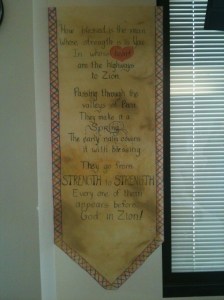
A friend of mine made a banner for me for my hospital room with Psalm 84:5-7 on it.

Banner of Psalm 84 in hospital room

I’m on day 20 of my first round of chemotherapy for acute leukemia, in case you don’t already know that. I’ve been blogging about it at Thrilled to Death.

There’s some hardship involved in my chemotherapy, but it’s not nearly as hard as I expected. I’ve found out, though, that the marrow or stem cell transplant that’s coming will probably be worse and will last much longer—at least 6 months, and one man I talked to today had 18 months that he called bearable but extremely difficult.

So how do I face this?

Strength in God

How blessed is the man whose strength is in you.

The greatest opponent I’ve faced is my own strength, my own attempts to have a positive attitude and to expect the best. My faith is easily shaken. On a bad day, my mood can easily swing, and I question people’s motives and judge their behavior.

God’s strength, however, is never shaken. The one who delights in the Lord is consistently supplied with grace, which Psalm 1 pictures as a tree planted by a flowing river which never runs dry.

"Thou wilt keep him in perfect peace, whose mind is stayed on thee. (Isaiah 26:3)"

If I’ve learned anything in the last five weeks—yeah, it’s only been five weeks since I was diagnosed!—it’s that I have to live right now. God has grace for right now, not grace for next week, six months from now, or next year.

The rest of that passage in Psalm 84 provides two awesome promises:

From Weeping to Springs of Life

Passing through the valleys of Baca, they make it a spring.

Baca is Hebrew for "weeping."

What an awesome picture! For those whose strength is in God, their weeping produces springs that feed those behind them.

You can probably draw your own analogies from that picture.

From Strength to Strength

They go from strength to strength. Every one of them appears before God in Zion.

If I’ve learned anything else over the last five weeks, it’s that strength is not continuous. Yesterday’s grace is not sufficient for today. I’m sure there’s really awesome Christians somewhere who never wander from the presence of God and pray without ceasing.

I’m not one of them.

But I do know what it’s like to go from strength to strength. I do know that the sea of grace is inexhaustible and can be tapped anew each day. I do know that the mercies of God are new every morning, and I know what it’s like to appear before God in Zion, though that last one is a story for a different day.

To sum up, let me encourage you that today is the day to let your strength be in Jesus Christ, to keep your mind stayed on him, and to know that yesterday’s grace won’t carry you today, and that there is no grace for tomorrow until tomorrow.

Posted in Holiness, Leukemia | Tagged , | 4 Comments