Untranslated Words in the Bible; A Rant

There are numerous words in our English Bible that aren’t translated, but transliterated. Sometimes that’s not a big deal, but there are some cases that it’s at best a theological cop-out and at worst purposeful deceit.

Baptizo

An example of transliteration, rather than translation, is rendered baptizo as baptize rather than dip, plunge, immerse, or drench.

With baptizo I understand. I once read a list of the various ways baptizo is used in Greek literature. It’s used even of a wave “baptizing” a beach. In almost every case, the object being “baptized” was completely soaked.

On the other hand, the Didache, a very early church manual. mentions that while immersing in a flowing river or stream was the preferred means of baptism, it’s acceptable to pour three times over the head as well. The Didache was written in Greek, so we English-speakers can’t accuse the writer of misunderstanding baptizo.

Others, though, I’m not okay with.

Angelos

Angelos is used 186 times in the New Testament. 179 of those times, it’s rendered as “angel,” which means it’s transliterated, not translated.

The word means messenger, not angel. It’s stupid—there’s probably a better word I should be using—to render it angel. Worse, it’s not very honest to render it angel 179 times, then never let people know that in the few cases where it refers to an earthly messenger, rather than a heavenly one, you translated it as messenger.

For example, when the Scriptures talk about John the Baptist being sent as a messenger to prepare the way of the Lord, it uses the word angelos (Matt. 11:2; Mark 1:2; Luke 7:27). Jesus sent messengers into Samaria in Luke 9:52. The word there is also angelos (well, angeloi, the plural). John’s messengers, sent to ask Jesus whether he was really the one, are referred to with the same word (Luk. 7:24).

Hebrew’s worse. Malak is rendered angel 111 times, messenger 98 times, and ambassador 4 times.

Don’t you think we’d understand better if angelos and malak were actually translated? Gabriel’s not an angel, he’s a messenger. Yes, he’s a heavenly messenger, and a powerful being, but he’s a messenger. That’s what the word means.
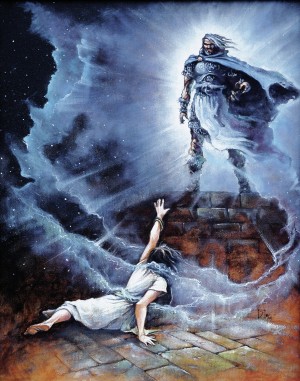
Maybe Gabriel didn't look like we think he did …
(Jeremiah Briggs has this image for sale.)

Seraphim

I have a whole web page on this one. This one irritates me because I find it dishonest.

There are seraphim mentioned in Isaiah 6. They fly, and they cry out praises to God night and day. They have six wings.

There are seraphim mentioned in Numbers 21, too. They bit the children of Israel in the wilderness. They were poisonous, and the children of Israel died.

There, in Numbers, the translators, who can’t seem to figure out what the word seraph means in Isaiah, have no problems rendering it “snake” or “serpent.”

It’s funny, though, in Isaiah 14:29 and Isaiah 30:6, they don’t seem to have problems figuring out that seraph means snake or serpent, either. It’s only in Isaiah 6.

Maybe we just don’t like the idea of flying snakes in heaven.

I like it. I call them “dragons.”

Diakonos

This one really bugs me, too.

Diakonos is in the New Testament 31 times. It’s only rendered “deacon” three times; in 1 Tim. 3:8 and 3:12 and Php. 1:1.

That’s ridiculous religious terminology. Give me a break. Translate the word! It’s SERVANT, thank you … SERVANT!

The really ridiculous translation is when the word is used as a verb, diakoneo. That’s in the NT 37 times, and they transliterate it, sort of, just twice, both times in 1 Tim. 3.

You can’t really transliterate it, though. “Deacon” is not a verb. So, when they don’t want to correctly translate it, like they did the other 35 times it’s found in the NT, and they instead want to lie to you, deceive you, trick you, and get in the way of your following God, they have a problem.

So they got around it by turning the one word, diakonos, which simply means “serve,” into “USE THE OFFICE OF DEACON.”

What????

That’s ridiculous.

In 1 Timothy 3, we should be reading about the fact that one has to qualify to be a servant in the house of God. It’s a position of honor, and those who serve well (not “use the office of deacon well”) obtain good standing and great boldness in the faith which is in Christ Jesus.

Grumble, grumble, grumble. Now I’m all irritated.

I hate dishonesty. Both goats and wolves mingle comfortably with God’s sheep because their “shepherds” are not honest, brave, trustworthy, properly taught, or really even shepherds at all. I want to run them all out so that God’s sheep, so few as they may be, can actually be the flock of God, shepherded by real shepherds raised up by Jesus Christ, the Chief Shepherd.

Posted in Leadership, Modern Doctrines | Tagged , , , , , , , , , | 11 Comments

My Book, Titles, and the Council of Nicea

I’m really looking for help on the title of my book. I’ve got a little help so far, and I’ve learned that I’m not as bad at titles as I thought. Titling a book is just difficult!

I have four chapters available online at the Council of Nicea page at Christian History for Everyman. A number of people have downloaded them‐yes, I have a way of tracking you!—for which I’m glad.

Please let me know what you think, and give me title suggestions. At Christian History for Everyman, you can use the Contact Me button on the NavBar to send me an email. There’s also a link there for title suggestions (use the link in the paragraph above). You can also use the comment section here.

Here’s the titles I’ve considered so far. Feedback on those would be great, too!

Setting it Straight
An Honest Man’s Look at the Council of Nicea
In the Beginning Was the Logos
The Council of Nicea for Everyman
Going the Wrong Way
An Honest Man’s Look at the Council of Nicea

I have an awesome picture that would go with the middle one. Jeremiah Briggs, my friend and brother and incredible artist, told me I can use a great painting of a boy holding a shining object in his hands. You can’t see the object, but it lights up his face and the front of his body. It would work great with In the Beginning was the Logos.

Thank you for any and all feedback!

Posted in Miscellaneous | Tagged | 14 Comments

Behavior Is Better Than Belief

Today, I just have some points for you to consider:

  • After 300 years of church history, the Council of Nicea still found only a paragraph’s worth of doctrine important enough to encapsulate in a creed.
  • The foundation of God, according to Scripture, has to do with behavior, not belief (2 Tim. 2:19).
  • Jesus didn’t say, “Not everyone who says to me ‘Lord, Lord’ will enter into the kingdom of heaven, but only those who can accurately answer a question about the atonement” (Matt. 7:21).
Posted in Gospel, Holiness, Modern Doctrines | Tagged , , , , , , , , | 9 Comments

Free Chapters of My Book: The Council of Nicea

I posted earlier today, too, with more content :-D.

If you read my blog, you probably know that I’ve been working on a book about the Council of Nicea. My writing part is done. All I’m doing now is formatting.

I’m having trouble picking a title, so this blog post is for two reasons:

  • You can read four chapters of the book for free. You can find the links at the Council of Nicea page at Christian History for Everyman.
  • After you’ve read those, I’m taking title suggestions! If I use yours, I’ll give a free, signed copy of the book (for whatever that’s worth) and a $25 gift certificate to amazon.com.

For the record, I’ve tried three titles so far:

  • Setting It Straight: An Honest Man’s Look at the Council of Nicea
  • Going the Wrong Way: An Honest Man’s Look at the Council of Nicea
  • In the Beginning Was the Logos: The Council of Nicea for Everyman

I’m not very good at title creating. Any help or feedback is really appreciated.

Posted in Church, History, Miscellaneous | Tagged , , | Leave a comment

Can You Be Controlled?

I wrote someone recently and told them that the best argument for some of the things I teach is Rose Creek Village. (Not that RCV does what I teach; I teach what RCV does.) I described “great power, great joy, and great satisfaction in God.”

Honestly, though, not everyone at Rose Creek Village believes that’s true.

I know a couple people, right here at our village, who would say that they can’t do anything because they can never get permission for the things that are on their heart. I always wonder if they live at the same place I do. In fact, I ask them, when I hear something like that, whether they live at the same place I do.

I’m talking about real personal stuff here, but it applies to all Christians.

The difference is not where we live or what we’re told. Those couple people and I have two major differences.

  • I don’t think I’ve been told no until I’ve been told no.
  • I’m willing to risk making people angry if I think I’m doing God’s will.

Maybe those both could be summed up in one statement: I care less what people think about me.

It’s not that I’m assertive by nature. All the psychological tests I’ve ever taken say that I’m extremely introverted. Growing up, I was shy and picked on all the time. I’m terrified to talk to strangers.

It bothers me greatly when people don’t like what I’m doing. When I say something controversial, and people don’t like it, I get nervous and jittery. It takes a great effort of will to choose to stand on a controversial truth.

But I do it.

I don’t feel like I have a choice. If I give up on a truth that comes from God, then I believe that God will give up on me. I get that from the verse where Jesus says that if we’re ashamed of him here, then he’ll be ashamed of us there.

So I don’t like it, but I do it anyway.

I’m a pretty good teacher, you know. I can be entertaining. I can say what people want to hear, and they’ll all pat me on the back when I’m done. Sometimes, when I lead a Bible study and I encourage everyone to talk, I’ll have people come up to me after and say, “I came to hear you talk, not them. You’re a lot more interesting. Do those others have to talk?”

I have a couple friends who are pastors. They became pastors by, well, lying. They said they agreed to a statement of faith that I know they don’t agree with, and they did so because they were told everyone does that. One of them told me, “You can’t repair a sinking ship from the outside.”

I can’t do that. I can’t do that at RCV, either. I’m at RCV because it’s the church. No, I don’t mean its the only church. I mean it’s the church. It’s people, gathered together for the purpose of following Jesus Christ.

So I listen to the church. When I say, “I think this,” and everyone disagrees with me, then I assume that the church is the pillar and support of the truth, not me. I yield.

But when everyone frowns, and says, “I don’t like it,” that doesn’t mean anything at all. I make them think about what they don’t like. If I think it’s God, then I go do what they don’t like. Maybe I’m wrong, and I try to pay attention to God putting a stop to me, or a brother running me down to say I’m sinning, but otherwise, I go on.

And if you’re trying to follow God, you’ll find that people don’t stop you. God has a way of moving everything out of the way, leaving the path open, and allowing you to blaze a trail …

… while everyone’s frowning at you.

Now, keep in mind, this only works for people who want God’s will. For those that are full of their own opinions and who have no fear of their own self-deceit, I just described a route to self-destruction, heresy, and destructive behavior towards the church that will result in God destroying you.

It’s good to be afraid.

But it’s good to be more afraid of God than you are of people.

That way, you won’t be confused into thinking that just because people frown at you a lot, they won’t give you permission to do anything. Get off your rear end and do something that you’re pretty sure God wants you to do!

Posted in Church, Leadership, Miscellaneous | Tagged , | 3 Comments

Picking the Winning Horse

First, as a total aside, you have got to read about this bat that lets any scorpion sting it in the face.

God’s creation is marvelous, isn’t it?

A Whole Thesaurus of Bad Manners

I’ve been watching a couple Rob Bell videos tonight. One in particular was an interview conducted by an obnoxious host who either didn’t care about or couldn’t tell the difference between a hard question and a petulant one.

For example, one question was concerning Japan. “Is God all-powerful but not loving, or is he loving but not powerful enough to prevent this disaster.”

Asking once was okay. This was a terrible disaster. Rob Bell gave a somewhat evasive answer; after all, it’s hard to explain why God lets the world be the way the world is.

I’m pretty sure from the rest of the interview that the interviewer thought he was being pointed rather than fatuous when he repeated the question. I thought, there’s two answers to the man’s question:

  1. God is both all-powerful and loving. Disasters cause us to question this, but God is also far greater than we are, and the universe and life are really difficult for humans to understand. There are several speculations we could give for why disasters happen, but they’d just be speculations. The fact is, some things are still mysteries to humans.
  2. God is both all-powerful and loving, but you’re too stupid to understand it.

That might give him a taste for the difference between being straightforward and being querulous.

Anyway, Rob Bell handled it marvelously well.

Is Rob Bell a Universalist?

The real point of the interview was to harass Rob Bell about his new book, Love Wins and to charge him with universalism.

Rob did a good job of—in so many words—saying that he’s raising questions, not necessarily giving answers. This is the impression that he left Greg Boyd, author of The Myth of a Christian Nation and several other books, with as well. Greg apparently knows Rob Bell and wrote a rebuke of all the people who critiqued Bell before they even read the book.

The host, while carefully maintaining a belligerent polemic, pointed out a couple places where Bell’s book, unlike his interview responses, gave some very clear answers, and they really did sound universalist.

What should we do about this?

Picking the Winning Horse

Let’s establish some parameters here that I think we can all agree on.

  1. Jesus is not going to consult Love Wins when he conducts the final judgment.
  2. The only way Love Wins could possibly affect the judgment is by getting some people to see how great our God really is, believe in Jesus, obtain his grace, and thus live a holy life.

The real question for me is not whether Rob Bell is a universalist, but whether he is getting people to see how great our God really is, believe in Jesus, obtain his grace, and thus live a holy life … with "holy" being defined by Jesus.

I can’t answer whether he’s doing that with Love Wins because I haven’t read it. I can, however, answer it in general. For example, his teaching on being covered in the dust of your rabbi is out of this world. It is so good and so inspiring that it just cannot be ignored.

Even if universalism turns out not to be true, “Covered in the Dust of Your Rabbi” will get us one step closer to everyone being saved!

That’s my opinion, anyway.

Further, I’m pretty sure that the hard-headed, hell-defending, purposely ignorant and sometimes petulant, fatuous, querulous, and belligerent purveyors of the “believe in this version of the atonement and you’ll be saved even if you’re evil” gospel … I’m pretty sure those folks are turning more people away from God than toward him.

Sorry, but mostly they’re making people who are twice as much disciples of hell as they are.

So, if this is a horse race, and the goal is to bring people to repentance (2 Pet. 3:9), then I’m betting on Rob Bell over the fatuous folk.

My Final Judgment on Rob Bell

I don’t really have time to judge Rob Bell, and I highly suspect Jesus wouldn’t pay much attention to my judgment, anyway, except to see how harsh it is so he knows how harshly to judge me.

But I need to have time to judge a couple things so I can determine where to learn from Rob Bell … and where not to. (Kind of like the time I’ve spent learning where to follow and mostly not follow the ignorant—on purpose—and querulant mainstream folks I mentioned above.)

Jesus occasionally accumulated masses of followers. Almost exactly as occasionally, he offended most of them so that they quit following him.

We have to be careful to speak the truth and keep people on the spot. People, in general, are liars and hypocrites. (Yeah, you and me, too, unless you’re making war on that part of you.) The lying and hypocrisy are not always real extensive, but where we don’t have people around us telling us the truth about us (and smiling and loving us at the same time) … well, most of the time we end up hiding some really important problems.

I’ll bet you think I mean internet pornography, drinking, or gambling or something like that.

I don’t. Those are important, too, but you already know about those. No, I mean coldness toward your wife, self-interest, ambition, and worshiping money and comfort by the way you live. I mean no real effort at overcoming the areas where you don’t get along with people, and I mean disinterest in finding out what God wants you to change today.

What does that have to do with Rob Bell?

Chances are, nothing. I happen to be a Christian teacher myself, and I use some of the same methods when I teach, so I’m prone to envying his incredible skill at getting a point across and keeping an audience’s attention. But I have enough of an audience myself to have to warn myself that having an audience doesn’t matter. The truth matters.

My goal has to be to speak the truth, not worry about audience size or audience approval. The real Truth is a being, and he can create his own audience, large or small. When he was on earth it was both, sometimes changing from one to the other quite rapidly. More than once his audience suddenly prepared to kill him!

Rob’s a charmer. Good for him. I’m not ready to follow him in that.

But getting people to be covered in the dust of the Ultimate Rabbi? Now that’s an awesome goal, and Rob Bell will talk you into it.

Posted in Gospel, Miscellaneous, Modern Doctrines | Tagged , , | 2 Comments

Pleading for Sin and Pleading for Righteousness

A friend mentioned I hadn’t posted in nearly a month. I’ve been working on my book about the Council of Nicea. 10 chapters done, 1 chapter to write, and 9 to edit. I also have to edit the glossaries. I hope to have it done within a month. It will be about 400 pages long, and there’s a lot of unique information.

It also does what I’m always trying to do with Christian History for Everyman: tell you stories to educate, entertain, and pique your interest, then put the sources in your hand so you can be an expert, too.

But I don’t want to completely neglect the blog.

Today I read in Jeremiah 23:14 about shepherds who “strengthen the hands of evildoers” (Holman Christian Standard Bible).

It made me think of George Fox, founder of the Quakers, who said complained about preachers who would “plead for sin.”

The purpose of the Scriptures, according to Paul in 2 Tim. 3:17, is to thoroughly equip us for every good work. That’s great; there’s a pattern there because that’s the purpose of the new birth, too (Eph. 2:10).

How much preaching today, however, ‘strengthens the hands of evildoers’ by explaining why we can’t stop sinning and why works don’t matter?

Jesus’ blood does provide forgiveness of sin and access to the throne room of God. But aren’t we entering the throne room of God specifically to access the grace that teaches us to deny ungodliness and worldly lusts (Tit. 2:11-12), that causes sin to lose its power over us (Rom. 6:14), and that makes us zealous for good works (Tit. 2:14).

Admittedly, we all “stumble in many ways” (Jam. 3:2). All the more reason, then, that we don’t need help in stumbling!!! Let us plead for righteousness, considering how to provoke one another to love and good works.

Consider Strengthening the Hands of Well-Doers

Rather than strengthening the hands of evil-doers, let’s strengthen the hands of well-doers, for it is only those who do not grow weary in well-doing who will reap eternal life (Gal. 6:9). All cowards, liars, adulterers, and such have their part in the lake of fire (Rev. 21:8).

My daughter likes to tell me she’s bored every now and then so I can throw out suggestions about things she can do. Recently she reminded me that I once told her, “Why don’t you sit on the couch and stare at the wall.”

I have a new suggestion for those with time on their hands, bored or not.

Consider.

Doesn’t the command to consider suggest that we should be stopping and thinking? Maybe sitting on the couch and staring at the wall isn’t such a bad idea.

And what are we to consider?

How to provoke one another to love and good works.

Let’s be those who strengthen the hands of well-doers and who frighten evil-doers the way God wants to (1 Pet. 1:17).

Posted in Holiness | Tagged , , , , , , , , , , | 4 Comments

The Three Most Important Chapters in the Bible

A friend of mine likes to say, “Salvation is not a plan, it’s a man.”

Our faith is not to be in something Jesus has done, but in Jesus himself, the Savior of the world.

But what does it mean to have faith in Jesus Christ?

Faith and Obedience

Jesus once said:

Whoever hears these sayings of mine and does them, I will compare him to a wise man who built his house upon a rock. The rain came down, the floods came, and the winds blew and beat upon that house, and it didn’t fall because it was built upon a rock. (Matt. 7:24-25)

Apparently, Jesus—the one in whom we are to have faith—thinks that having faith in him is listening to and obeying what he has to say.

Corroborating Jesus

Now I know we shouldn’t have to corroborate the words of Jesus. He is, after all, the Lord and Creator of everything and everyone.

But since Christians today seem to prefer other voices than that of the great Shepherd of the Sheep himself—Jesus doesn’t always seem to grasp or agree with our ideas about faith alone—let me point out that the writer of Hebrews entirely concurs with Jesus.

He has become the author of eternal salvation to them that obey him. (Heb. 5:9)

To whom did he swear that they would not enter into his rest except to those that did not obey (Gr. apeitheo: to refuse to be persuaded or comply)? So we see that they could not enter in because of unbelief (Gr. apistia: unbelief). (Heb. 3:18-19)

And Paul warns us about people who would trick us into not believing that faith has nothing to do with obedience to Christ:

For you know this: No sexually immoral or unclean person, nor a greedy man—who is an idolater—has any inheritance in the kingdom of Christ and of God. Don’t let anyone deceive you with empty sayings, for it’s because of these things that the wrath of God comes upon the sons of disobedience. So don’t be their companions in crime. (Eph. 5:5-6)

In fact, so does the apostle John:

Little children, don’t let anyone deceive you. The one that does righteousness is righteous, just as he is righteous. (1 Jn. 3:7)

Jesus Speaks on Obedience Again

Jesus makes his concern about obedience even more clear a few verses before his comment about who is building his house on a solid foundation:

Not everyone who says to me “Lord, Lord” will enter the kingdom of heaven, but only those who do the will of my Father in heaven. (Matt. 7:21)

So Jesus is concerned about obedience. To Jesus, faith is obedience.

But what does he want us to obey?

The Three Most Important Chapters in the Bible

Both passages from Matthew (above) are part of the Sermon on the Mount. Chapters five, six, and seven of the Gospel of Matthew are about the most concise description of how God wants you to live that you could ever hope for.

You could spend the rest of your life living out those three chapters and learning what they mean by obedience to them.

And according to Jesus, you’d be wise if you did.

Posted in Gospel, Holiness, Modern Doctrines | Tagged , , , , | 3 Comments

I repent …

… for ever thinking that God cares about cussing.

Don’t get me wrong. There are more important things for me to repent for, and I’m doing that the best I know how. And cussing is childish, inconsiderate, and indicates either low intelligence or being too lazy to use intelligence. I do not recommend it.

But I’ll be damned if I’m ever going to return to being a Pharisee, making moral mountains out of the minutiae of human behavior.

I mean that literally … the "damned" part, I mean.

After all, Jesus was pretty condemning with the Pharisees 2,000 years ago.

Why?

I could find Scriptures to back up what I’m saying, and, in fact, Jesus’ statement that we’re to be concerned with the weightier matters of the Law—judgment, mercy, and faith—has a lot to do with this post.

Further, the people that Jesus hung out with have a lot to do with this post.

Further, the treatment Jesus gave the good, line-toeing, religious people have a lot to do with this post.

But mostly, a particular wasp on Facebook stirred up this post. By wasp, I don’t mean a white, anglo-saxon Protestant, though he is one. I mean an insect that delivers painful stings and devours other insects without producing any honey.

What?

Christmas, Easter, the King James Version, evolution, gambling, smoking, homosexuality and every other "don’t touch, don’t taste, don’t handle" that we’ve aggrandized so that there’s no way to even discuss them.

I thought about leaving this section just that one paragraph long, but I probably owe you at least a little explanation.

Smoking’s bad. It will kill you. It’s wrong for a disciple. Why shorten your time on earth at your own hand? It’s a version of suicide … no, murder by your own lusts. It ought to make the victim mad.

But, do we really need to tell a person that they can’t be baptized until they quit smoking? Are we basing that on Scripture, or are we basing that on the Surgeon General’s report?

You know the answer. We’re not basing it on either. We’re basing it on conservative American culture. It’s the bad guy in America, so it’s the bad guy in the church.

I don’t believe for a minute that our powers of scriptural interpretation are so bad that we would believe that 1 Cor. 3:16-17 refers to our physical body unless we were simply sold on American prejudices. God’s not going to just destroy anyone that happens to do things destructive to their bodies. His concern is Jesus’ body. Your body isn’t the temple of God; Jesus’ body is. As long as you are joined to Jesus’ body, you can defile that body by joining yourself to a harlot (1 Cor. 6:15). And there our bodies are called members, to the temple of God. In 1 Cor. 3, where our body, singular, is called the temple of God, all the yous are plural.

Mess with the church, and God will destroy you.

Smoke? Then he may have mercy because 1 Cor. 3:16-17 has nothing to do with smoking or overeating.

Homosexuality? God will condemn homosexuals, just like he will condemn adulterers and the heterosexually promiscuous.

But he will not condemn them as harshly as he will condemn those with a Pharisaical attitude, who ignore their own sins while harshly denouncing homosexuals as though that were the worst plague that’s ever hit the earth.

And holidays? Heavens to Betsy! This guy on Facebook poured out the most unloving, embarrassing batch of insults and invective on some lady who presented an argument against his anti-holiday logorrhea (love that word!). I understand the arguments against "pagan" holidays like Christmas and Easter, but I have yet to see God back up that argument or for there to be the slightest bit of good fruit from it.

Missing the Boat

We Americans think that righteousness involves "I don’t smoke, drink, cuss, or chew, nor hang around with those that do."

Jesus hung around with those that do as preferred company.

Something about the way he was made them want to hang around him.

It’s true that bad company corrupts good morals (1 Cor. 15:33). It’s also true that a guy who smokes and cusses may not be bad company. Pharisees may be bad company. Bad company is a person that moves you to be less like Christ. Don’t follow your buddy down to the strip joint while pretending that you’re doing what Jesus did. Sinners got righteous around Jesus.

But they didn’t become Pharisees.

Last Word

There is a point to all this.

Jesus wants people who can hear God, see into people’s hearts, control their temper, speak out of love, care all the time about people, and care little about this world.

Rooting out the great public corruption of public smoking, proving that we’re too pure to listen to a sinner cuss, and bringing the government down on the head of immoral non-Christians is hardly on God’s priority list.

Judgment, he says, begins in his house.

Posted in Holiness, Modern Doctrines | Tagged , , , , , , , , , , , | 4 Comments

Book Teaser: The Council of Nicea and the Trinity

I’m off by myself for another couple days working on a book on the Council of Nicea. I have no working title for it at the moment.

I’ve hit a point where I think if I show you a couple excerpts, I might be able to pique your interest. So here goes.

If any of the following seems somewhat abrupt, there’s two reasons. Some of this is still in rough draft form, and I have left paragraphs out for brevity:


At the heart of the Nicene Creed is the threefold statement of belief:

We believe in one God, the Father … and in one Lord, Jesus Christ, the Son of God … also in the Holy Spirit.

That is the basic outline. The rest of the creed is explanatory.

Notice that the one God, according to the Nicene Creed, is the Father. Jesus is the one Lord and the Son of God, and nothing at all is said about the Holy Spirit except that he exists.

We all know that the Bible occasionally applies the title “God” to the Father only. In fact, 1 Corinthians 8:6 says it in almost the exact same words as the Nicene Creed:

But for us there is but one God, the Father, from whom are all things, and we for him, and one Lord, Jesus Christ, through whom are all things, and we through him.

The issue is really not whether modern Christians are okay with the way the New Testament writings talk about God.

The question is whether we would dare use the same terminology.

I believe that if we’re honest with ourselves, we have to admit that we have adopted a view of the Trinity that is different from Nicea. We would never write a creed that says, “We believe in one God, the Father, and in one Lord, Jesus Christ, and in the Holy Spirit.” That simply is not the terminology we would use.

Instead, we would use something closer to what is known as the Athanasian Creed, which Athanasius did not write, but dates to somewhere around the end of his life in A.D. 360. I am quoting just portions of it here because it is quite long. You can read the whole creed at Christian History for Everyman.

We worship one God in Trinity and Trinity in Unity …
The Father is Almighty, the Son Almighty, and the Holy Spirit Almighty
Yet there are not three Almighties, but one Almighty
So the Father is God, the Son is God, and the Holy Spirit is God
Yet there are not three Gods, but one God

No wonder the Trinity is so confusing to people! Is this anything like the wonderfully clear explanations of the pre-Nicene Christians that we’ve been reading about?

In the book here, there is a list of statements on the Trinity from the five largest Christian denominations in the USA, including the Roman Catholics; all of which use Athanasian Creed terminology and not Nicene terminology.

But what is normative? Finding one verse and pointing out the Nicene Creed is nice, but was this the way the early Christians and, more importantly, the apostles spoke on a regular basis?

Let’s find out.

First, though, I’d like to point out the explanation that Tertullian, writing around A.D. 210, gives for the terminology that’s in the Nicene Creed (though, of course, he’s not referring to the Nicene Creed itself, which wouldn’t be written for over a century).

I shall follow the apostle [Paul], so that if the Father and the Son are alike to be invoked, I shall call the Father “God” and invoke Jesus Christ as “Lord.”
     But when Christ alone [is invoked], I shall be able to call him “God.” As the same apostle says, “Of whom is Christ, who is over all, God blessed forever” [Rom. 9:5].
     For I should give the name of “sun” even to a sunbeam, considered by itself. But if I were mentioning the sun from which the ray emanates, I would certainly withdraw the name of sun from the mere beam. For although I do not make two suns, still I shall reckon both the sun and its ray to be as much two things—and two forms of one undivided substance—as God and his Word, as the Father and the Son. (Against Praxeas 13).

Tertullian seems to think Nicene terminology is normative. He seems to think that the apostles, or at least the apostle Paul, only called Jesus God when the Father is not being discussed along with him. Is this true?

If you’re familiar with the Scriptures, you probably don’t need me to tell you it’s true. You already know. But let’s give you some statistics:

  • The Father is referred to as God in a verse where Jesus is also mentioned 42 times.
  • Jesus is referred to as God in a verse where the Father is also mentioned 0 times.
  • God is used in such a way as to clearly indicate a reference to all three persons of the Trinity 0 times.
  • Jesus is called God in a verse where the Father is not mentioned at least 7 times. There are several others that are subject to interpretation.

Now I’m going to complain here a little bit because I believe I’m rightfully angry.

In all the studies of the Trinity that have been published since the printing press has been invented, is it really true that no one has noticed these things? While scholars and historians were publishing careful definitions of hypostasis and ousios, did they really not notice that the Nicene Creed calls the Father the one God and we don’t? Did they really never run across Tertullian’s explanation of the reason for that?

I can’t help but feel that never publishing Tertullian’s explanation of when to call Jesus God while repeatedly mentioning that Tertullian was the first early Christian writer to use the term Trinity is, well, dishonest. Worse, it’s larceny! We have been robbed of a closer, easier relationship with the Scriptures and a better understanding of God, within the context he’s been revealed to us! We’re not overstepping our bounds in understanding God more fully this way; instead, we are holding more closely to "the faith once for all delivered to the saints" (Jude 3).

Posted in History, Modern Doctrines | Tagged , , , , | Leave a comment